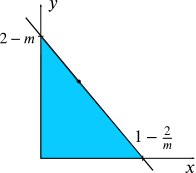
How small can this triangle be?
Question
Write down the equation of the line of gradient through the point . Find, in terms of , the intercepts which this line makes on the two axes. A line is drawn through the point to form with the axes a triangle in the first quadrant. Find the least possible area of the triangle.
Suggestion
[interactive embed (geogebra-iframe): //www.geogebratube.org/material/iframe/id/uA3Jc3q4/width/400/height/400/border/888888/rc/false/ai/false/sdz/false/smb/false/stb/false/stbh/false/ld/false/sri/true/asb/false/at/html5] — not part of the text import; see the source page.
Download GeoGebra file
Can you express the area of the triangle as a function of the gradient, ?
How can we find the minimum value of a function?
Solution
We can write the equation as or
The -intercept is at .
The -intercept is given by , which yields .
If , the line is the horizontal line , so there’s no -intercept.
A line is drawn through the point to form with the axes a triangle in the positive quadrant. Find the least possible area of the triangle.
Note that to form a triangle in the first quadrant, must be negative.
The area of the blue triangle is
So the least area of the triangle is given by the minimum of the function .
We can sketch this graph by adding the curves , and .
For a triangle to be created, must be negative, so we’re looking for the minimum that we can see on the graph.
Approach 1 - Differentiation
We can find the minimum by differentiating . We have
Therefore when . Since has to be negative, .
To check if this is a minimum point consider the gradients either side of .
So the least possible area of the triangle is
As an alternative to using calculus, we could notice that the two terms and multiply to one and that we are looking for the maximum of their sum.
This is a situation that crops up surprisingly often in mathematics and has a simple solution. It turns out that the maximum of occurs when the two terms are equal.
To see why this is, you might think about the symmetry or you might think about the graphs of and .
Using this fact leads to the solution as above.
The graph of also has a stationary point at . What does this correspond to geometrically?
Approach 2 - Two numbers multiplying to a constant If two negative numbers have a constant product, as and do (i.e. ), then their sum is maximised when they are equal.
Can you see why? Note we're being asked to minimise , or in other words to maximise remembering that our and therefore this sum is negative. Imagine that we have two positive numbers that can vary. -- If their product is constant, when is their sum a minimum? -- If their sum is constant, when is their product a maximum? These two questions crop up surprisingly often in mathematics, and the answer to both questions is the same - when the two numbers are equal. Have a think about this: you might like to make sketches to help. What happens if we fix and let vary, or if we fix and let vary? What can we say about the coordinates of the points where the curves meet?
This is when , which gives , as before. We need to be negative, so . Thus using either approach the least possible area of the triangle is
It is interesting to note that in both approaches we get an option of which we discard because must be negative. We can easily see that when we are on the branch of the curve of against in the 4th quadrant at its maximum point. This local maximum is smaller than the local minimum when , it would be the area where a straight line through the point made no triangle at all in any quadrant, which might be seen as a minimum area of !