When does this cubic equation have distinct real positive solutions?
Question
Find the coordinates of the turning point on the curve . Sketch the curve in the case that the equation has two distinct real roots. Use your sketch to determine necessary and sufficient conditions on and for the equation to have two distinct real roots. Determine necessary and sufficient conditions on and for this equation to have two distinct positive roots.
Find the coordinates of the turning points on the curve (with ) and hence determine necessary and sufficient conditions on and for the equation to have three distinct real roots. Determine necessary and sufficient conditions on , and for the equation to have three distinct positive roots.
Show that the equation has three distinct positive roots.
Solution
We have that so the turning point is at , which gives . Therefore the turning point is at .
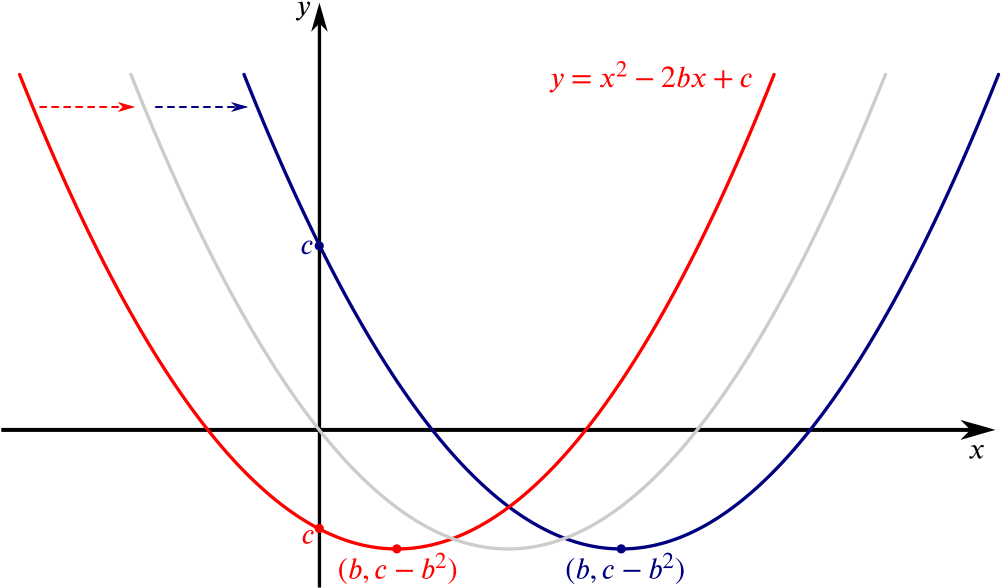
We can see from our sketch that as long as the turning point lies below the -axis, the curve will meet the -axis in two different places and hence will have two distinct real roots.
That is, we must have in order to have two distinct real roots of .
This condition is necessary and sufficient.
We’d like to see when these distinct real roots are also positive. Firstly, in order for us to have a chance of this happening, we must have .
Imagine shifting a parabola along the -axis like in this picture:
Notice that, provided , the sign of determines whether or not both roots are positive.
If we already know that we have two distinct positive roots, the parabola must cut the -axis before reaches the value of the smallest root.
Therefore, the necessary and sufficient conditions for
to have two distinct positive roots are
In fact we can combine the first and last of these to give
We’ve derived these conditions by looking at our sketches, as the question asked. We could double-check these results using the quadratic formula.
From the quadratic formula the roots of the equations are The roots are both real if and only if . In addition, both roots are positive if and only if and (which implies ). Therefore we have two positive roots if and only if and , as before.
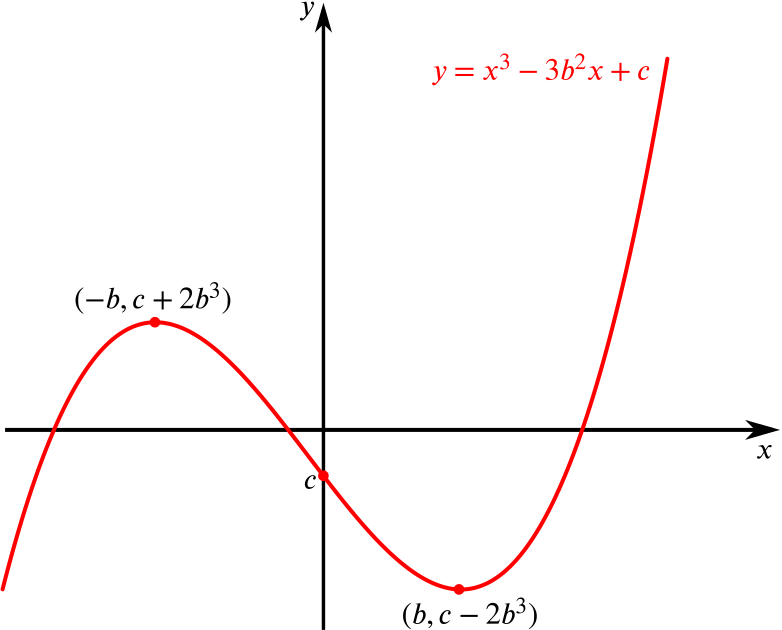
We have that So the turning points on are and .
To determine the conditions on and for to have three distinct real roots, let’s sketch as we did for the quadratic case.
We see will have three distinct real roots as long as the turning points lie with one above the -axis and one below the axis.
Since , this condition is and , or . We can combine these inequalities into .
Let’s sketch on the same axis as our previous sketch. This is just a shift of in the -direction, so our sketch becomes
Examining our sketch, we certainly need both turning points to have positive -coordinates if we want the roots to be positive, and so we need .
We see also that the graph must cross the -axis before the smallest root, which means that we must have a negative -intercept. The -intercept comes from the constant terms, which can be found by looking at the last term in the expansion of each bracket (there’s no need to do the full expansion, we can just think about the constant). Therefore we need if the cubic is to have three positive roots. (In the diagram above the -intercept is positive and you can see that the cubic has a negative root.)
We determined earlier the condition for the cubic to have three distinct real roots, namely .
Since we just established conditions for a cubic in a certain form to have three distinct positive roots, we should try to write in this form, so that we can check if these conditions hold.
We seek and such that Let’s multiply out the brackets on the right hand side. so we have From this we can see that , and .
We can easily solve the first equation to see that .
The second equation becomes and so which tells us that Finally, we must solve Rearranging, we find that so that .
Therefore we can write Now we can check that the conditions we gave earlier are satisfied.
We have and .
Also ,
So the equation has three distinct positive real roots.