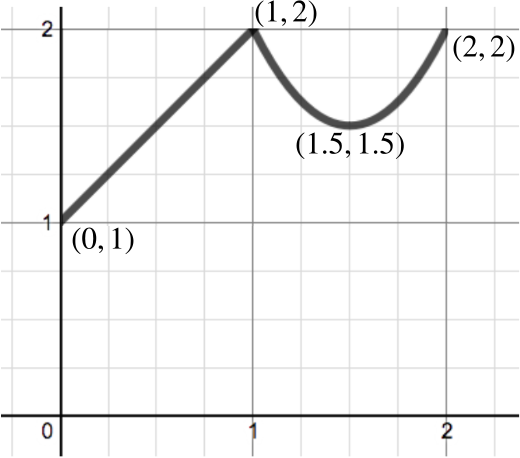
Can we sketch the graph of this piecewise function?
Question
Let f(x)={x+12x2−6x+6for 0≤x≤1;for 1≤x≤2.
- Sketch a graph of y=f(x) for 0≤x≤2, labelling any turning points and the values attained at x=0, 1, 2.
- For 1≤t≤2, define g(t)=∫t−1tf(x) dx. Express g(t) as a cubic in t.
- Calculate and factorise g′(t).
- What are the minimum and maximum values of g(t) for t in the range 1≤t≤2?
Suggestion
Are there any turning points for f(x)?
- For 1≤t≤2, define g(t)=∫t−1tf(x)dx. Express g(t) as a cubic in t.
Can we helpfully split g(t) into two integrals?
What happens if we differentiate g(t)?
Where could g(t) attain its minimum and maximum values?
Solution
There is no turning point in the interval 0≤x≤1. To find any turning points in the interval 1≤x≤2, we first differentiate f(x) in this interval to get f′(x)=4x−6. Setting f′(x)=0 gives x=23, so there is just one turning point, at (23,23).
We also have f(0)=1;f(1)=2;f(2)=2.
We could alternatively find the turning point for the quadratic section by completing the square. We have 2x2−6x+6=2(x−3/2)2+3/2.
- For 1≤t≤2, define g(t)=∫t−1tf(x)dx. Express g(t) as a cubic in t.
As
0≤t−1≤1≤t
, we can split the integral at
x=1
. We have
g(t)=∫t−11x+1dx+∫1t2x2−6x+6dx=[2x2+x]t−11+[32x3−3x2+6x]1t=32t3−27t2+6t−35.
Note ∫t−11x+1dx=[2x2+x]t−11=[2(x+1)2]t−11.
We have
g′(t)=2t2−7t+6=(2t−3)(t−2).
The minimum and maximum values will occur either at the end points (t=1 or t=2) or at the turning points.
The turning points occur when g′(t)=0, which is when t=23 or t=2.
We have
g(1)g(23)g(2)=23=2436;=2441;=35=2440.
So the maximum occurs at t=23 with value 2441, and the minimum is at t=1 with value 23.