When does have four real solutions?
Question
The equation in , has four real solutions
- when ;
- when ;
- when ;
- when .
Suggestion
The equation in , has four real solutions
- when ;
- when ;
- when ;
- when .
[interactive embed (geogebra-iframe): //www.geogebratube.org/material/iframe/id/ZUJ6hAz4/width/600/height/400/border/888888/rc/false/ai/false/sdz/false/smb/false/stb/false/stbh/false/ld/false/sri/true/asb/false/at/html5] — not part of the text import; see the source page.
Download GeoGebra file
The curve is the function .
Solution
The equation in , has four real solutions
- when ;
- when ;
- when ;
- when .
The understanding here is that the solutions are distinct.
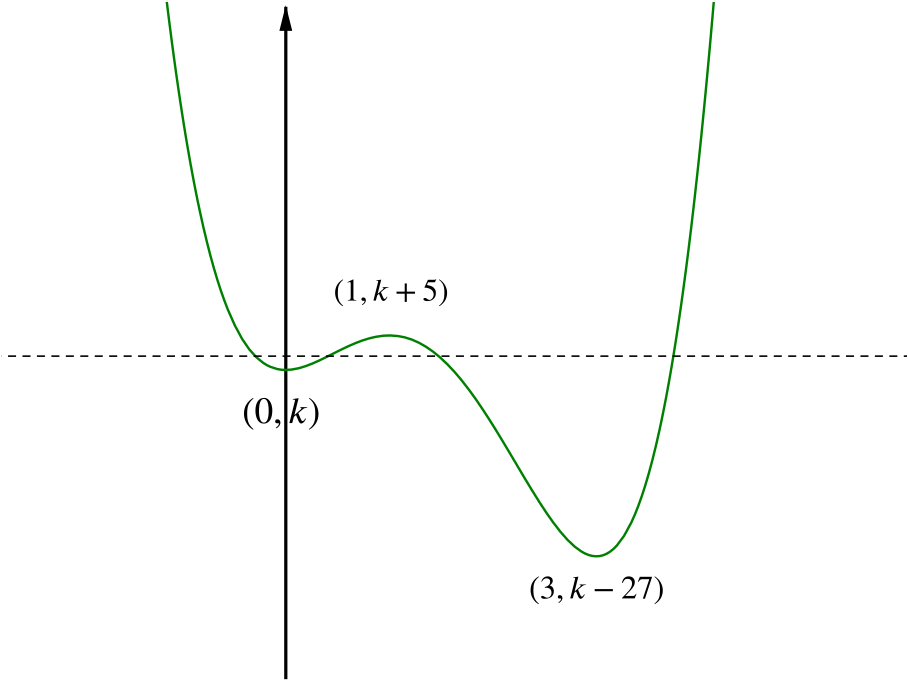
The number of distinct solutions to equals the number of times the graph crosses the -axis, so it’ll be helpful to sketch the graph of .
We can use differentiation to learn about the stationary points and therefore the shape of this graph. So we write
and then we differentiate to find
To find the stationary points, we solve . We see that the stationary points of the graph occur at , and .
To classify these stationary points, we can use the second derivative. We have
Substituting,
so we find that the stationary points at and are minima, and the stationary point at is a maximum.
If we now substitute , and into the equation, we find that the coordinates of our minima are and , and the coordinates of the maximum are .
Or alternatively, we can say we know the rough shape of the curve (see below) so we know which turning points are maxima, and which are minima.
This information about the curve is summarised in the sketch of given below.
The equation has four real solutions when the graph crosses the -axis four times.
This occurs when the -axis is in the position of the dotted line in the diagram above.
That is, it’s in a position such that the minima at and are below it, and the maximum at is above it.
In terms of inequalities, this is when , and .
So combining these, our final inequality is , so the answer is (d).