Order! Order!
Excerpt: Students are asked to think about and describe combinations of graph transformations with a view to seeing when the order matters and when it does not.
Warm-up
Here is a graph of a function, .
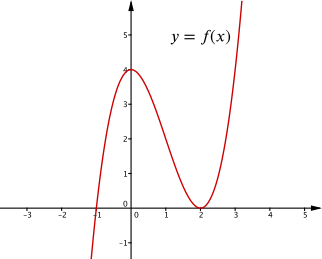
For each of the following transformations, sketch the transformed graph and write its equation in terms of .
Translation by
Translation by
Stretch by factor parallel to
Stretch by factor parallel to
To get an idea of what a transformed graph looks like, identify a few key points on the graph and apply the transformations to those points. What would be the key points on our graph? You might find that some points are not so informative with certain transformations.
Things to think about
Warm-up solution
Here is a graph of a function, .
For each of the following transformations, sketch the transformed graph and write its equation in terms of .
Translation by
This is a translation to the left by units.
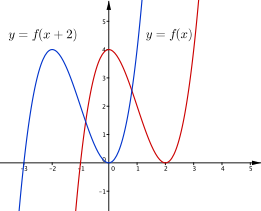
Algebraically, when translating units left we replace with , so we can write
The graph is translated units downwards.
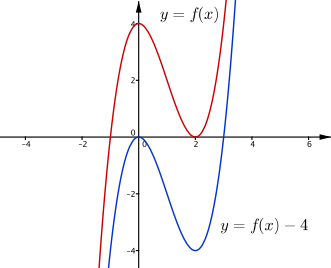
We can write this as
You can think of this as replacing with , which is consistent with how we treated in the first example.
The graph is made times as wide.
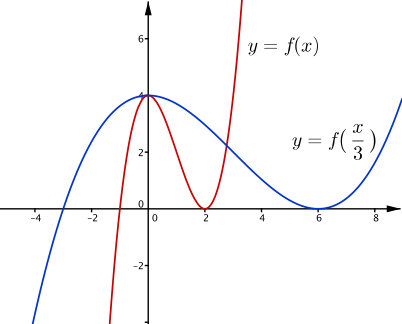
We replace the with , so we can write this as
The graph is made half as tall.
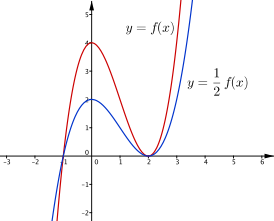
We replace with and write this as
Main problem
What happens if we apply more than one transformation to a graph?
Choose two of these transformations and apply them in turn starting with the function . Sketch the resulting graph after you have applied one transformation and then the other. Does it matter which order you apply the two transformations?
Does the order matter for all pairs, some pairs or none of the pairs?
Translation by
Translation by
Stretch by factor parallel to
Stretch by factor parallel to
Would your answer be different if we had chosen a different set of transformations? Or a different starting function?
Solution
Transformations (1) and (2)
Applying (1) then (2) translates the graph units to the left and then units down. Applying (2) then (1) translates it down then left. The result is the same; the order does not matter.
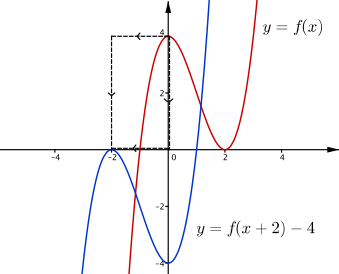
One of the key points on the graph is the local maximum at . Applying the transformations in either order takes this point to as shown dotted in the diagram.
Algebraically, we replace with , and replace with , giving us
Transformations (1) and (3)
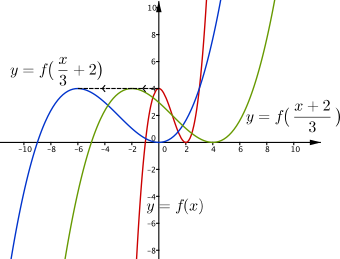
Applying (1) then (3) translates the graph units to the left and then stretches it horizontally. The local maximum at moves to which is then stretched away from the -axis to .
Applying (3) to the point does not move it as it is on the -axis. Transformation (1) then moves it to . This time, the order has made a difference to where the local maximum ends up and we get two different graphs, as shown here in blue and green.
What is it that makes the order matter this time whereas it didn’t matter for transformations (1) and (2)?
How are the two resulting graphs related? What is the transformation from one to the other?
The green and blue graphs are related by a horizontal translation through a distance of . This is the difference between a translation of , and a translation of that is then scaled up by a factor of .
The order matters because both transformations are acting horizontally.
The transformation
Algebraically, transformation (1) replaces
with
while (3) replaces
with
. So the different orders look like this.
Transformations (1) and (4)
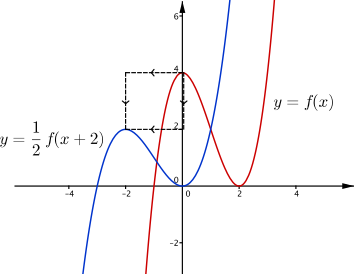
The order does not matter. Algebraically we have .
Transformations (2) and (3)
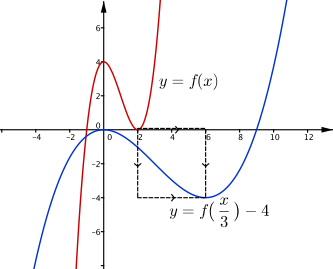
The order does not matter. Algebraically we have .
Transformations (2) and (4)
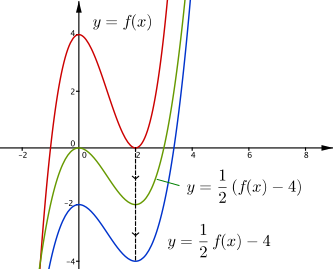
The order does matter. Algebraically, transformation (2) replaces
with
while (4) replaces
with
. So the different orders look like this.
As before, how are the two resulting graphs related?
Transformations (3) and (4)
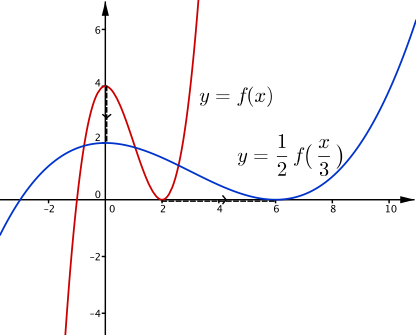
The order does not matter. Algebraically we have .
Of our four transformations, (1) and (3) are in the direction while (2) and (4) are in the direction. The order matters whenever we combine a stretch and a translation in the same direction.
In each of the cases (1)(3) and (2)(4) above, the resulting graphs are related by a translation. Can you explain the magnitude of the translation in each case?
The function used in this example has the shape of a cubic. The same conclusions would be true of any other function, but notice that with simple functions such as you cannot distinguish visually between a horizontal and a vertical stretch.
Conclusion
How would a translation by behave when combined with other transformations?
What if we combined three of the original transformations? Would the order always matter?