When will the arclength take a maximum value?
Question
is a point on the circumference of a circle of diameter An arc of another circle is drawn with centre , intersecting at and . Express the lengths of and the minor arc of in terms of , where is the angle, in radians, between and the diameter of through .
Prove that the length of the arc has a stationary value when , and that this value is a maximum.
Suggestion
We ought to begin by drawing the configuration described in the question. How can we find the length of ? Could we try adding to the configuration?
A further suggestion
If we let denote the other end of the diameter of that passes through , what can we say about ?
A final suggestion
Do we know anything about ?
When checking that a value is a maximum of a function, do we have to calculate the second derivative of the function?
Solution
is a point on the circumference of a circle of diameter . An arc of another circle is drawn with centre , intersecting at and . Express the lengths of and the minor arc of in terms of , where is the angle, in radians, between and the diameter of through .
Here’s a diagram of the two circles and .
If you drew your circle larger than your circle , your diagram will look quite different to this: there’s no need to worry, the mathematics works just the same.
You can explore different versions of the diagram with this interactive:
Varying
[interactive embed (geogebra-iframe): //www.geogebratube.org/material/iframe/id/NFaPz3AU/width/700/height/450/border/888888/rc/false/ai/false/sdz/false/smb/false/stb/false/stbh/false/ld/false/sri/true/asb/false/at/html5] — not part of the text import; see the source page.
Download GeoGebra file
Drag the point to change the size of .
We’ll calculate the two lengths in turn. Firstly, to find , let’s look at the circle .
Since the angle lies in a semicircle, it must be a right angle. Now, from trigonometry,
Secondly, to find the length of the minor arc , let’s look at the circle .
The length of an arc of a circle is , where is the angle subtended at the centre of the circle by the arc.
By symmetry, , and so the length of the minor arc is
We know that Using the product rule, we have
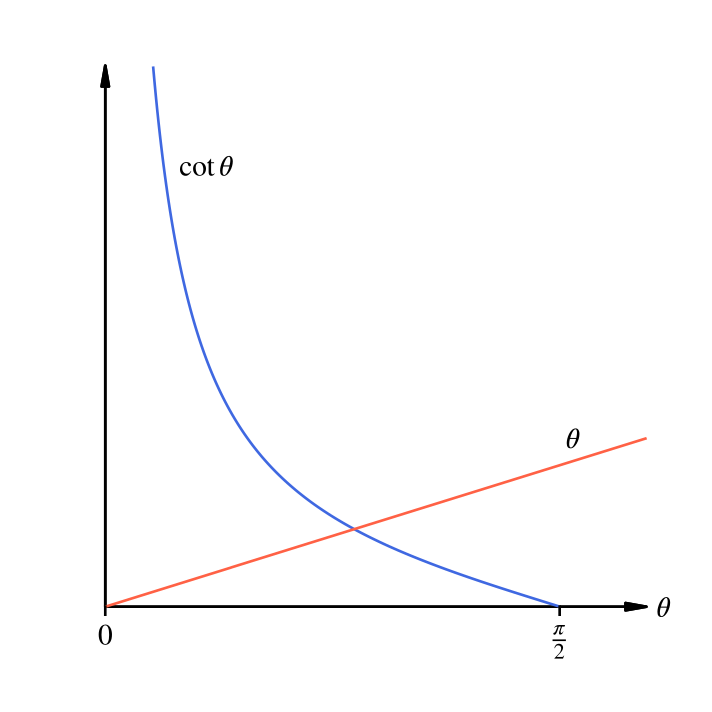
So the stationary points are those values of for which which is true if and only if
We can divide through here by , since is not going to be a solution to our equation.
We are only concerned with the interval .
Since increases from zero and descends from infinity, as illustrated below, our equation has just one solution.
Is this a maximum? We know that when , that when and , and that there’s only one stationary point between and ; therefore, this point has to be a maximum.
We can see this in the changing values in the GeoGebra illustration above.
If we try dragging , what happens to ? For what value of is this a maximum? Does here?
Alternatively, we could calculate the second derivative and check that it’s negative on this interval.