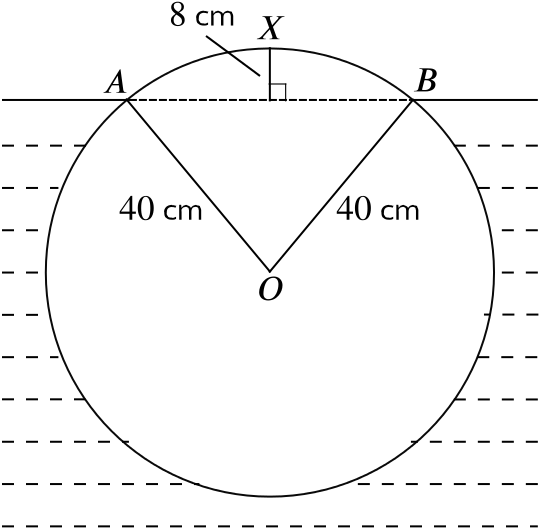
The figure shows the circular cross-section of a uniform log of radius 40cm floating in water. The points A and B are on the surface and the highest point X is 8cm above the surface.
Show that AOB is approximately 1.29 radians.
Calculate
the length of the arc AXB,
the area of the cross-section below the surface,
the percentage of the volume of the log below the surface.
Solution
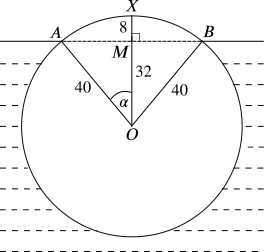
Let M be the point on AB vertically below X. The length OX is 40 and MX is 8, so OM is 32cm.
We’ll compute the angle α, shown here, using its cosine.
We find α=cos−1(4032)≈0.6435... radians.
Since the angle AOB is 2α, we have AOB≈1.2870...=1.29 radians (3sf).
The length of the arc is s=rθ. In our case, s≈40×1.287=51.5cm (3sf).
Let’s call the area of the cross-section below the surface S. We can calculate it as the sum of the triangle OAB and the major sector OAB.
The area of the triangle is 21absinC=21402sin1.287≈768.0.
The area of the sector is 21r2θ=21402(2π−1.287)≈3997.0.
So we have S≈768.0+3997.0=4765.0=4770cm2 (3sf). To calculate S, we need to compute the area of the circle segment shown in red below. This is approximately the area of the sector OAXB minus the area of triangle OAB, which is 2402(1.287−sin(1.287))≈261.6. Given that the whole circle has an area of 402π≈5026.6cm2, S≈5026.6−261.6=4765.0=4770cm2 (3sf).
The percentage of the volume of the log below the surface is the same as the percentage of the area of the cross-section below the surface.