Atoms: Definitions & Structure (Edexcel IGCSE Chemistry)
Guided lessons are live for this note
Work through it step by step — key points, depth layers, a worked example and self-checks.
Atoms & Molecules
Spec point — know what is meant by the terms atom and molecule
Atoms and molecules
- It is important to understand the terms atom and molecule when referring to atomic structure, elements and compounds
| Term | Definition |
|---|---|
| Atom | The smallest particle of an element that contains electrons surrounding a nucleus that contains protons and neutrons |
| Molecule | A group of two or more atoms chemically combined to form an identifiable unit which retains the properties and composition of the substance |
The Structure of the Atom
Spec point — know the structure of an atom in terms of the positions, relative masses and relative charges of sub-atomic particles
Atomic structure
-
All substances are made of tiny particles of matter called atoms which are the building blocks of all matter
-
Each atom is made of subatomic particles called protons, neutrons, and electrons
-
The protons and neutrons are located at the centre of the atom, which is called the nucleus
- The nucleus is positively charged
-
The electrons move very fast around the nucleus in orbital paths called shells
-
The mass of the electron is negligible, hence the mass of an atom is contained within the nucleus where the protons and neutrons are located
Atomic structure
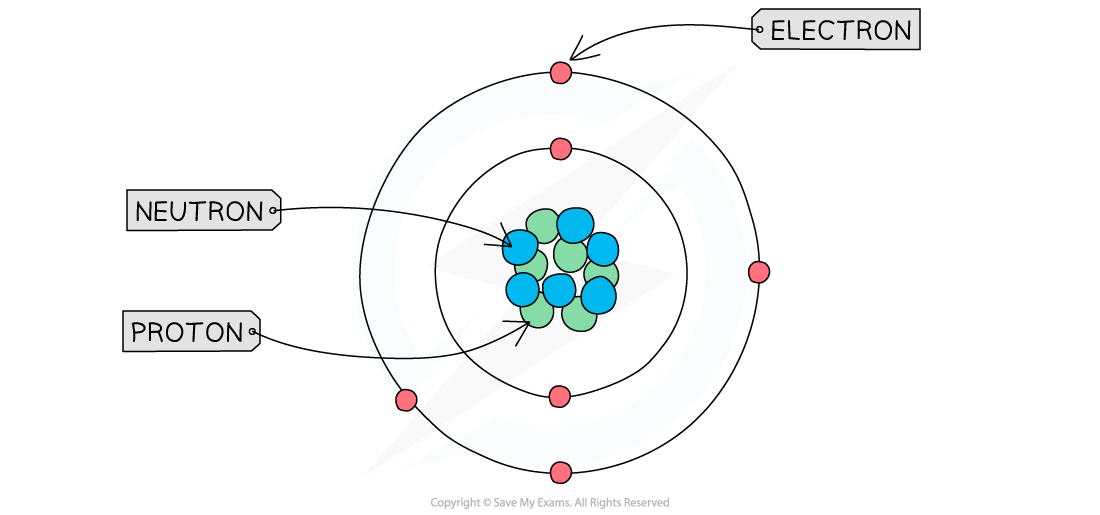
Protons and neutrons are in the nucleus, and electrons in shells orbiting the nucleus
-
Subatomic particles are so small that it is not practical to measure their masses and charges using conventional units (such as grams or coulombs)
-
Instead, their masses and charges are compared to each other, and so are called ‘relative atomic masses’ and ‘relative atomic charges’
- Protons and neutrons have a very similar mass, so each is assigned a relative mass of 1
- Electrons are 2000 times smaller than a proton and neutron, and so their mass is often described as being negligible
- These are not actual charges and masses, but rather charges and masses of particles relative to each other
Table of mass and charge of subatomic particles
| Particle | Relative Mass | Charge |
|---|---|---|
| Proton | 1 | +1 |
| Neutron | 1 | 0 (neutral) |
| Electron | 1/1840 | -1 |
Exam Hint The mass of an electron can just be stated as 'negligible' or 'very small' in an exam. You do not need to learn the value.
Key Terms
Spec point — know what is meant by the terms atomic number, mass number, isotopes and relative atomic mass (Ar)
Calculating protons, neutrons and electrons
- You need to know the following terms to describe the properties and characteristics of atoms
| Term | Definition |
|---|---|
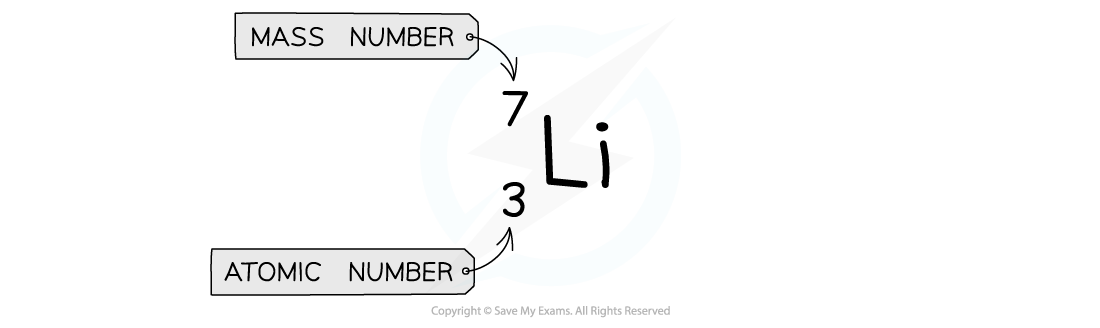
| Atomic number | The number of protons in the nucleus of an atom |
| Mass number | The number of protons and neutrons in the nucleus of an atom |
| Isotope | Atoms of the same element which have the same number of protons but a different number of neutrons |
| Relative atomic mass | The average mass of one atom of an element, taking into account the abundance of all the isotopes for the element. It is equal to 1/12th the mass of an atom of carbon-12. |
-
The atomic number is equal to the number of protons in an atom
-
Since atoms are neutral, then it is also the same as the number of electrons
-
The mass number is the number of protons plus neutrons
- The number of neutrons can thus be calculated by subtracting the atomic number from the mass number
-
For example, lithium has an atomic number of 3, therefore it has 3 protons and 3 electrons
-
The mass number of lithium is 7, so it has 7 - 3 = 4 neutrons
-
Lithium therefore has:
- 3 protons
- 3 electrons
- 4 neutrons
Worked Example Determine the number of protons, electrons and neutrons in an atom of element X with atomic number 29 and mass number 63.
Answer:
The number of protons of element X is the same as the atomic number
- Number of protons = 29
The number of protons is always equal to the number of electrons
- Number of electrons = 29
The number of neutrons is calculated by:
- Number of neutrons = mass number – atomic number
- Number of neutrons = 63 – 29
- Number of neutrons = 34
Exam Hint Both the atomic number and the mass number are given on the Periodic Table, but it can be easy to confuse them.
Think MASS = MASSIVE, as the mass number is always the bigger of the two numbers, the other smaller one is therefore the atomic number.
Was this revision note helpful?
Build on this topic