Atoms: Definitions & Structure
2 guided lessons · 18 checks · 1. Principles of Chemistry → Atomic Structure
Guided lessons for this note
Which concept don't you understand yet?
We'll explain it simply and check your understanding. Pick any lesson — any order works.
0 of 18 checks correct so far
Lesson 1 of 2
The Structure of the Atom
Every substance around you is built from atoms, and atoms can join into molecules. This lesson covers what those two words mean, what the smaller parts inside an atom are, where each part sits, and why almost all of an atom's mass is packed into its centre. By the end you should be able to state the relative masses and charges of the three particles without your notes.
What you know already
Before starting this note you should already know that all substances are made of particles, that an element contains only one kind of atom, and that a compound joins atoms of different elements together. You met these ideas in Elements, Compounds & Mixtures, along with the difference between mixtures and compounds. If any of those terms feel shaky, revisit that subtopic first, because this note builds directly on it.
Key points of understanding
- An atom contains three kinds of sub-atomic particle: protons, neutrons and electrons.
- An atom is the smallest particle of an element; a molecule is two or more atoms joined chemically.
- Protons and neutrons sit in the nucleus at the centre of the atom, and the nucleus is positively charged.
- Electrons race around the nucleus along orbital paths known as shells.
- A proton and a neutron each have relative mass 1, while an electron's mass of about 1/1840 is treated as negligible.
- Because the electron's mass is negligible, effectively all of an atom's mass is contained in its nucleus.
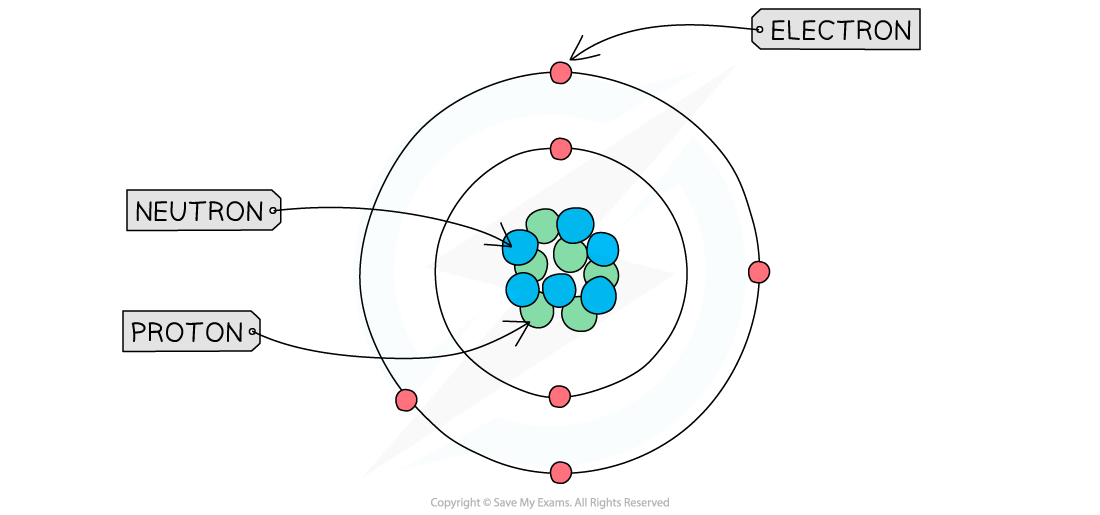
Protons and neutrons are in the nucleus, and electrons in shells orbiting the nucleus
Choose a confidence level to continue.
Prefer to read it all at once? Show the full lesson as a page
1.The Structure of the Atom
Every substance around you is built from atoms, and atoms can join into molecules. This lesson covers what those two words mean, what the smaller parts inside an atom are, where each part sits, and why almost all of an atom's mass is packed into its centre. By the end you should be able to state the relative masses and charges of the three particles without your notes.
Protons and neutrons are in the nucleus, and electrons in shells orbiting the nucleus
Key points
Guided content from the SME authoring corpus — note rn_kb2VkFMdBTbmG33t, pinned at 96c261a3a06e · promoted SyllabAI/syllabai-resources e967e75f1339