Practical: Investigating Paper Chromatography (Edexcel IGCSE Chemistry)
Exam board Pearson Edexcel · IGCSEUpdated 2025-11-04
Guided lessons are live for this note
Work through it step by step — key points, depth layers, a worked example and self-checks.
Practical: Investigate Paper Chromatography Using Inks & Food Colourings
Spec point — practical: investigate paper chromatography using inks/food colourings
Aim:
Investigate how paper chromatography can be used to separate and identify a mixture of food colourings
Apparatus:
- A 250 cm3 beaker
- A wooden spill
- A rectangle of chromatography paper
- Four known food colourings labelled A–D
- An unknown mixture of food colourings labelled U
- Five glass capillary tubes
- Paper clip
- Ruler & pencil
Diagram of the apparatus needed for paper chromatography
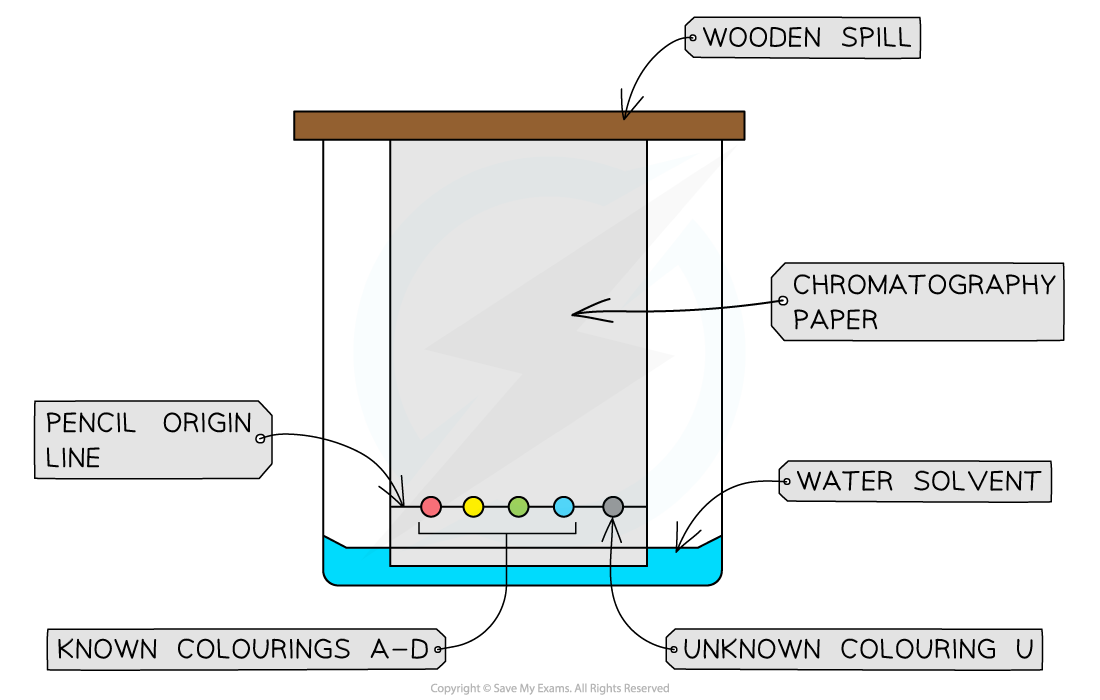
Method:
- Use a ruler to draw a horizontal pencil line 2 cm from the end of the chromatography paper
- Use a different capillary tube to put a tiny spot of each colouring A, B, C and D on the line
- Use the fifth tube to put a small spot of the unknown mixture U on the line
- Make sure each spot is no more than 2-3 mm in diameter and label each spot in pencil
- Pour water into the beaker to a depth of no more than 1 cm and clip the top of the chromatography paper to the wooden spill. The top end is the furthest from the spots
- Carefully rest the wooden spill on the top edge of the beaker. The bottom edge of the paper should dip into the solvent
- Allow the solvent to travel undisturbed at least three quarters of the way up the paper
- Remove the paper and draw another pencil line on the dry part of the paper as close to the wet edge as possible. This is called the solvent front line
- Measure the distance in mm between the two pencil lines. This is the distance travelled by the water solvent
- For each of food colour A, B, C and D measure the distance in mm from the start line to the middle of the spot
Common errors & sources of inaccuracy
- When carrying out paper chromatography, it is important to be aware of the potential sources of error to ensure your results are accurate
Starting line drawn in ink
- The ink is a mixture of dyes and will run with the solvent
- This will interfere with the chromatogram and make it difficult to interpret the results
- Solution: Always draw the starting line in pencil
Large sample spots
- This can cause the separated spots to merge or spread out
- This can lead to smearing and an inaccurate measurement of the Rf value
- Solution: Keep the sample spots as small and concentrated as possible
Solvent level above the starting line
- The samples will dissolve directly into the solvent
- This means that the samples will not move up the chromatogram and there will be no separation
- Solution: Ensure the solvent is always below the pencil starting line
Solvent front runs off the top of the paper
- If the solvent runs off the end of the paper, you cannot measure the distance it travelled
- Therefore, you cannot calculate the Rf values
- Solution: Remove the chromatogram from the beaker before the solvent front reaches the very top
Beaker is not covered
- The solvent will evaporate from the surface of the paper as it moves up
- This can slow down the separation and affect the final position of the spots
- Solution: Place a lid (such as a watch glass or plastic wrap) on top of the beaker to create a saturated atmosphere of solvent vapour
Results:
- Record your results in a suitable table
| Food colouring | Distance moved by spot (mm) | Distance Moved by solvent (mm) | Rfvalue |
|---|---|---|---|
| A | |||
| B | |||
| C | |||
| D |
- The Rf values of food colours A, B, C and D should be compared to that for the unknown sample as well as a visual comparison being made
- Substances with matching Rf values are the same substance and will move the same distance up the paper
Was this revision note helpful?