Practical: Investigating Paper Chromatography
2 guided lessons · 18 checks · 1. Principles of Chemistry → Elements, Compounds & Mixtures
Guided lessons for this note
Which concept don't you understand yet?
We'll explain it simply and check your understanding. Pick any lesson — any order works.
0 of 18 checks correct so far
Lesson 1 of 2
Apparatus and Method
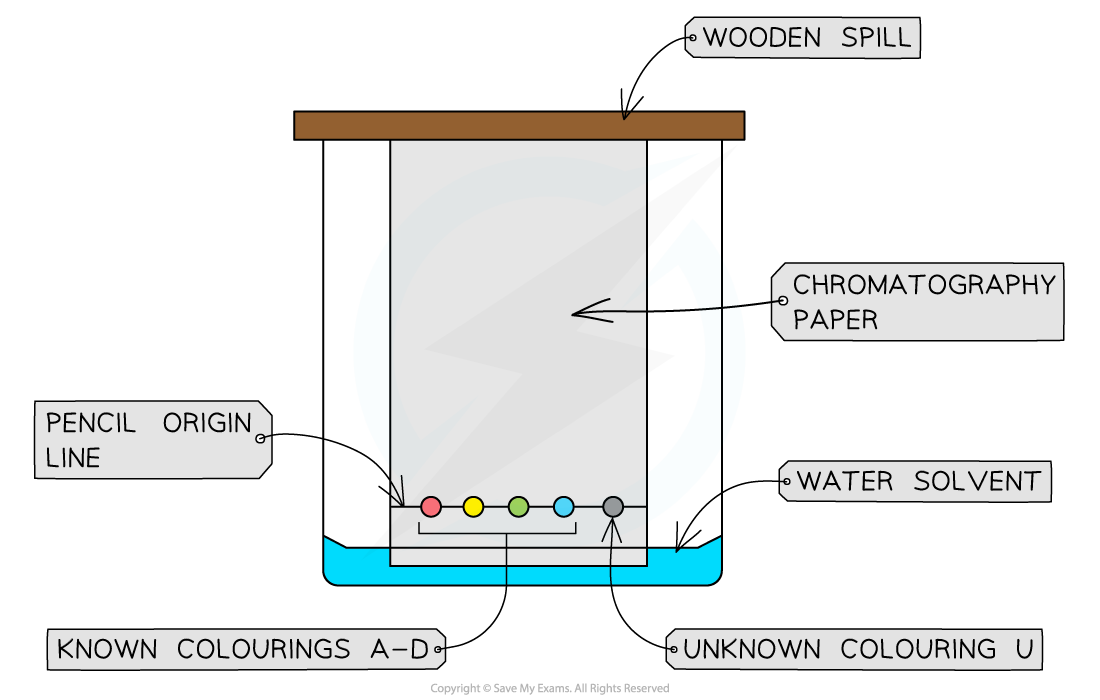
This practical separates the dyes in four known food colourings and an unknown mixture using paper chromatography. Capillary tubes place tiny spots on a pencil start line, water climbs the paper, and each dye travels its own distance. Careful setup matters: every distance you measure later depends on how cleanly the run was carried out.
What you know already
Separation Techniques introduced paper chromatography as a way of splitting an ink into its dyes. This practical turns that idea into a full procedure: setting up the paper, spotting samples, running the solvent, and comparing Rf values so an unknown mixture of colourings can be named. Revisit the chromatography part of Separation Techniques first if the setup still feels new.
Key points of understanding
- A pencil start line is drawn 2 cm from the bottom edge of the chromatography paper.
- Each colouring gets its own capillary tube, so one sample cannot contaminate another.
- Spots are kept no bigger than 2-3 mm so the dyes can pull apart cleanly.
- Water goes in to 1 cm or less, keeping the solvent below the pencil line.
- The run is left undisturbed until the solvent has climbed at least three quarters of the paper.
- A solvent front line is drawn at the wet edge before any distances are measured in mm.
Choose a confidence level to continue.
Prefer to read it all at once? Show the full lesson as a page
1.Apparatus and Method
This practical separates the dyes in four known food colourings and an unknown mixture using paper chromatography. Capillary tubes place tiny spots on a pencil start line, water climbs the paper, and each dye travels its own distance. Careful setup matters: every distance you measure later depends on how cleanly the run was carried out.
Key points
- A pencil start line is drawn 2 cm from the bottom edge of the chromatography paper.
- Each colouring gets its own capillary tube, so one sample cannot contaminate another.
- Spots are kept no bigger than 2-3 mm so the dyes can pull apart cleanly.
- Water goes in to 1 cm or less, keeping the solvent below the pencil line.
Guided content from the SME authoring corpus — note rn_TsfqyK9BYMtN2Bfd, pinned at 96c261a3a06e · promoted SyllabAI/syllabai-resources e967e75f1339