Can we find the areas enclosed between a circle and its tangent?
Question
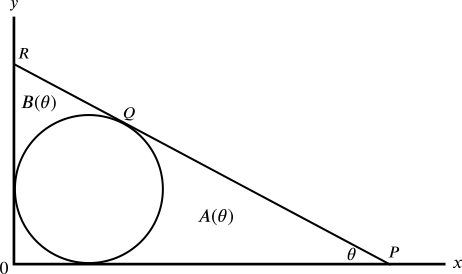
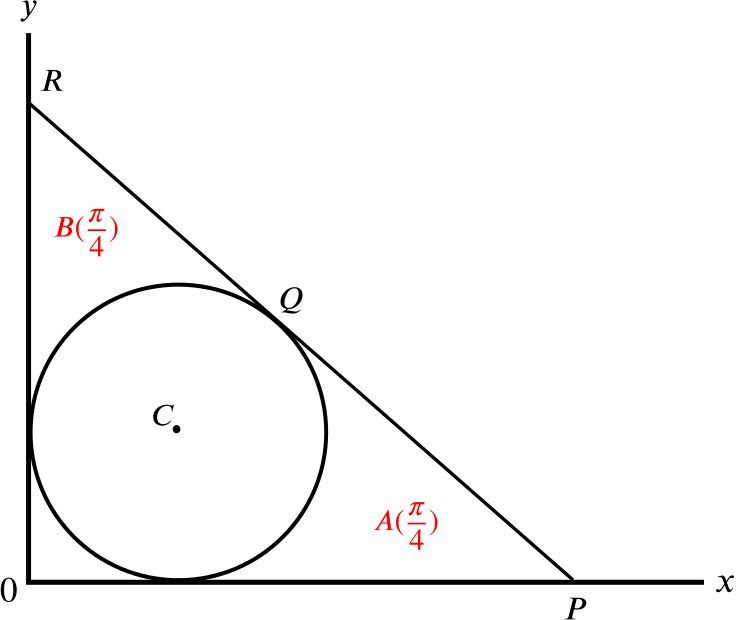
In the diagram below is sketched the circle with centre (1,1) and radius 1 and a line L. The line L is tangential to the circle at Q. Further, L meets the y-axis at R, and the x-axis at P in such a way that the angle OPQ equals θ where 0<θ<2π.
Show that the co-ordinates of Q are (1+sinθ,1+cosθ), and that the gradient of PQR is −tanθ. Write down the equation of the line PQR and so find the co-ordinates of P.
The region bounded by the circle, the x-axis and PQ has area A(θ); the region bounded by the circle, the y-axis and QR has area B(θ). (See diagram.) Explain why A(θ)=B(2π−θ) for any θ. Calculate A(4π).
Show that A(3π)=3−3π.
Suggestion
Could we add the radius of the circle which meets the tangent to the diagram? What angles do we know now?
If we draw two diagrams, one with angle θ at P, and the other with angle (2π−θ) at P, then what do we notice?
Interactive diagram
Download GeoGebra file
The angle ∠OPQ=θ can be varied using the slider.
The values of A(θ) and B(θ) are indicated by the height of the bars on the right.
Could we sketch a new diagram with θ=4π? Can we calculate the length OP?
Show that A(3π)=3−3π.
Could we sketch a new diagram with θ=3π?
Maybe A(3π) could be found by finding the area of two right-angled triangles and subtracting part of the area of the circle?
Solution
We know the centre of the circle is at (1,1).
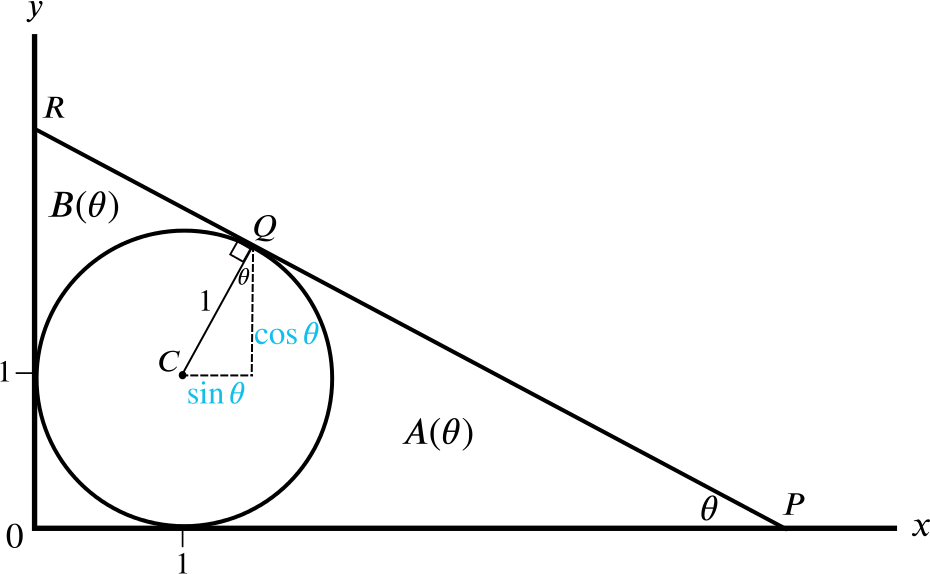
From the diagram, we can see that to get from the centre, C, to the point Q we must travel “sinθ” horizontally and “cosθ” vertically, so
Q=(1+sinθ,1+cosθ).
If we now let the length of
PQR=ℓ
, then
gradient of PQR=change in xchange in y=ℓcosθ−ℓsinθ=−tanθ,as required.
Alternatively, we could find the gradient of the radius to Q and (because we know the radius and tangent are perpendicular) we can then find the gradient of the tangent PQR.
The gradient of CQ is sinθcosθ (the change in y values ÷ the change in x values). The product of perpendicular gradients is −1.
The tangent
PQR
is perpendicular to the radius, therefore:
sinθcosθ×m⟹m=−1,=−cosθsinθ=−tanθ,as required.
The line PQR has gradient −tanθ and goes through the point (1+sinθ,1+cosθ), and so has equation
y−(1+cosθ)=−tanθ(x−(1+sinθ)).
We’re not asked to give the equation of the line in any particular form, so we can leave it as is.
At the point
P
we know
y=0
. Substituting this value into the equation of the line we find
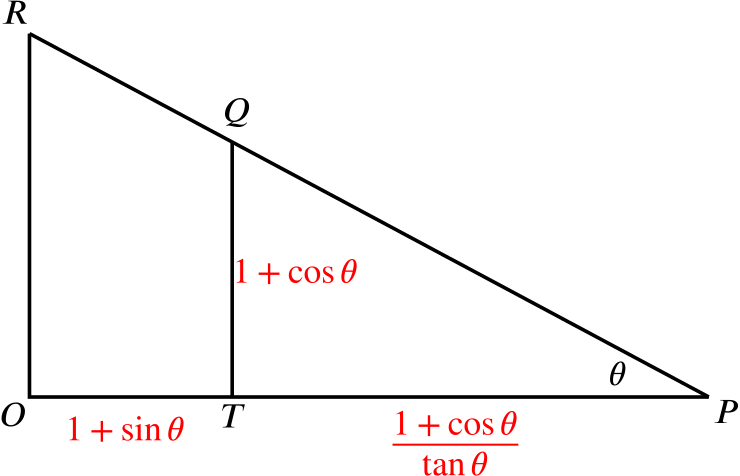
If we’d looked at our diagram carefully, we could’ve arrived at the same answer:
Using tanθ=adjacentopposite, we see TP=tanθ1+cosθ, and so
x=1+sinθ+tanθ1+cosθ.
Therefore the co-ordinates of P are (1+cotθ+cosecθ,0).
The region bounded by the circle, the x-axis and PQ has area A(θ); the region bounded by the circle, the y-axis and QR has area B(θ). (See diagram.) Explain why A(θ)=B(2π−θ) for any θ.
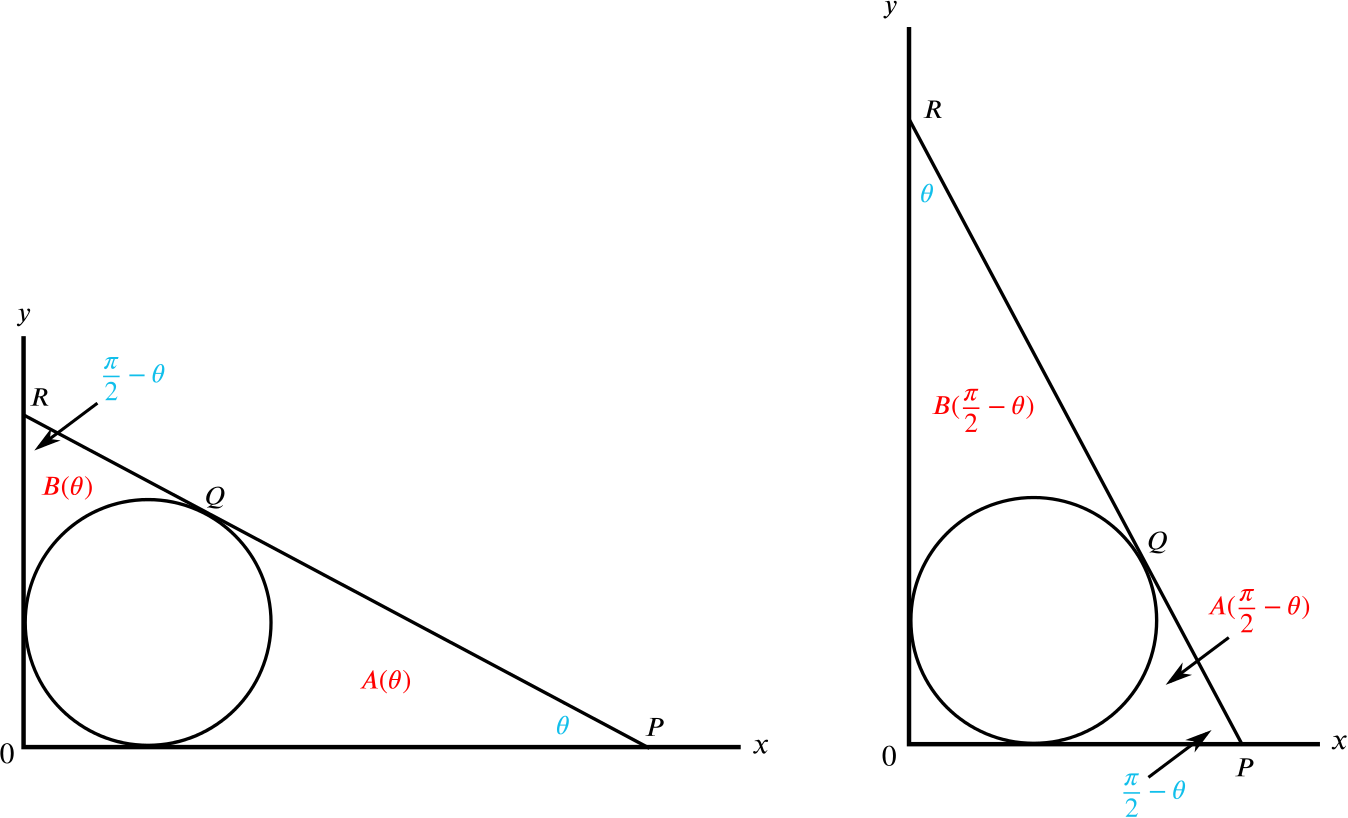
Let’s draw two diagrams - one with angle θ at P and the other with angle 2π−θ at P:
We can see simply from the symmetry of the diagrams that A(θ)=B(2π−θ).
To calculate A(4π), let’s draw the diagram and see if it might help us.
By symmetry, we see that A(4π)=B(4π).
Next, we need to know the lengths OP and OR of the triangle OPR.
Using our final answer from (i), we have
OP=1+sin4π1+sin4πcos4π=1+2+1=2+2.
Our triangle is isosceles, since both the angle at P and the angle at R are 4π, so we have OR=OP and OR=2+2also.
Now we can calculate the area of the whole triangle OPR.
The area of triangle
OPR
is
21(2+2)2
which simplifies to
21(4+42+2)=21(6+42)=3+22.
The shaded area in the diagram below is made up of a square of side length 1, and 43 of the circle (of radius 1).
The shaded area is therefore: 1×1+43×π×(1)2=1+43π.
The area of A(4π) can now be found. We have
A(4π)=21(area of triangle OPR−shaded area)=21(3+22−(1+43π))=21(2+22−43π)=1+2−83π.
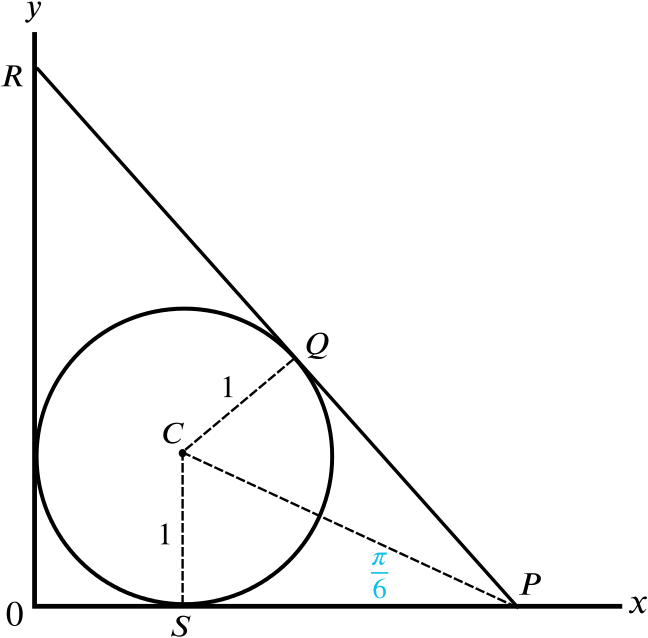
Show that A(3π)=3−3π.
The length SP can be found from the triangle CSP: we have
tan6π31so SP=SPCS=SP1=3.
Therefore the area of triangle CSP is 21×1×3=23.
By symmetry, the area of triangle CQP is also 23.
The area of the sector CQS is 31×π×(1)2=31π.
Therefore we can now find the area A(3π): we have
A(3π)=area of triangle CSP+area of triangle CQP−area of sector CQS=23+23−3π=3−3π,as required.