What can we say if two circles cut at right angles?
Question
Derive a condition for the two circles
x2+y2+2g1x+2f1y+c1x2+y2+2g2x+2f2y+c2=0,=0,
to cut orthogonally.
Hence, or otherwise, show that in general there is just one circle orthogonal to three given circles.
Find the centre and radius of the circle orthogonal to the three circles
x2+y2−12x−8y+34x2+y2−6x−12y+32x2+y2−10x−6y+30=0,=0,=0.
Suggestion
‘Orthogonally’ means ‘at right angles’.
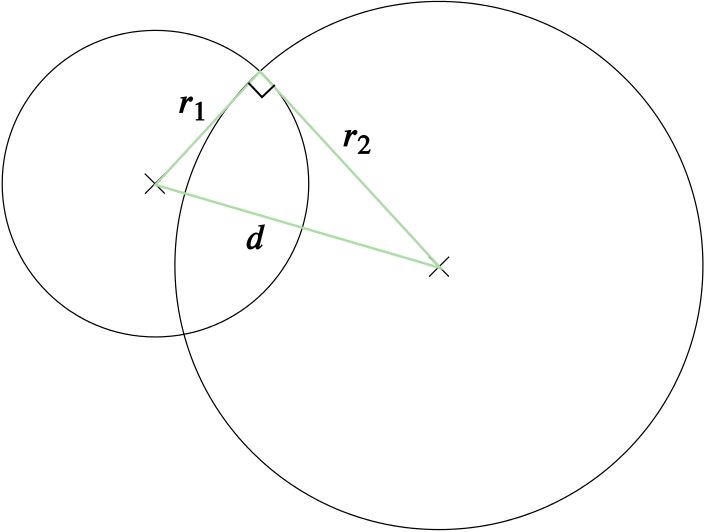
Could we draw a helpful diagram? If we assume two circles cut orthogonally, can we deduce a relationship between their radii and the distance apart of their centres?
If such a circle exists, what equations can we write down? When do these equations have a unique solution?
Solution
If we complete the square for each equation (by adding +g2−g2+f2−f2 to the left hand side), we find
(x+g1)2+(y+f1)2(x+g2)2+(y+f2)2=g12+f12−c1,=g22+f22−c2.
The centres are (−g1,−f1) and (−g2,−f2), and
r12=g12+f12−c1,r22=g22+f22−c2.
If two circles cut orthogonally, their radii and the line connecting their centres form a right triangle.
Hence, using Pythagoras, we have
r12+r22=d2=(g1−g2)2+(f1−f2)2.
Now we have
g12+f12−c1+g22+f22−c2⟹c1+c2=(g1−g2)2+(f1−f2)2=2g1g2+2f1f2.
This is the condition for the given circles to cut orthogonally.
Given three circles, let’s define them via
x2+y2+2g1x+2f1y+c1x2+y2+2g2x+2f2y+c2x2+y2+2g3x+2f3y+c3=0,=0,=0.
Can the unknown circle x2+y2+2Gx+2Fy+C=0 be orthogonal to all three circles? If so, we have three equations for three unknowns:
I:II:III:C+c1C+c2C+c3=2Gg1+2Ff1,=2Gg2+2Ff2,=2Gg3+2Ff3.
In general, three equations for three unknowns can be solved to give a unique solution.
There are special cases when, for example, two of the circles coincide, where the solution will not be unique, or when the three equations have no solutions (imagine three circles of equal radius with their centres collinear that don’t intersect) but we’ve been asked about the general case.
We need to solve simultaneously the three equations
I:II:III:C+34C+32C+30=2G(−6)+2F(−4),=2G(−3)+2F(−6),=2G(−5)+2F(−3).
Subtracting the second from the first, and the third from the first, we derive the two equations in G and F 2=−6G+4F,4=−2G+−2F.
Adding twice the second to the first here gives 10=−10G, and so G=−1,F=−1,C=−14.
Thus the circle orthogonal to all three circles is (x+1)2+(y+1)2=16, which has centre (−1,−1), and radius 4.