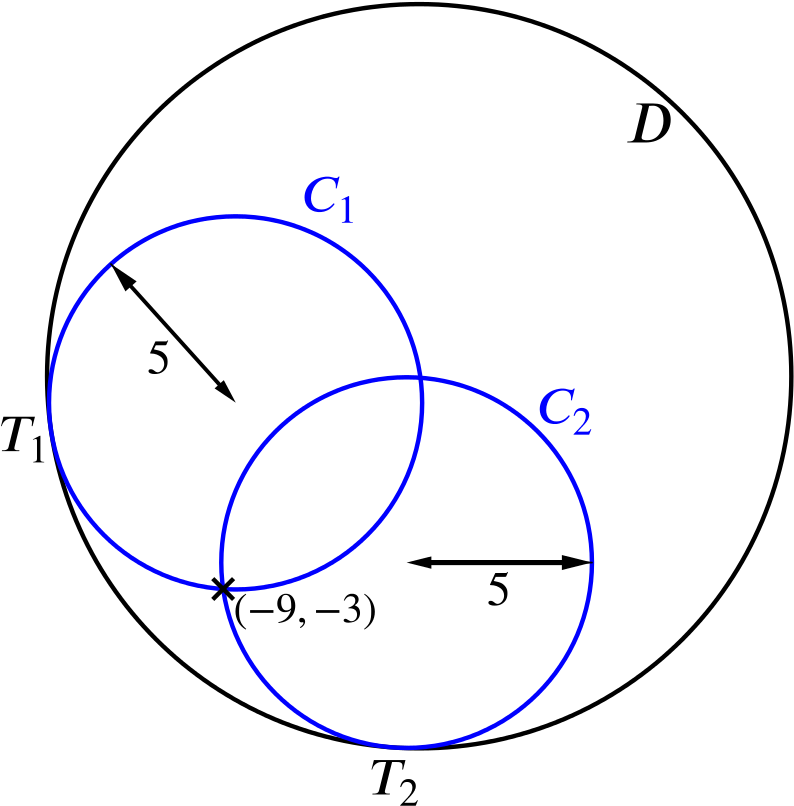
Can we find the equations of two circles that touch another?
Question
Show by calculation that the point P(−9,−3) lies inside the circle x2+y2+4x−8y−80=0.
Find the equations of the two circles which pass through P, touch the given circle, and have radii of 5 units.
Suggestion
Can we find the centre and the radius of the circle? How far is P from the centre of the circle?
We know these circles pass through P — can we find another point that these circles must go through?
Solution
Let’s call this circle D. Firstly, we rewrite the equation of D in the form (x−a)2+(y−b)2=r2, so that we can easily work out its centre and radius.
We have
⟺⟺x2+y2+4x−8y−80=0(x+2)2−4+(y−4)2−16−80=0(x+2)2+(y−4)2=100.
D has centre (−2,4) and radius 10. This means that a point Q lies inside D if and only if the distance between Q and the point (−2,4) is less than 10.
Let
d
be the distance between
(−9,−3)
and
(−2,4)
. Then
d=(−9−(−2))2+(−3−4)2=(−7)2+(−7)2=49+49=98
Now 98<10, so the distance between P and (−2,4) is less than 10, and P lies inside D.
The normal to the circle C1 at T1 is also normal to D.
It must go through the centre of C1, but it must go through the centre of D too.
Now D has radius 10, and C1 has diameter 10, so we can deduce C1, and similarly C2, goes through (−2,4), the centre of D.
Now suppose one of the smaller circles C has centre (a,b).
The circle C passes through (−9,−3), so the distance between (a,b) and (−9,−3) is 5. So (a+9)2+(b+3)2=25, by Pythagoras’ theorem.
But also C passes through (−2,4), so the distance between (a,b) and (−2,4) is 5. So (a+2)2+(b−4)2=25, by Pythagoras’ theorem.
So we have the two equations a2+b2+18a+6b+65=0 and a2+b2+4a−8b−5=0.
Subtracting these gives 14a+14b+70=0, so 70=−14a−14b and b=−5−a.
Substituting this into (a+9)2+(b+3)2=25 gives us a2+18a+81+4+4a+a2=25, that is, a2+11a+30=0.
This quadratic factorises into (a+5)(a+6)=0, so a=−5 or a=−6.
Substituting these values into b=−5−a, we get two possibilities for (a,b), (−5,0) and (−6,1).
It’s easy to check that these points are viable ones for the centre of C (they do satisfy both equations).
So as the circles have radius 5, we get that the equations for these two circles are (x+5)2+y2=25, and (x+6)2+(y−1)2=25.