Brownian Motion (Cambridge International IGCSE Physics)
Spec point —
2.1.4· - Know that the random motion of microscopic particles in a suspension is evidence for the kinetic particle model of matter
- Describe and explain this motion (sometimes known as Brownian motion) in terms of random collisions between the microscopic particles in a suspension and the particles of the gas or liquid
What is Brownian motion?
-
The kinetic particle model of matter — the idea that all matter is made up of tiny particles in constant motion — was first supported by an accidental observation
- The Scottish scientist Robert Brown first described the random motion of pollen grains in water, which he saw under a microscope
- This observation could not be explained at the time, but later it was realised that it shows that substances are made of particles which are in constant motion (hence 'kinetic')
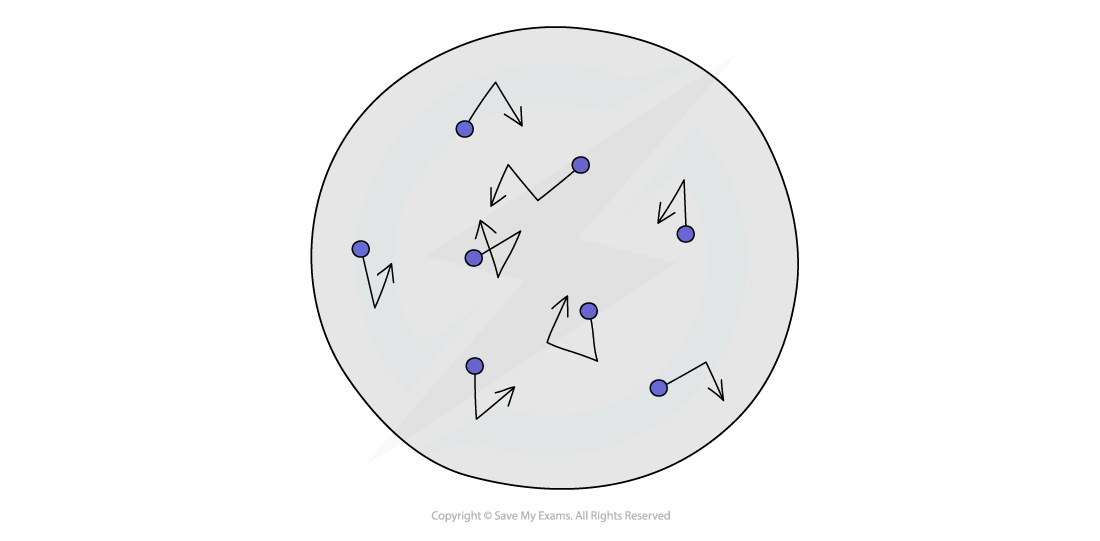
Brownian motion: the random motion of microscopic particles in a suspension when observed through a microscope
-
Brownian motion is the random movement of microscopic particles suspended in a liquid or a gas, caused by large numbers of collisions with the much smaller, lighter, faster-moving molecules of that liquid or gas
-
When small particles (such as pollen or smoke) are suspended in a liquid or gas, they can be observed through a microscope moving around in a random, erratic fashion
Exam Hint If you are asked to draw the path of a smoke particle, use short straight lines of different lengths joined by sudden changes of direction. Curved paths score no marks, and neither does a path that only changes direction when it hits the edge of the container. If you are asked to name the motion, the answer is Brownian motion — not diffusion.
Explaining Brownian motion
Spec point —
2.1.4· - Know that microscopic particles may be moved by collisions with light fast-moving molecules and correctly use the terms atoms or molecules as distinct from microscopic particles (E)
Extended Tier Only
What is Brownian motion caused by?
-
When observing Brownian motion, even with a microscope, only the microscopic particles can be seen
- The pollen or smoke particles are seen to move
- Smaller atoms and molecules, of water or air, are still too small to be seen
-
These light, fast-moving atoms and molecules collide with the larger microscopic particles
- The collisions give the particles a little nudge, causing them to change their speed and directions randomly, each time they are struck by a molecule
- At any moment, more molecules happen to strike one side of the microscopic particle than the other
- This uneven bombardment produces a resultant force that pushes the particle in a random direction
-
The presence of the light, fast moving atoms and molecules is inferred from the motion of the microscopic particles
- Inferences such as this are an important part of scientific investigation
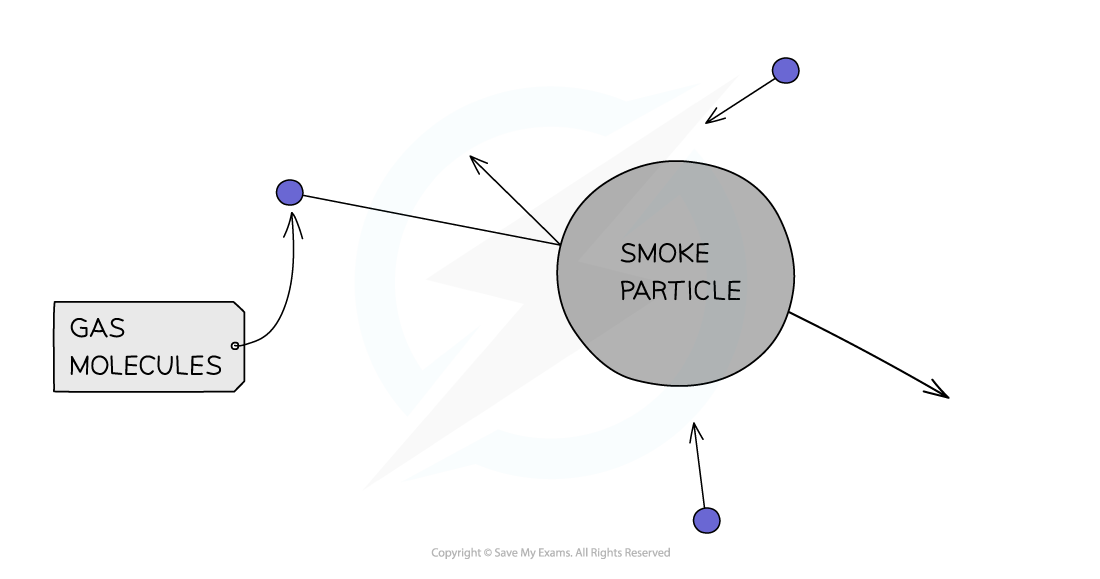
Light, fast-moving molecules collide with larger particles, giving them a little nudge
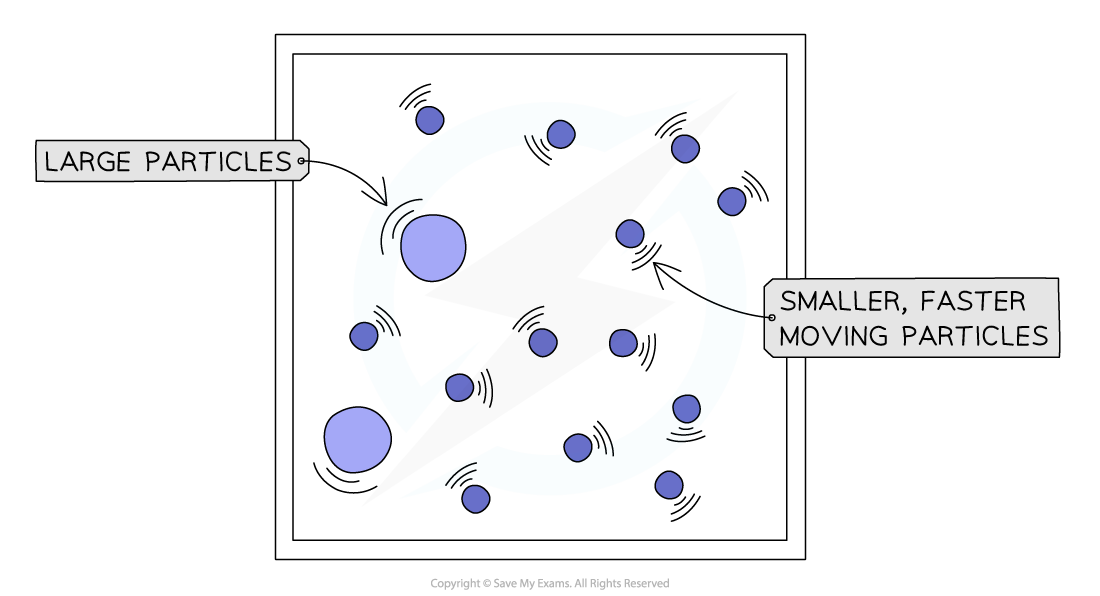
This not-to-scale diagram shows how the smaller, fast-moving particles (atoms and molecules) cause the larger, visible particles to move
Was this revision note helpful?