Gases & Absolute Temperature (Cambridge International IGCSE Physics)
Absolute temperature
Spec point —
2.1.5· Convert temperatures between kelvin and degrees Celsius; recall and use the equation T (in K) = θ (in °C) + 273
What is absolute temperature?
-
Temperature measured in kelvin is called absolute temperature
-
The kelvin temperature scale begins at absolute zero
- **0 K is equal to -273 °C **
- An increase of 1 K is the same change as an increase of 1 °C
-
It is not possible to have a temperature** lower** than 0 K
-
This means a temperature in kelvin will never have a negative value
-
To convert between a temperature θ in degrees Celsius and a temperature T in kelvin, use the following conversion:
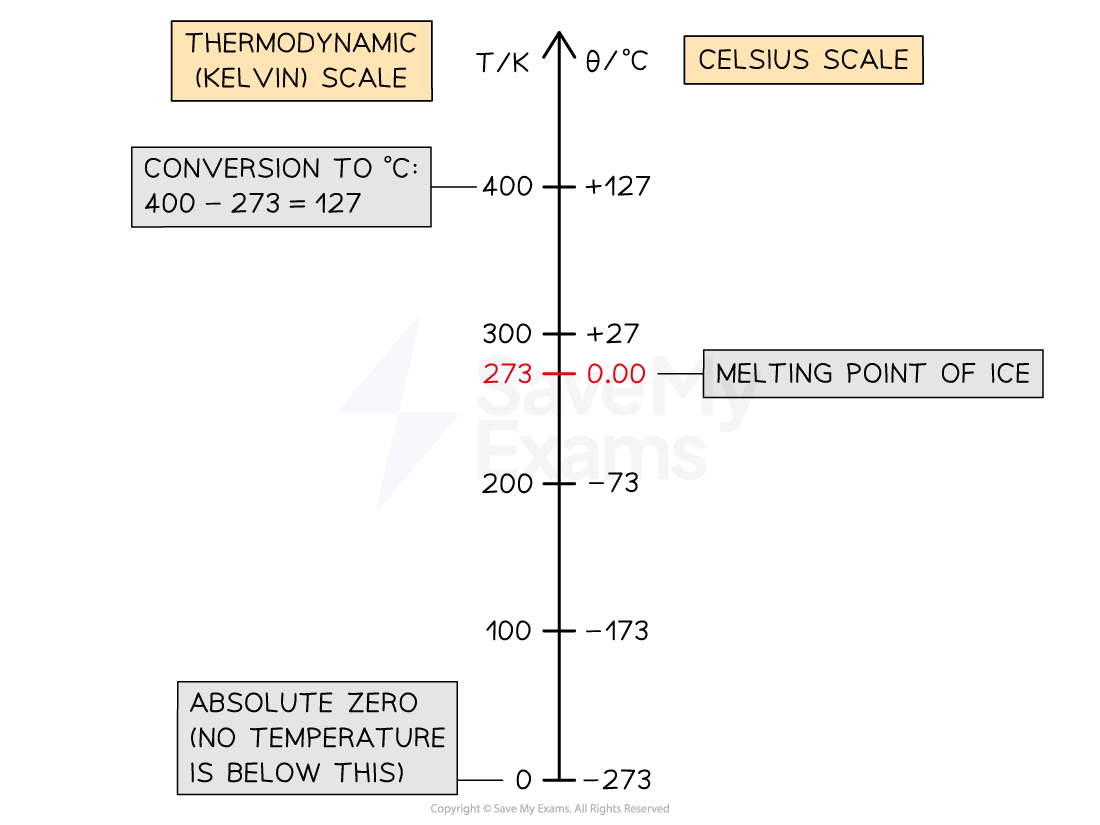
Conversion chart relating the temperature on the Kelvin and Celsius scales
Worked Example Convert the following values between the Kelvin (absolute) and Celsius scales of temperature.
a) 0 K = _______ °C [1]
b) 0 °C = _______ K [1]
c) 20 °C = _______ K [1]
Answer:
Part (a)
Step 1: Choose whether to add or subtract 273 to the value
- The question is in kelvin therefore subtract 273 to convert to Celsius
Step 2: Do the calculation
Step 3: Write the answer with units
- 0 K = −273 °C [1 mark]
Part (b)
Step 1: Choose whether to add or subtract 273 to the value
- The question is in Celsius therefore add 273 to convert to kelvin
Step 2: Do the calculation
Step 3: Write the answer with units
- 0 °C = 273 K [1 mark]
Part (c)
Step 1: Choose whether to add or subtract 273 to the value
- The question is in Celsius therefore add 273 to convert to kelvin
Step 2: Do the calculation
Step 3: Write the answer with units
- 20 °C = 293 K [1 mark]
The gas laws
Spec point —
2.1.5· Describe qualitatively, in terms of particles, the effect on the pressure of a fixed mass of gas of: (a) a change of temperature at constant volume (b) a change of volume at constant temperature
The gas laws
Pressure and volume (constant temperature)
-
For a fixed mass of gas, if the temperature of a gas remains constant, the pressure of the gas changes when it is:
- Compressed – decreases the volume which increases the pressure
- Expanded – increases the volume which decreases the pressure
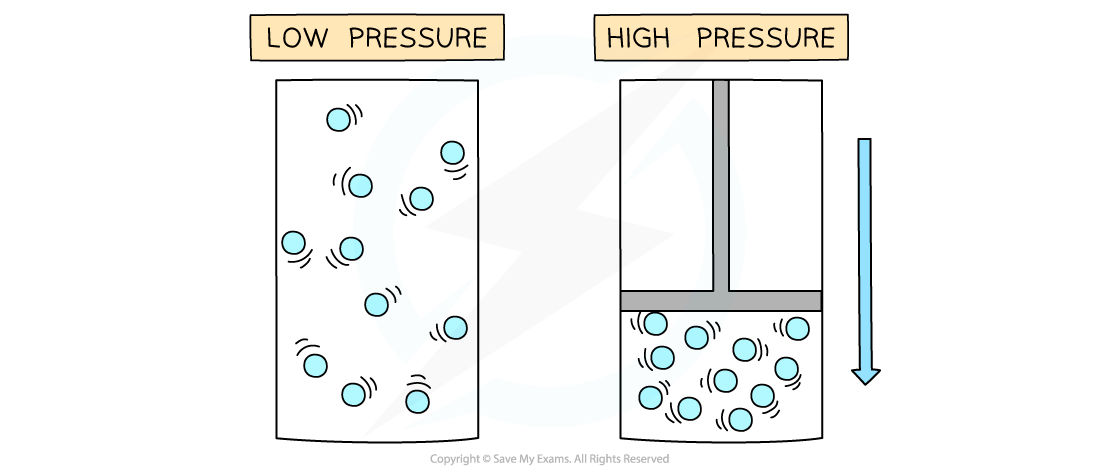
At constant temperature, changing the volume changes the pressure
-
Similarly, a change in pressure can cause a change in volume
-
A vacuum pump can be used to remove the air from a sealed container
-
The diagram below shows the change in volume to a tied-up balloon when the pressure of the air around it decreases:
- The balloon is tied, so there are a fixed number of air particles within it
- At normal pressure, the air pressure outside the balloon is greater than the air pressure inside the balloon
- When air is removed from the bell jar, the air pressure outside the balloon is less than the air pressure inside the balloon
- The space between the air particles in the balloon increases, so the volume of the balloon increases
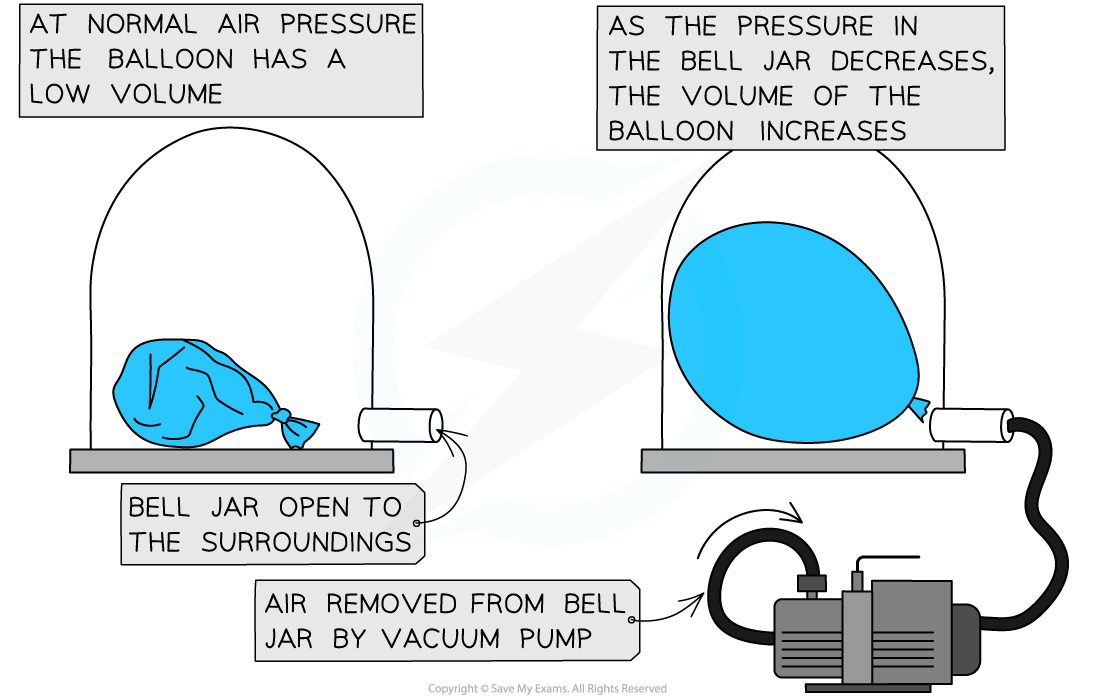
At constant temperature, changing the pressure changes the volume
-
When a gas is compressed, the molecules will hit the walls of the container more frequently
- Each wall is struck more often, and so the total force on each wall increases, which increases the pressure
Pressure and temperature (constant volume)
-
For a fixed mass of gas, increasing temperature increases the pressure of a gas which is kept at a constant volume
-
The average speed of molecules increases when the temperature increases (and vice versa)
-
As the gas heats up, the molecules will travel at a higher speed
- They collide with the walls more often and with greater force, increasing the pressure
-
Therefore, at a constant volume, an increase in temperature increases the pressure of a gas and vice versa
-
Diagram A shows that molecules in the same volume collide with the walls of the container more frequently, and with greater force, as the temperature increases
-
Diagram B shows that the pressure increases steadily as the temperature rises
- If the temperature is measured in kelvin, pressure is directly proportional to temperature and the line passes through the origin
-
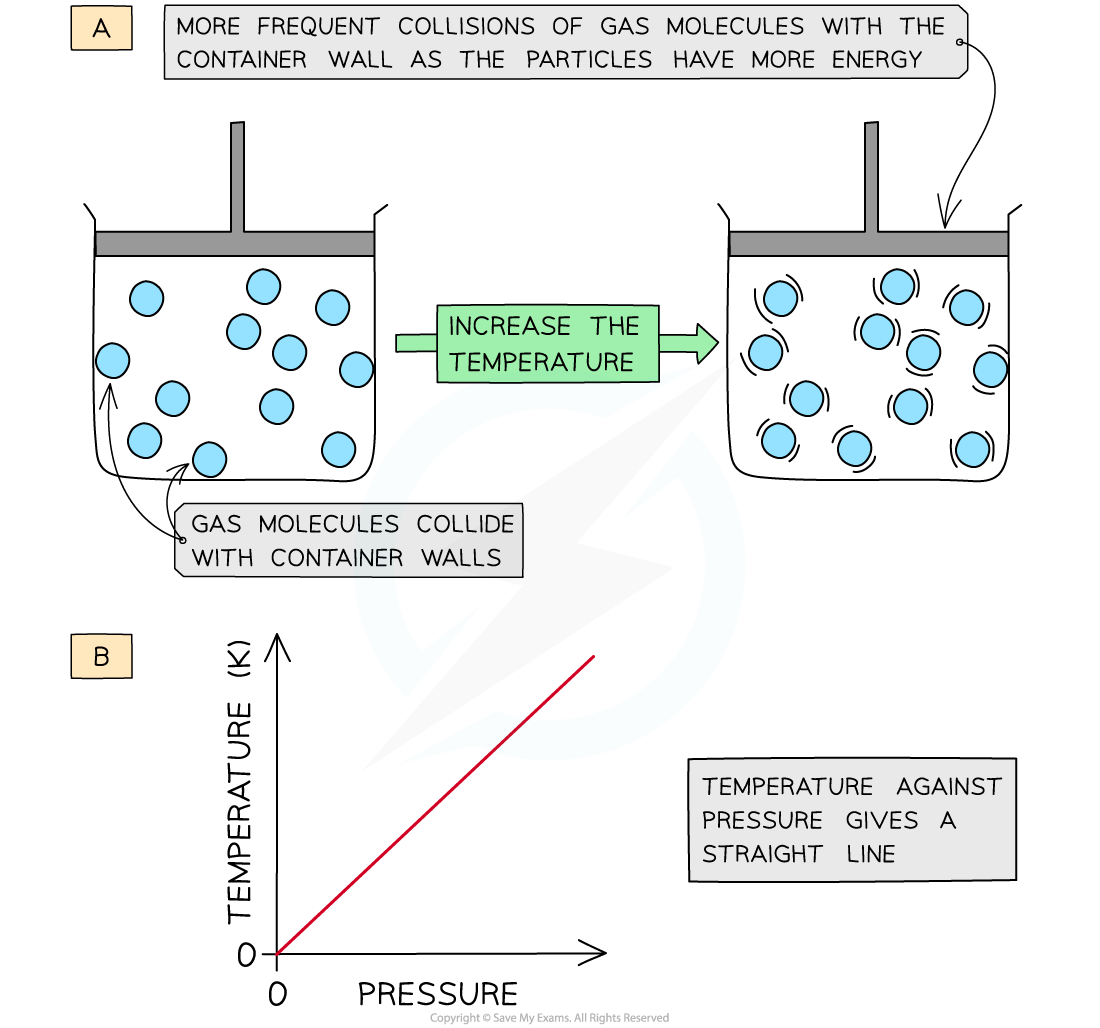
At constant volume, an increase in the temperature of the gas increases the pressure due to more collisions on the container walls
Boyle's law
Spec point —
2.1.5· Recall and use the equation pV = constant for a fixed mass of gas at constant temperature, including a graphical representation of this relationship
Extended Tier Only
- For a fixed mass of gas at constant temperature, Boyle’s law is given by:
- This means the pressure is inversely proportional to the volume of a gas
- This can also be written as:
- The relationship between the pressure and volume for a fixed mass of gas at constant temperature can also be written as:
-
Where:
- p1 = initial pressure (Pa)
- p2 = final pressure (Pa)
- V1* *= initial volume (m3)
- V2 = final volume (m3)
-
Notice that pressure and volume are measured in Pa and m3 respectively
- Exam questions often give the pressure and volume in units other than Pa and m³, such as kPa and cm³. You can work in those units, as long as the initial and final units match and you give your answer in the same units
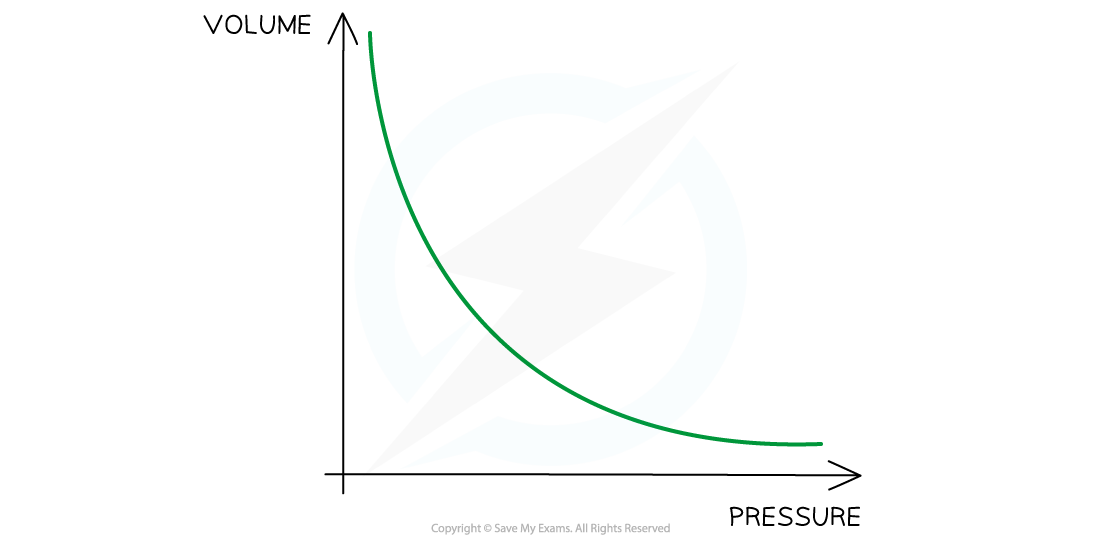
Boyle's law graph: Pressure is inversely proportional to volume
Worked Example A fixed mass of gas has a volume of 35 cm³ at a pressure of 120 kPa. The volume is slowly decreased by 20 cm³ at constant temperature. Calculate the change in pressure.
[3]
Answer:
Step 1: List the known quantities
- Initial pressure,
- Initial volume,
Step 2: Write down the equation for Boyle's law
Step 3: Calculate the final volume
[1 mark]
Step 4: Calculate the final pressure using Boyle's law
[1 mark]
Step 5: Calculate the change in pressure
[1 mark]
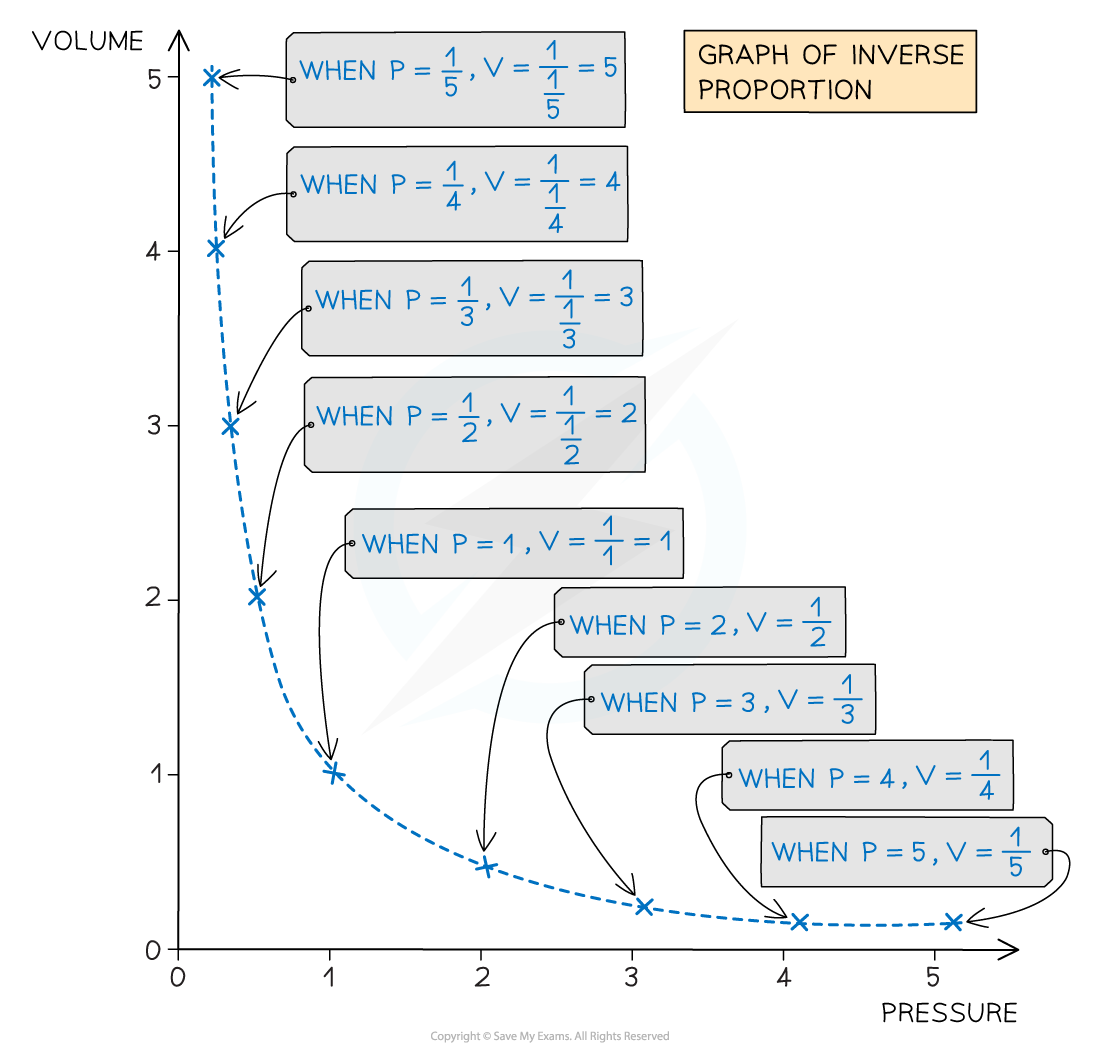
Exam Hint It is an easy mistake to make to think that an inversely proportional graph will be a straight line sloping downwards. After all, a directly proportional graph is a straight line (through the origin) which slopes upwards.
An inversely proportional graph is a curve that tends towards zero — it gets closer and closer to each axis but never touches it, as the graph below shows.
Was this revision note helpful?