Thermal Expansion (Cambridge International IGCSE Physics)
Spec point —
2.2.1· Describe, qualitatively, the thermal expansion of solids, liquids and gases at constant pressure
Thermal expansion
-
When a material is heated at constant pressure:
- Its temperature increases
- Its overall volume increases (it expands)
- Its density decreases
-
This expansion happens because:
- The particles gain kinetic energy and vibrate or move faster
- This increases the average distance between the particles, so the material expands
-
The expansion comes from an increase in particle separation — the particles themselves do not get any bigger
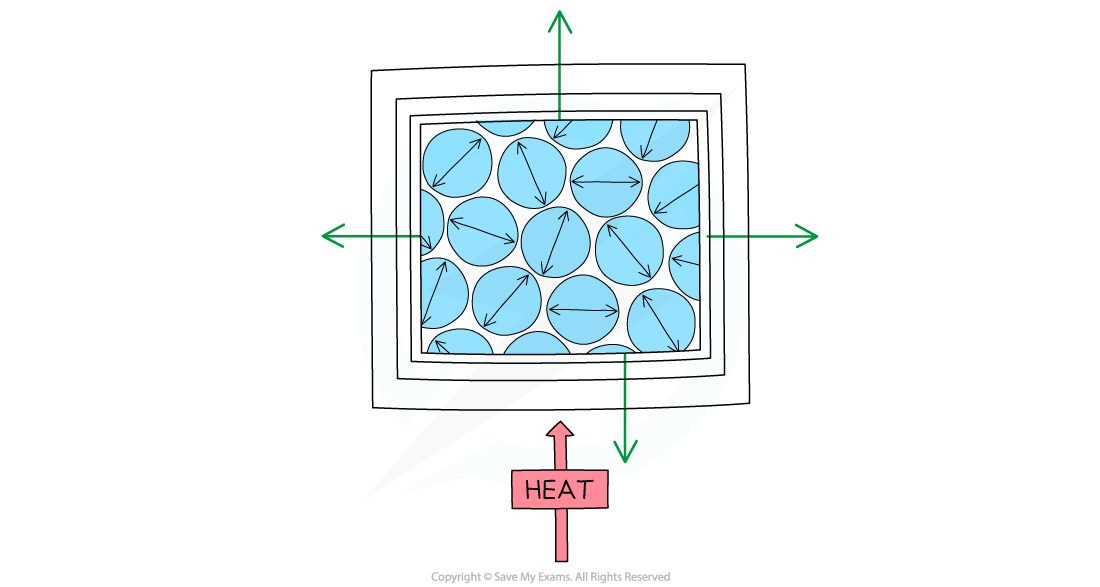
When a solid is heated, the molecules vibrate more, pushing each other apart
Exam Hint Remember that it is the material that expands, not the molecules. This trips up many students, losing marks.
As thermal energy is transferred to the material:
- The temperature increases
- Which increases the kinetic energy of the particles
- So the molecules and atoms move or vibrate more quickly
- And move further apart
- So the separation of the molecules increases and the substance gets bigger
Thermal expansion in terms of particles
Spec point —
2.2.1· Explain, in terms of the motion and arrangement of particles, the relative order of magnitudes of the expansion of solids, liquids and gases as their temperatures rise
Extended Tier Only
-
Thermal expansion occurs in solids, liquids and gases
-
When temperature is increased (at constant pressure):
- Solids will tend to expand the least
- Gases expand the most
- Liquids fall in between the two
-
This behaviour is influenced by the distances and strength of the forces between particles in each state
| State | Magnitude of Expansion | Explanation |
|---|---|---|
| Solid | Expands slightly | Strong forces hold the particles in fixed positions, so they can only vibrate a little further apart |
| Liquid | Expands more than solids | Weaker forces let the particles move further apart than in a solid, so the expansion is greater |
| Gas | Expands significantly | There are almost no forces between the particles, so they move much further apart and the expansion is far greater |
Uses & consequences of thermal expansion
Spec point —
2.2.1· Describe some of the everyday applications and consequences of thermal expansion
- The thermal expansion of materials can have some useful applications as well as some undesirable consequences
Applications of thermal expansion
-
Useful applications of thermal expansion include:
- Liquid-in-glass thermometers
- Temperature-activated switches
Liquid-in-glass thermometer
-
A liquid-in-glass thermometer relies on the expansion of liquids to measure temperature
-
It consists of a thin glass capillary tube containing a liquid that expands with temperature
- At one end of the tube is a glass bulb, containing a large volume of the liquid which expands into the narrow tube when heated
- A scale along the side of the tube allows the temperature to be measured based on the length of liquid within the tube
-
A thermometer is more sensitive if the capillary tube is narrower, because the same expansion of liquid moves further along a narrower tube
- Thinner glass around the bulb also makes the thermometer respond more quickly
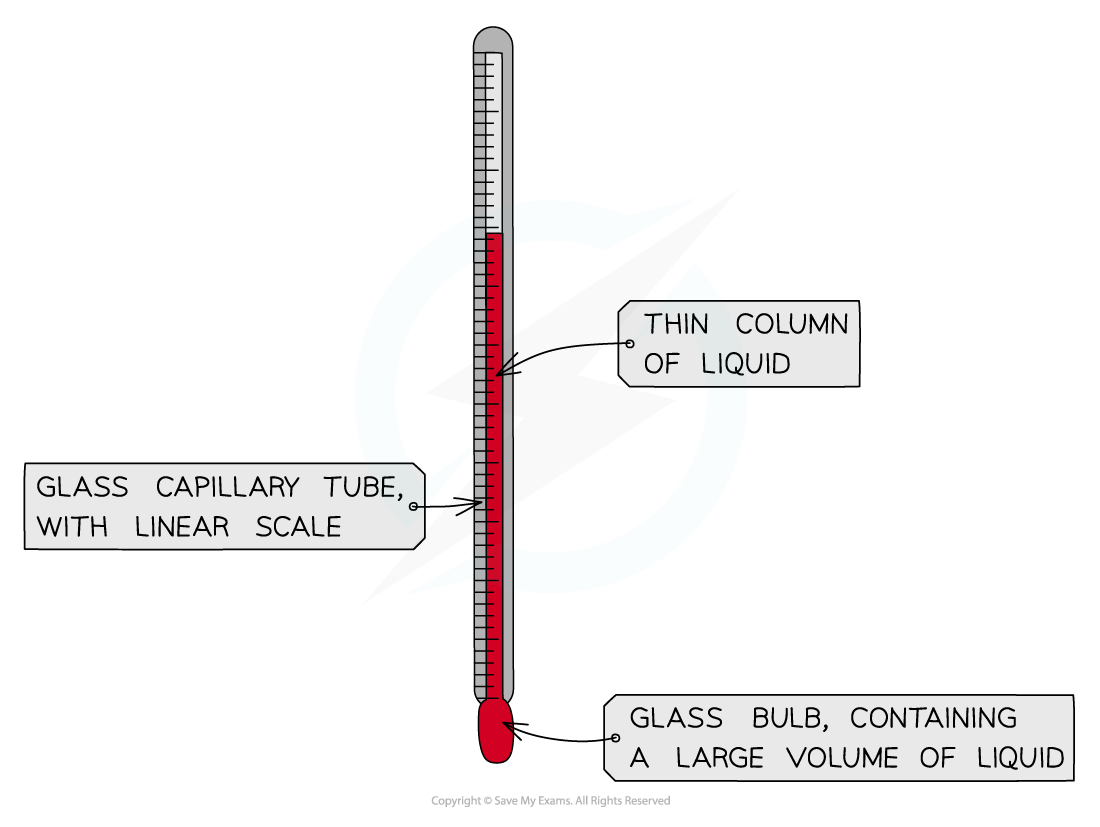
As the bulb is heated, the liquid expands and moves along the capillary tube
Temperature-activated switches
- Temperature-activated switches use a bimetallic strip, made from two different metals joined together
- The two metals expand by different amounts when heated, so the strip bends by a predictable amount at a given temperature
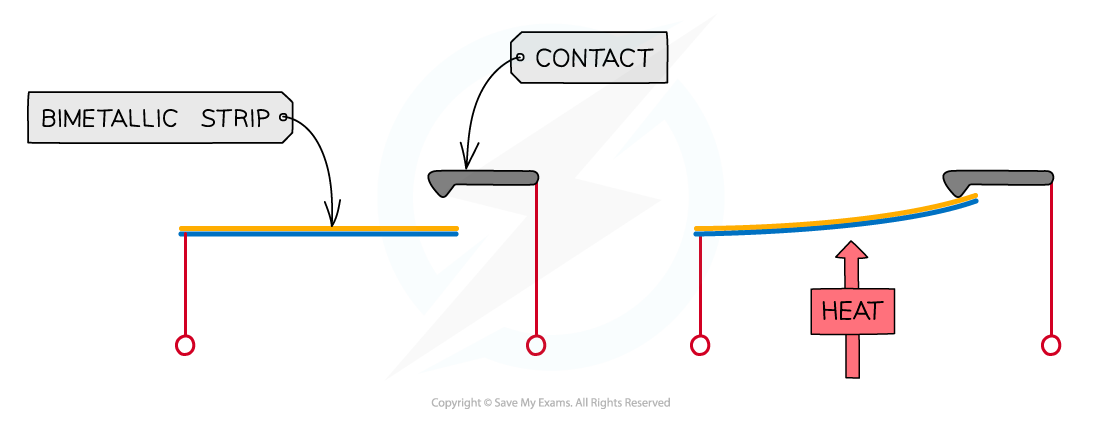
The bimetallic strip will bend upwards when heated, closing the circuit
Consequences of thermal expansion
-
The expansion of solid materials can cause them to buckle if they get too hot
-
This could include:
- Metal railway tracks
- Road surfaces
- Bridges
-
Objects that are prone to buckling in this way have gaps built into them to create space for the expansion to happen without causing damage
Was this revision note helpful?