Specific Heat Capacity (Cambridge International IGCSE Physics)
Internal energy
Spec point —
2.2.2· Know that a rise in the temperature of an object increases its internal energy
-
A rise in the temperature of an object increases its internal energy
- This can be thought of as due to an increase in the average speed of the particles
- Increasing speed increases kinetic energy
-
Internal energy is defined as:
The total energy stored inside a system by the particles that make up the system due to their motion and positions
-
Motion of the particles affects their kinetic energy
-
Positions of the particles relative to each other affects their potential energy
- Together, these two make up the internal energy of the system
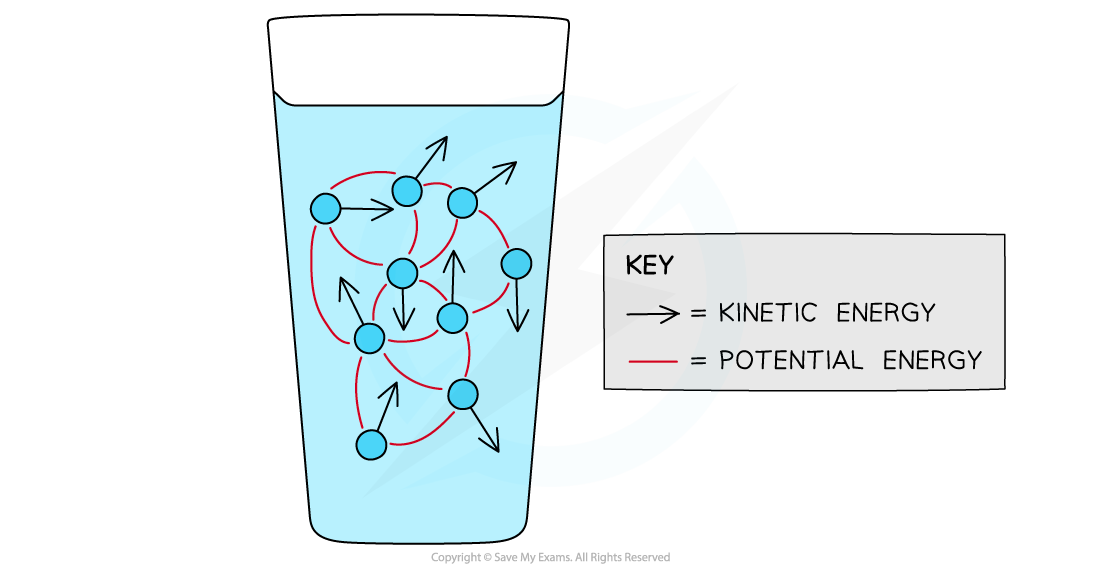
Substances have internal energy due to the motion of the particles and their positions relative to each other
Average kinetic energy
Spec point —
2.2.2· Describe an increase in temperature of an object in terms of an increase in the average kinetic energies of all of the particles in the object
Extended Tier Only
-
Heating a system changes a substance's internal energy by increasing the kinetic energy of its particles
- The temperature of the material, therefore, is related to the average kinetic energy of the molecules
-
An increase in temperature leads to an increase of the average kinetic energy of the particles in the substance
- This also means that internal energy increases, as internal energy is the sum of all kinetic and potential energies
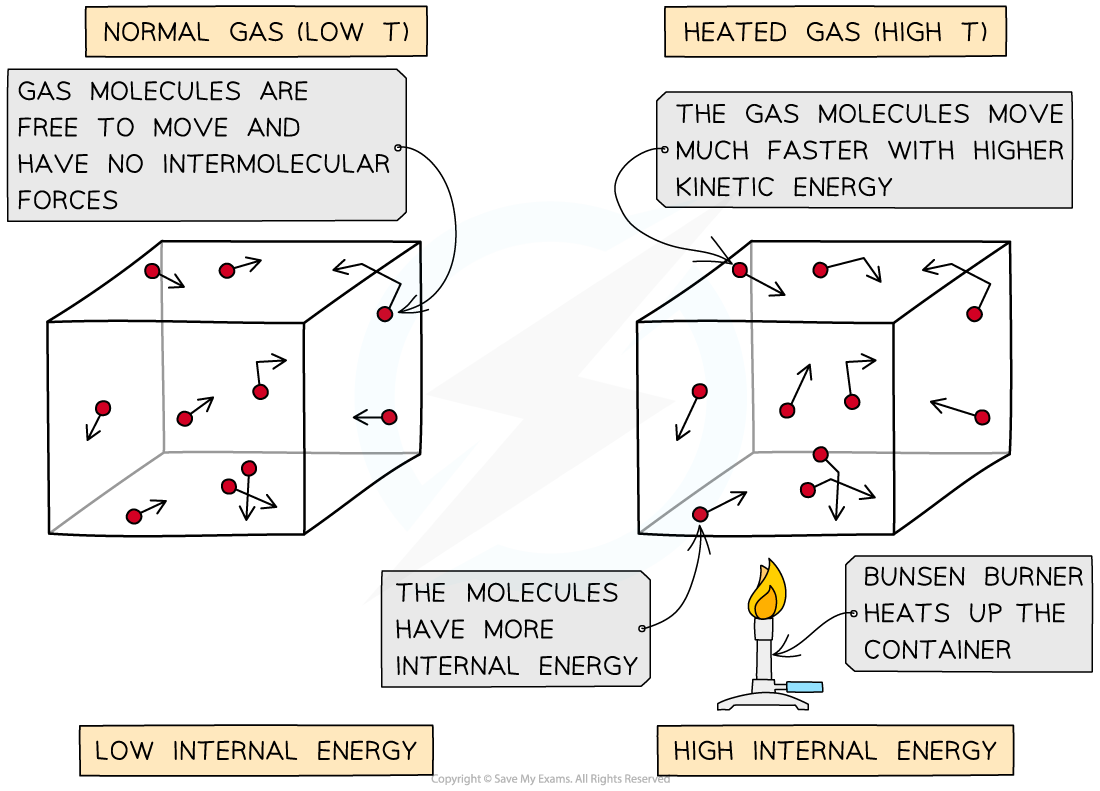
As the container heats up, the gas molecules move faster. Faster motion causes higher kinetic energy and therefore higher internal energy
Specific heat capacity
Spec point —
2.2.2· Define specific heat capacity as the energy required per unit mass per unit temperature increase;
- recall and use the equation c = ∆E/m∆θ
Specific heat capacity
Extended Tier Only
What is specific heat capacity?
-
When heated, a substance's temperature can increase
-
The amount by which the temperature increases depends on:
- The mass of the substance heated
- The type of material
- The amount of thermal energy transferred into the system
-
The specific heat capacity, c, of a substance is defined as:
The energy required per unit mass per unit temperature increase
-
In other words, this is the amount of energy required to raise the temperature of 1 kg of a substance by 1 °C
-
Different substances have different specific heat capacities
- If a substance has a low specific heat capacity, it heats up and cools down quickly (i.e. it takes less energy to change its temperature)
- If a substance has a high specific heat capacity, it heats up and cools down slowly (i.e. it takes more energy to change its temperature)
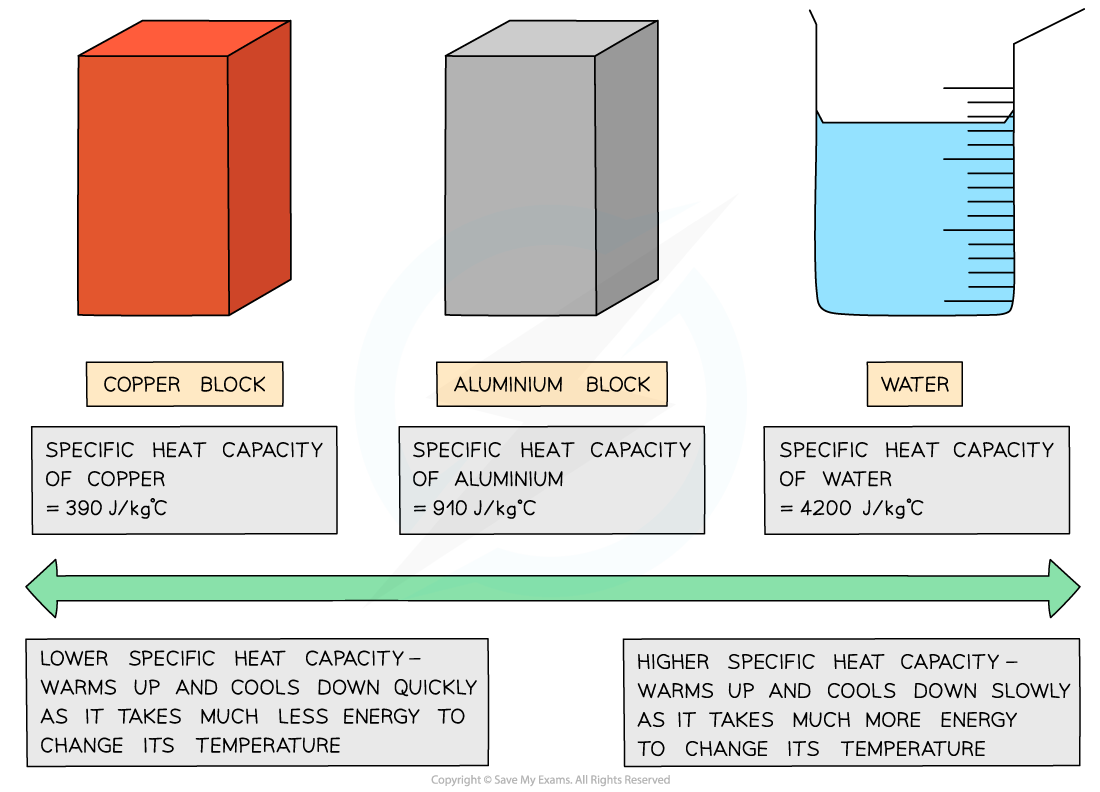
Low vs high specific heat capacity
Calculating specific heat capacity
- The amount of energy needed to raise the temperature of a given mass by a given amount can be calculated using the equation:
-
Where:
- ΔE = change in thermal energy, in joules (J)
- m =* *mass, in kilograms (kg)
- c =* *specific heat capacity, in joules per kilogram per degree Celsius (J/kg °C)
- Δθ =* *change in temperature, in degrees Celsius (°C)
Worked Example What unit is used to measure energy when calculating specific heat capacity?
A. kilograms
B. joules
C. joules per kilogram per degree Celsius
D. kelvin
[1]
Answer: B
The correct answer is B [1 mark]
The question asks what unit is used to measure energy when calculating specific heat capacity
The units of energy are joules
- A common mistake is for students to see 'specific heat capacity' and state the units of that, not energy
Worked Example Water of mass 0.48 kg is increased in temperature by 0.7 °C. The specific heat capacity of water is 4200 J/kg °C.
Calculate the amount of thermal energy transferred to the water.
[2]
Answer:
Step 1: Write down the known quantities
- Mass, m = 0.48 kg
- Change in temperature, Δθ =* *0.7 °C
- Specific heat capacity, c = 4200 J/kg °C
Step 2: Write down the relevant equation
[1 mark]
Step 3: Calculate the thermal energy transferred by substituting in the values
Step 4: Round the answer to 2 significant figures and include the units
[1 mark]
Exam Hint While you must remember the equation for specific heat capacity, you will always be given the specific heat capacity of a substance so you do not need to memorise any values.
However, it's useful to have the general idea that, the larger the number, the less the substance will increase in temperature for a given amount of thermal energy.
You can see this for yourself in the kitchen. Metal pans, which have a relatively low specific heat capacity get very hot, very quickly when put on the hob. Add water to the pan, which has a relatively high specific heat capacity and the water will take much longer to heat up.
Notice the units of specific heat capacity:
joules per kilogram per degree Celsius : J/kg °C
'per' means 'divided by'. You say 'per' in front of every value that is being divided by, hence 'per kilogram per degree Celsius'
Was this revision note helpful?