Measuring Density (Cambridge International IGCSE Physics)
Spec point —
1.3.3· Describe how to determine the density of a liquid, of a regularly shaped solid and of an irregularly shaped solid which sinks in a liquid (volume by displacement), including appropriate calculations
Measuring density
- This is a list of equipment used in these experiments:
| Apparatus | Purpose |
|---|---|
| Regular and irregularly shaped objects | Objects used to measure the density of |
| A suitable liquid (e.g. sugar or salt solution) | Liquid to use to measure the density |
| A 30 cm ruler | To measure objects up to 30 cm in length |
| Vernier callipers | To measure objects to around 15 cm in length |
| Micrometer | To measure objects to around 3 cm in length |
| Digital balance | To measure the mass of objects |
| Displacement "Eureka" can | To measure the displacement of water of irregularly shaped objects |
| Measuring cylinders | To measure the volume of liquid |
-
Resolution of measuring equipment:
- 30 cm ruler = 1 mm
- Vernier callipers = 0.1 mm
- Micrometer = 0.01 mm
- Digital balance = 0.01 g
Experiment 1: measuring the density of regularly shaped objects
- The aim of this experiment is to determine the densities of regular objects by using measurements of their dimensions
Variables:
- Independent variable = Type of shape / volume
- Dependent variable = Density of the object
Method
Equipment needed to measure the density of regularly shaped objects
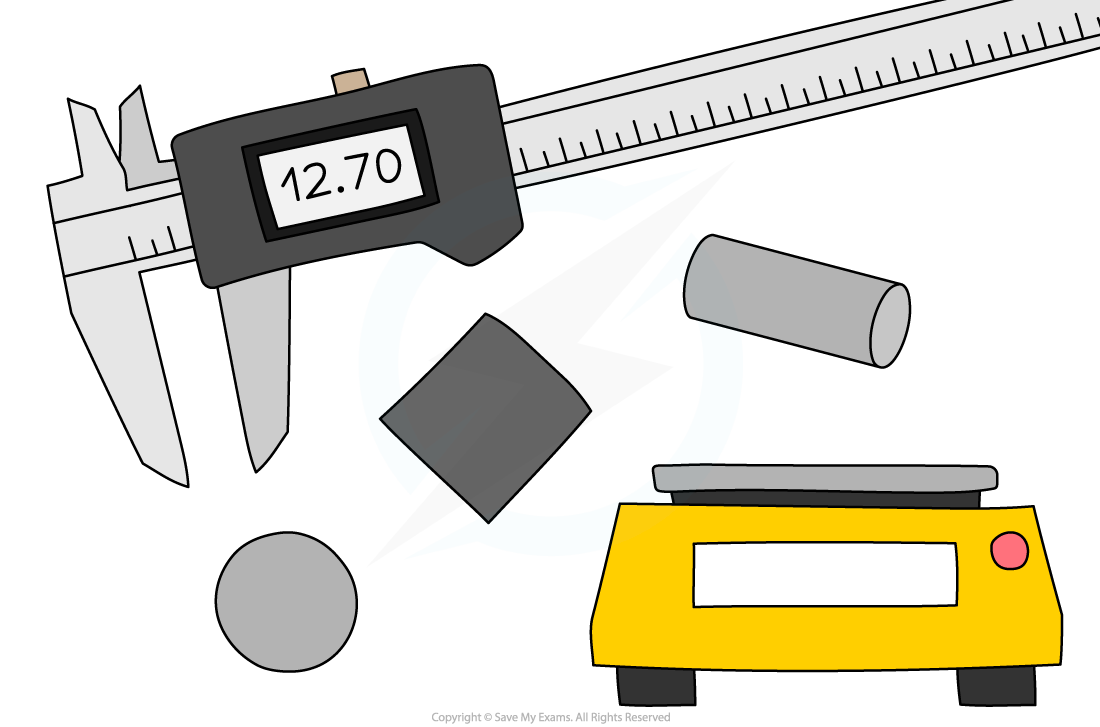
Apparatus for measuring the dimensions and mass of regularly shaped objects
- Place the object on a digital balance and note down its mass
- Use either the ruler, Vernier callipers or micrometer to measure the object’s dimensions (width, height, length, radius) – the apparatus will depend on the size of the object
- Repeat these measurements and take an average of these readings before calculating the density
Results
An example results table to measure the density of regularly shaped objects
| Cuboid | Sphere | Cylinder | ||||||||||
|---|---|---|---|---|---|---|---|---|---|---|---|---|
| Mass readings / g | ||||||||||||
| Average mass / g | ||||||||||||
| Average mass / kg | ||||||||||||
| Dimension reading / cm | Height | Radius | Radius | |||||||||
| Width | ||||||||||||
| Length | Length | |||||||||||
| Average dimensions / m | Height = Width = Length = | Radius = | Radius = Length = | |||||||||
| Volume / m3 |
A suitable results table must contain space for multiple readings and any calculations that need to be performed
Analysis of results
-
Calculate the volume of the object depending on whether it is a cube, sphere, cylinder (or other regular shape)
-
Then use the formula for density to calculate the density of each object
- The formulae for volume and density are explained in the revision note Density
Experiment 2: measuring the density of irregularly shaped objects
- This experiment aims to determine the densities of irregular objects using a displacement technique
Variables:
- Independent variable = Different irregular shapes / mass
- Dependent variable = Volume of displaced water
Method
Equipment needed to measure the density of irregularly shaped objects
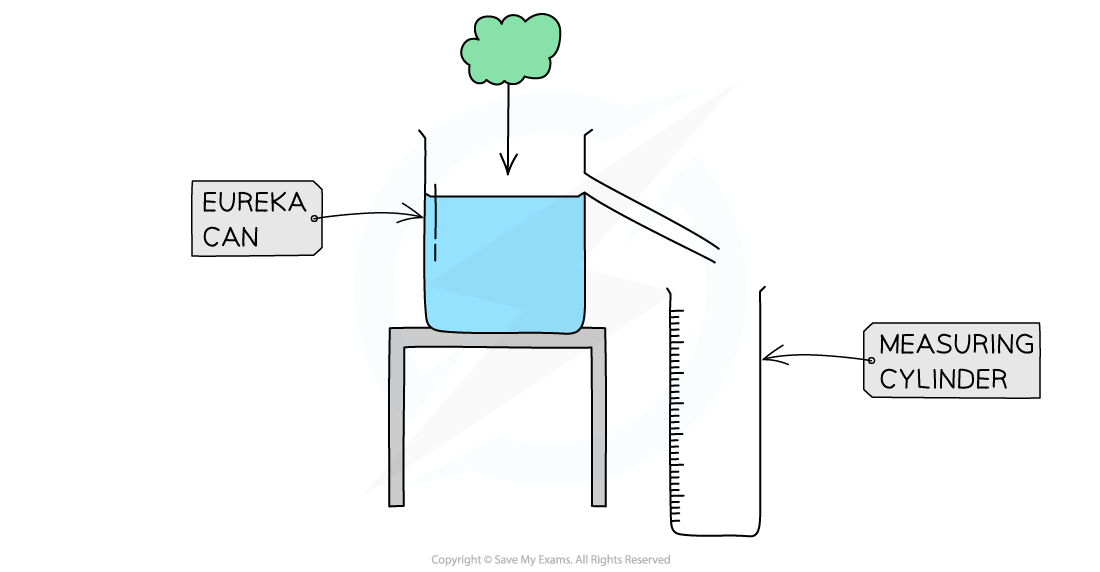
Apparatus for measuring the density of irregular objects
- Place the object on a digital balance and note down its mass
- Fill the eureka can with water up to a point just below the spout
- Place an empty measuring cylinder below its spout
- Carefully lower the object into the eureka can and let it sink in the liquid
- Measure the volume of the displaced water in the measuring cylinder
- Repeat these measurements and take an average before calculating the density
- Alternatively, the object can be placed in a measuring cylinder containing a known volume of liquid, and the change in volume then measured
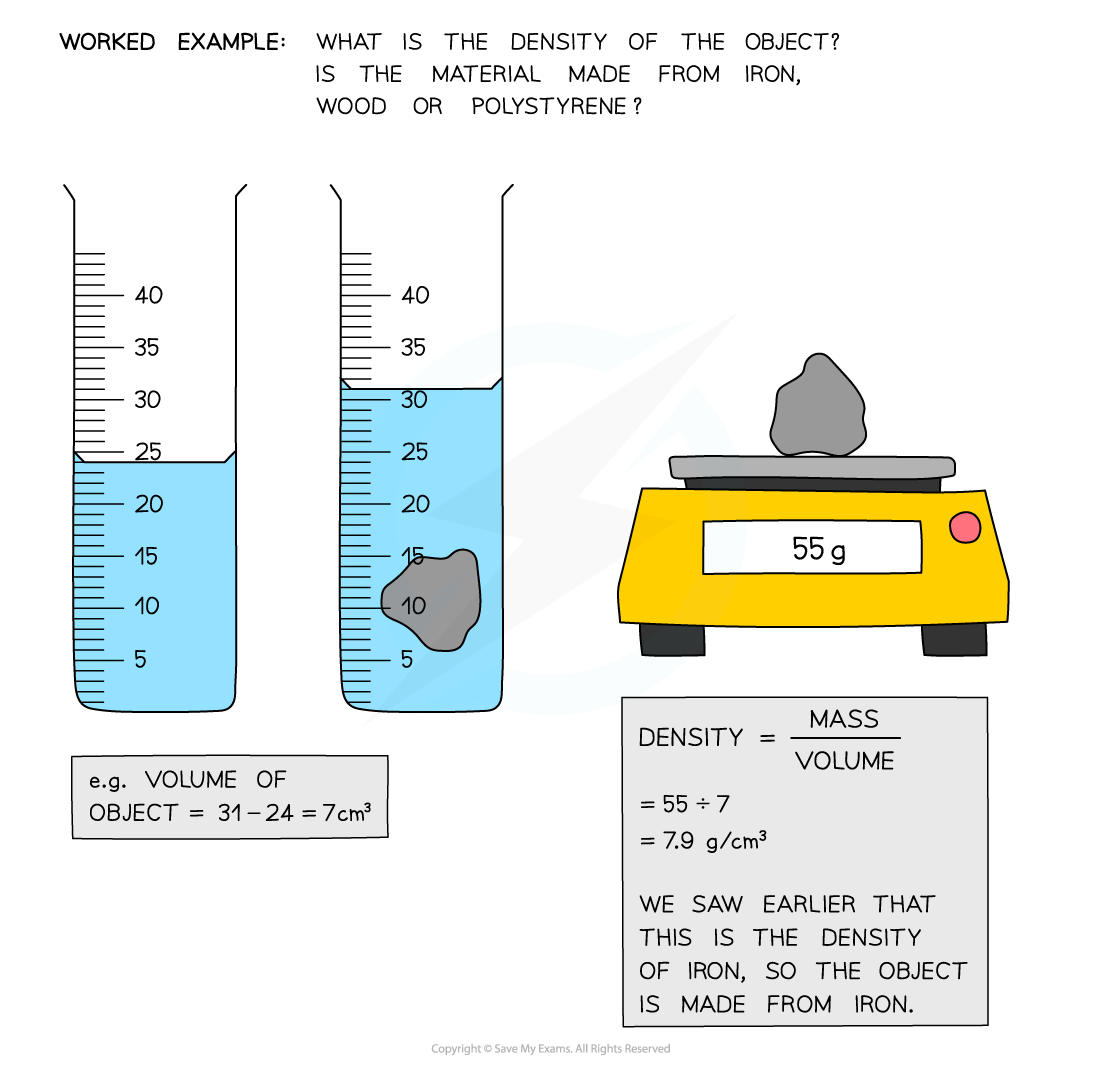
When an irregular solid is placed in a measuring cylinder, it will sink in the liquid and the level of the liquid will rise by an amount equal to the volume of the solid
- Once the mass and volume of the shape is known, its density can be calculated
Results
An example results table to measure the density of irregularly shaped objects
| Object | Mass of object / g | Average mass / kg | Volume of water displaced / m3 | Average volume of water displaced / m3 | ||||
|---|---|---|---|---|---|---|---|---|
| 1 | 2 | 3 | 1 | 2 | 3 | |||
| 1 | ||||||||
| 2 | ||||||||
| 3 |
A suitable results table must contain space for multiple readings and any calculations that need to be performed
Analysis of results
- The volume of the water displaced is equal to the volume of the object
- Once the mass and volume of the shape are known, the density can be calculated using:
Experiment 3: measuring the density of liquids
- This experiment aims to determine the density of a liquid by finding a difference in its mass
Variables:
- Independent variable = Volume of water added
- Dependent variable = Mass of cylinder
Method
Equipment needed to measure the density of liquid
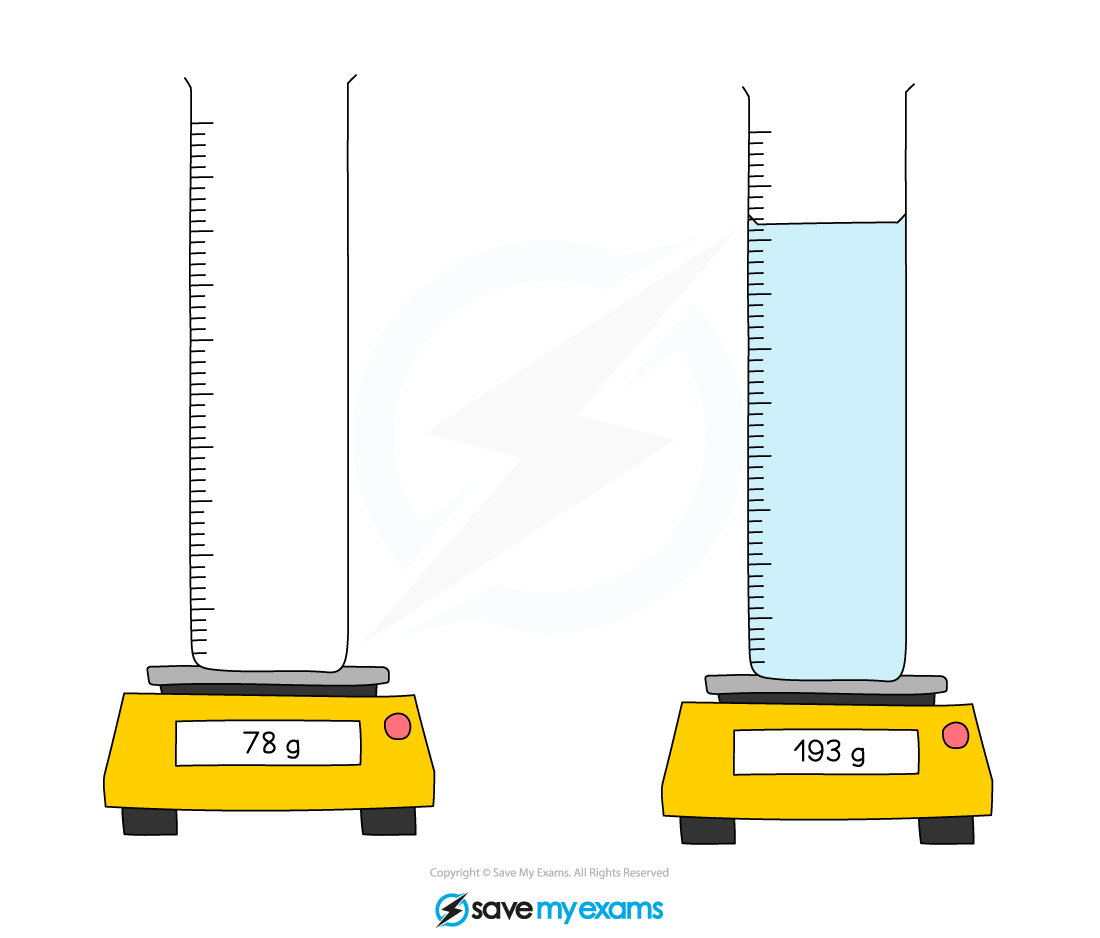
Apparatus for determining the density of a liquid
- Place an empty measuring cylinder on a digital balance and note down the mass
- Fill the cylinder with the liquid and note down the volume
- Note down the new reading on the digital balance
- Repeat these measurements and take an average before calculating the density
Results
An example results table to measure the density of a liquid
| Mass of cylinder before / g | Average mass / kg | Volume of water added / m3 | Mass of cylinder with water / g | Average mass of cylinder with water / kg | ||||
|---|---|---|---|---|---|---|---|---|
| 1 | 2 | 3 | 1 | 2 | 3 | |||
A suitable results table must contain space for multiple readings and any calculations that need to be performed
Analysis of results
- Find the mass of the liquid by subtracting the original reading from the final reading
Mass of liquid = Mass of cylinder with water – mass of cylinder
-
Once the mass and volume of the liquid are known, the density can be calculated using the equation for calculating density
- This is explained in the revision note Density
Evaluating the experiments
-
Systematic errors:
-
Ensure the digital balance is set to zero before taking measurements of mass
- This includes when measuring the density of the liquid – remove the measuring cylinder and zero the balance before adding the liquid
-
-
Random errors:
-
A main cause of error in this experiment is in the measurements of length
- Ensure to take repeat readings and calculate an average to keep this error to a minimum
-
Place the irregular object in the displacement can carefully, as dropping it from a height might cause water to splash, which will lead to an incorrect volume reading
-
Safety considerations
-
There is a lot of glassware in this experiment, ensure this is handled carefully
-
Water should not be poured into the measuring cylinder when it is on the digital balance
- This could lead to electric shock
-
Make sure to stand up during the whole experiment, to react quickly to any spills
Exam Hint When writing about experiments, a good sequence is as follows:
- If you need to use an equation to calculate something, start off by giving it as this will give you some hints about what you need to mention later
- List the apparatus that you need
- State what measurements you need to make (your equation will give you some hints) and how you will measure them
- Finally, state that you will repeat each measurement several times and take averages
Was this revision note helpful?
Build on this topic