Particle Model of Gases (Cambridge International IGCSE Physics)
Motion of particles in a gas
Spec point —
2.1.3· Describe the pressure and the changes in pressure of a gas in terms of the motion of its particles and their collisions with a surface
-
In the particle model, molecules in a gas are in constant random motion at high speeds
-
Random motion means that the molecules are travelling in no specific path and undergo sudden changes in their motion when they collide:
- With the walls of its container
- With other molecules
-
Pressure in a gas is caused by the collisions of particles with the walls of the container
-
When the particles travel faster(e.g. at a higher temperature), they collide with walls more frequently
- They also hit the walls with a greater force, because they are moving faster
- This means the gas exerts a greater pressure
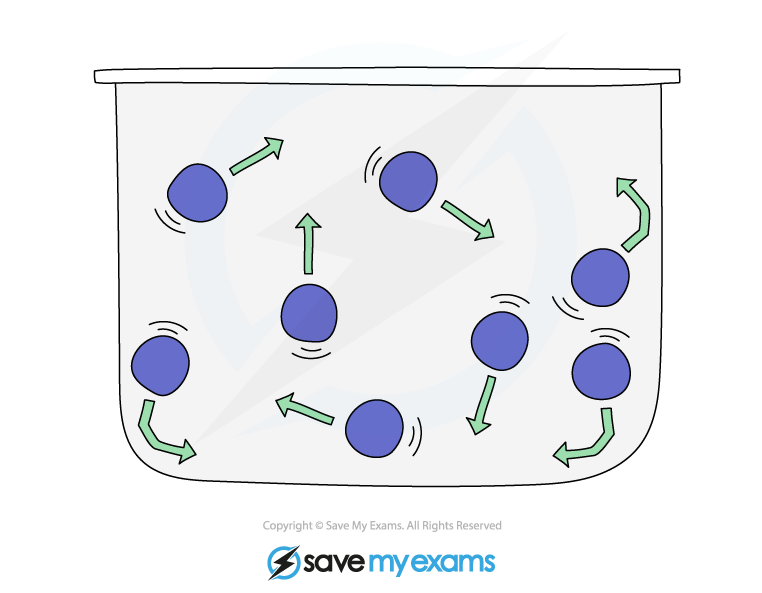
Random motion of gas molecules in a container. Collisions with container walls create pressure in the particle model
Exam Hint Always say that the particles collide with the walls of the container. Answers that only mention 'particles colliding' will not gain marks.
Pressure & force of particles in a gas
Spec point —
2.1.3· Describe the pressure and the changes in pressure of a gas in terms of the forces exerted by particles colliding with surfaces, creating a force per unit area
Extended Tier Only
-
When a molecule bounces off a wall, its momentum changes direction
-
This change of momentum over time produces a force on the wall
-
The pressure is defined as the force per unit area
-
Where:
- = pressure, measured in pascals (Pa)
- = force, measured in newtons (N)
- = area, measured in metres squared (m2)
-
This equation and the particle model can be used to explain how particles exert pressure
-
As the gas particles move about randomly they collide with the walls of their containers
-
These collisions produce force at right angles to the wall of the gas container (or any surface)
- Pressure is force per unit area, so the force of these collisions exerts a pressure
-
When the particles move faster, they have more frequent collisions with the container walls, and these exert a greater force
- If the force exerted per unit area is greater and more frequent, the pressure exerted is also greater
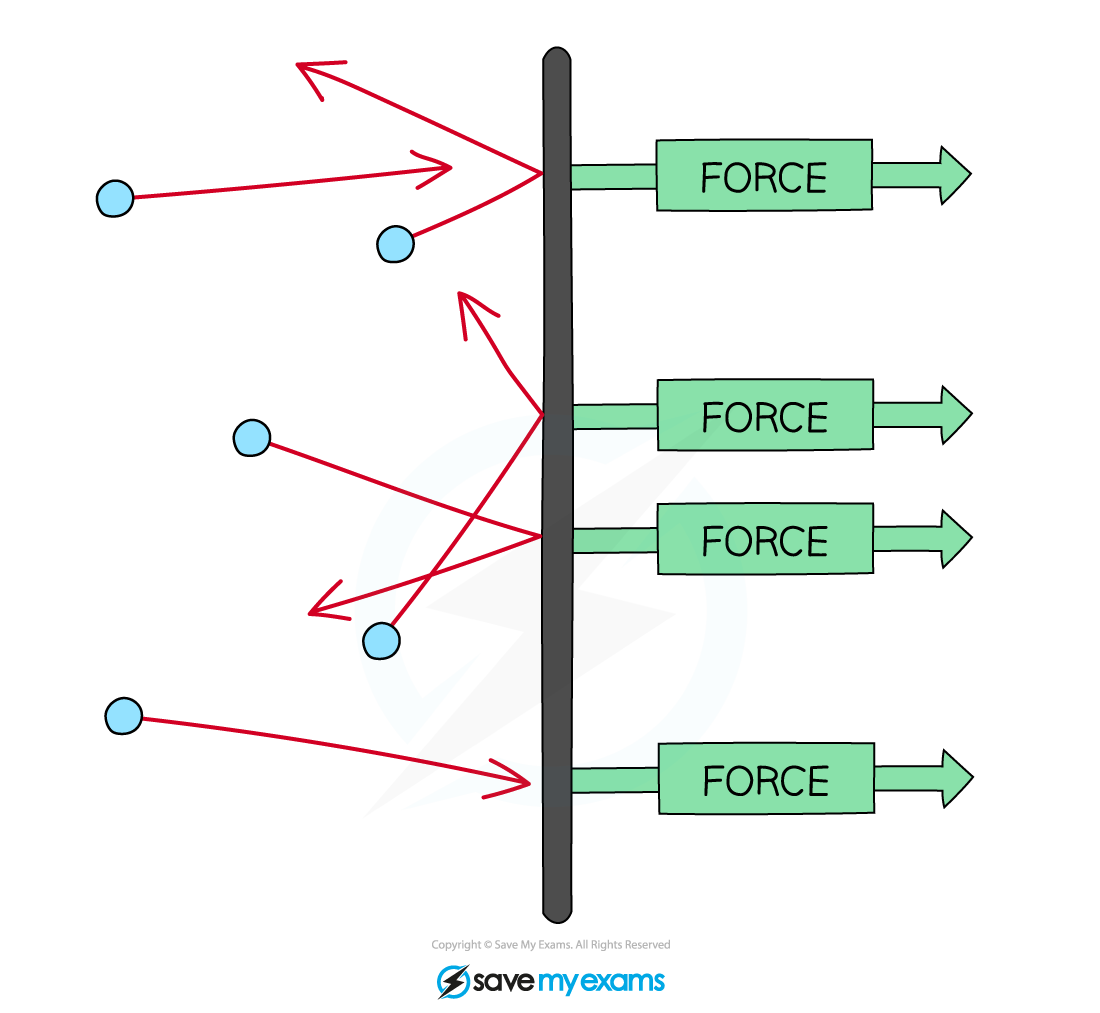
Gas molecules bouncing off the walls of a container exert a force perpendicular to the surface
Exam Hint When a gas is compressed at constant temperature, only the frequency of collisions changes. The molecules move at the same average speed, so their average kinetic energy stays the same — only the force per unit area increases.
Was this revision note helpful?