Tests for Cations (Edexcel IGCSE Chemistry)
Guided lessons are live for this note
Work through it step by step — key points, depth layers, a worked example and self-checks.
Spec point — describe tests for these cations: • NH4 + using sodium hydroxide solution and identifying the gas evolved • Cu2+, Fe2+ and Fe3+ using sodium hydroxide solution.
Tests for cations
Testing for metal cations
- Metal cations in aqueous solution can be identified by the colour of the precipitate formed when sodium hydroxide (NaOH) is added
- A few drops of NaOH is added at first and any colour changes or precipitates formed are noted
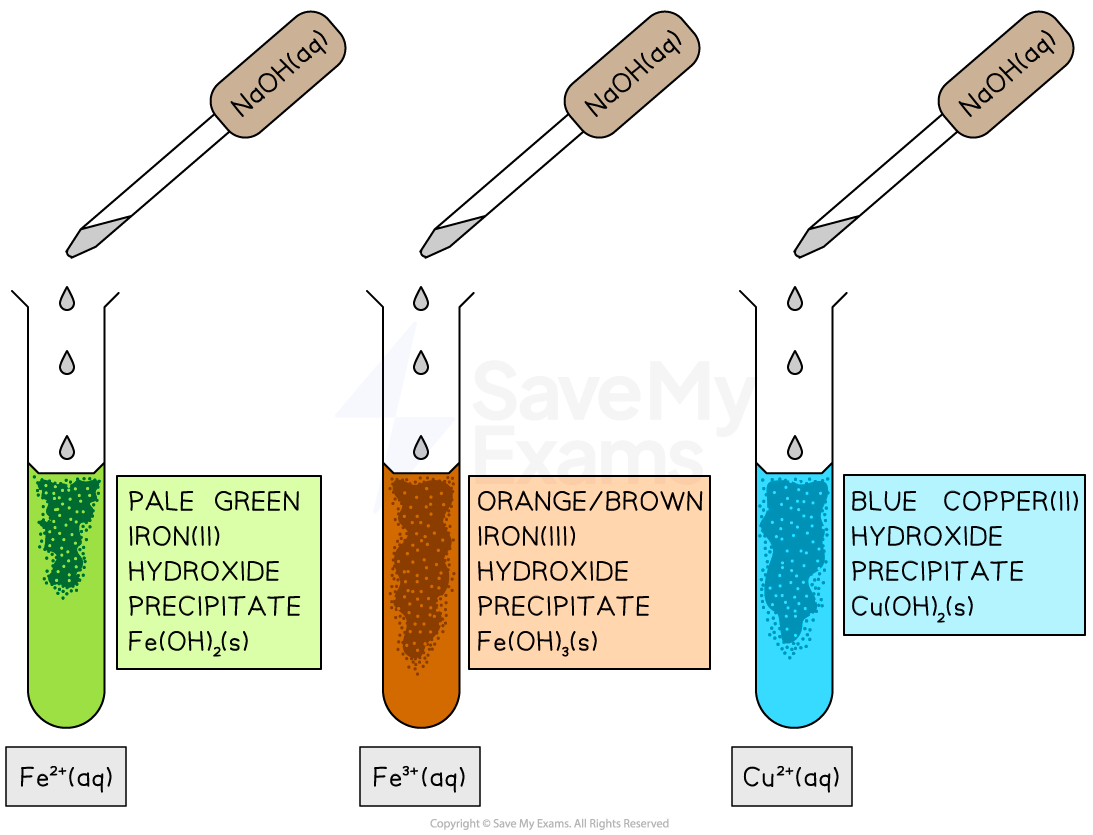
The addition of sodium hydroxide to the metal ions forms precipitates of different colours
-
A metal hydroxide precipitate typically forms if the hydroxide is insoluble in water
-
If no precipitate forms, the hydroxide may be soluble or there may not be enough of the metal ion present
-
A summary of the reactions is shown in the table below
Table showing the colour of the precipitates formed
| Metal ion | Reaction | Colour |
|---|---|---|
| Fe2+ | Fe2+ (aq) + 2OH– (aq) → Fe(OH)2 (s) | Pale green precipitate |
| Fe3+ | Fe3+ (aq) + 3OH– (aq) → Fe(OH)3 (s) | Orange / brown precipitate |
| Cu2+ | Cu2+ (aq) + 2OH– (aq) → Cu(OH)2 (s) | Blue precipitate |
Exam Hint Examiners are often quite specific about the copper(II) ions, Cu2+ (aq). You need to specifically state light blue for the precipitate colour to be sure of the mark
Test for ammonium ion, NH4+
- Add NaOH and warm the mixture
- Observation with NaOH : Ammonia gas is released
- Ionic equation:
NH4+ (aq) + OH- (aq) → NH3 (g) + H2O (l)
- Test for ammonia gas: Ammonia turns damp red litmus paper blue
Exam Hint Sometimes the cation may be present in very small amounts, so the precipitate might appear only as a slight cloudiness or faint colour change - this can still indicate a positive test result.
Was this revision note helpful?
Build on this topic