Tests for Cations
2 guided lessons · 18 checks · 2. Inorganic Chemistry → Chemical Tests
Guided lessons for this note
Which concept don't you understand yet?
We'll explain it simply and check your understanding. Pick any lesson — any order works.
0 of 18 checks correct so far
Lesson 1 of 2
Testing for metal cations
Metal cations in solution are identified by the colours of the solids that drop out when a few drops of sodium hydroxide are added. Iron(II) gives a pale green solid, iron(III) an orange-brown solid and copper(II) a light blue solid. If nothing appears, the hydroxide may simply be soluble, or the solution may hold too few ions to show.
What you know already
From Flame Tests you already know one way to identify a metal cation: the colour it gives a flame. This note adds the solution route, where sodium hydroxide drops out coloured hydroxide solids, and finishes with the ammonium ion's own gas test.
Key points of understanding
- A few drops of sodium hydroxide are added first, and any precipitate is noted.
- Iron(II) ions give a pale green precipitate of iron(II) hydroxide.
- Iron(III) ions give an orange-brown precipitate of iron(III) hydroxide.
- Copper(II) ions give a light blue precipitate of copper(II) hydroxide.
- No precipitate can mean the hydroxide is soluble, or too few ions are present.
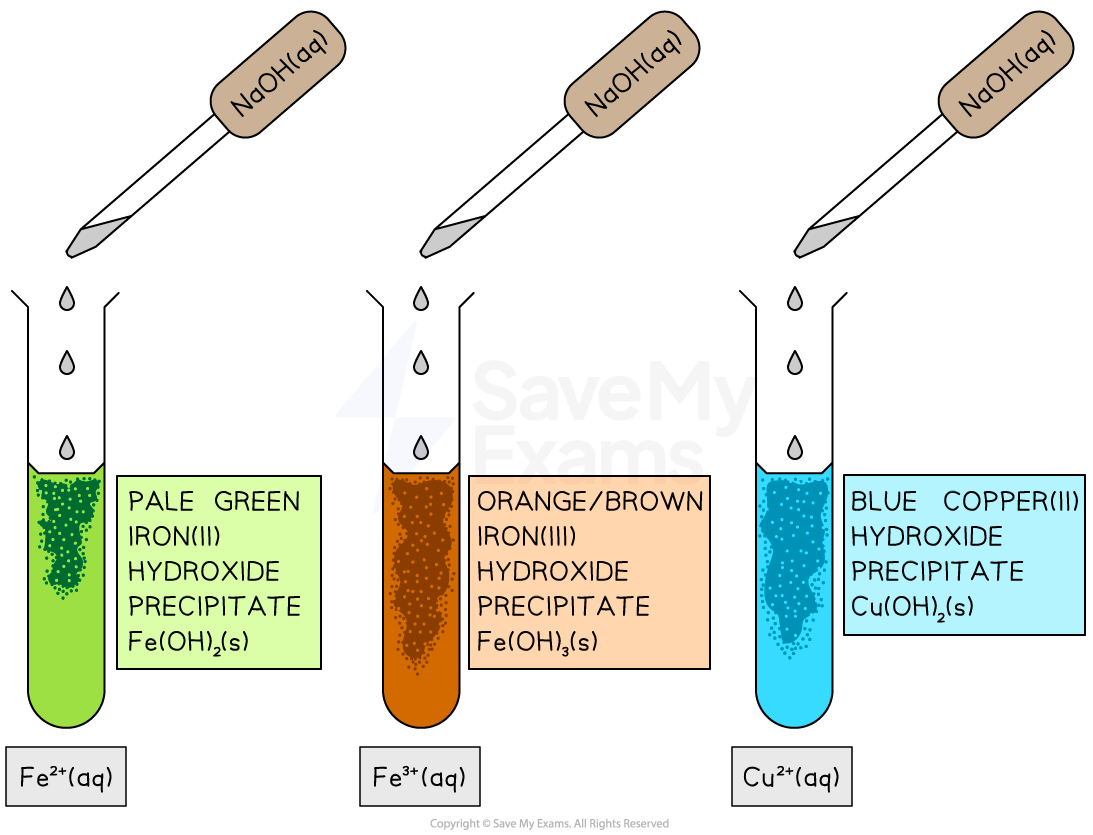
The addition of sodium hydroxide to the metal ions forms precipitates of different colours
Choose a confidence level to continue.
Prefer to read it all at once? Show the full lesson as a page
1.Testing for metal cations
Metal cations in solution are identified by the colours of the solids that drop out when a few drops of sodium hydroxide are added. Iron(II) gives a pale green solid, iron(III) an orange-brown solid and copper(II) a light blue solid. If nothing appears, the hydroxide may simply be soluble, or the solution may hold too few ions to show.
The addition of sodium hydroxide to the metal ions forms precipitates of different colours
Key points
- A few drops of sodium hydroxide are added first, and any precipitate is noted.
- Iron(II) ions give a pale green precipitate of iron(II) hydroxide.
- Iron(III) ions give an orange-brown precipitate of iron(III) hydroxide.
Guided content from the SME authoring corpus — note rn_v5JjfpT6grhtq3QW, pinned at a8889009338b · promoted SyllabAI/syllabai-resources e967e75f1339