Electronic Configuration & Reactivity (Edexcel IGCSE Chemistry)
Guided lessons are live for this note
Work through it step by step — key points, depth layers, a worked example and self-checks.
Similar Chemical Properties
Spec point — understand why elements in the same group of the Periodic Table have similar chemical properties
Chemical properties
Chemical properties of elements in the same group
-
Elements in the same group in the Periodic Table will have similar chemical properties
-
This is because they have the same number of outer electrons so will react and bond similarly
-
The group number of an element which is given on the Periodic Table indicates the number of electrons in the outer shell
- This rule holds true for all elements except helium; although is in Group 0, it has only one shell, the first and innermost shell, which holds only 2 electrons
-
We can use the group number to predict how elements will react as the number of outer shell electrons in an element influences how the element reacts.
-
Therefore, elements in the same group react similarly
- By observing the reaction of one element from a group, you can predict how the other elements in that group will react
- By reacting two or more elements from the same group and observing what happens in those reactions you can make predictions about reactivity and establish trends in reactivity in that group
-
For example, lithium, sodium and potassium are in Group 1 and can all react with elements in Group 7 to form an ionic compound
-
The Group 1 metals become more reactive as you move down the group while the Group 7 elements show a decrease in reactivity moving down the group
Why Noble Gases are Unreactive
Spec point — understand why the noble gases (Group 0) do not readily react
Why are noble gases unreactive?
-
The elements in Group 0 of the Periodic Table are called the noble gases
-
Noble gases are:
- Non-metals
- Monatomic (exist as single atoms)
- Colourless and non-flammable gases at room temperature
-
Most elements participate in reactions to complete their outer shells by losing, gaining, or sharing electrons
-
Group 0 elements do not do this because they have full outer shells of electrons
- They are therefore unreactive (inert) and do not form molecules easily
-
Most noble gases have 8 electrons in their outer shell, except helium which has 2
-
Electronic configurations of the noble gases:
- He = 2
- Ne = 2, 8
- Ar = 2, 8, 8
- Kr = 2, 8, 18, 8
- Xe = 2, 8, 18, 18, 8
The noble gases
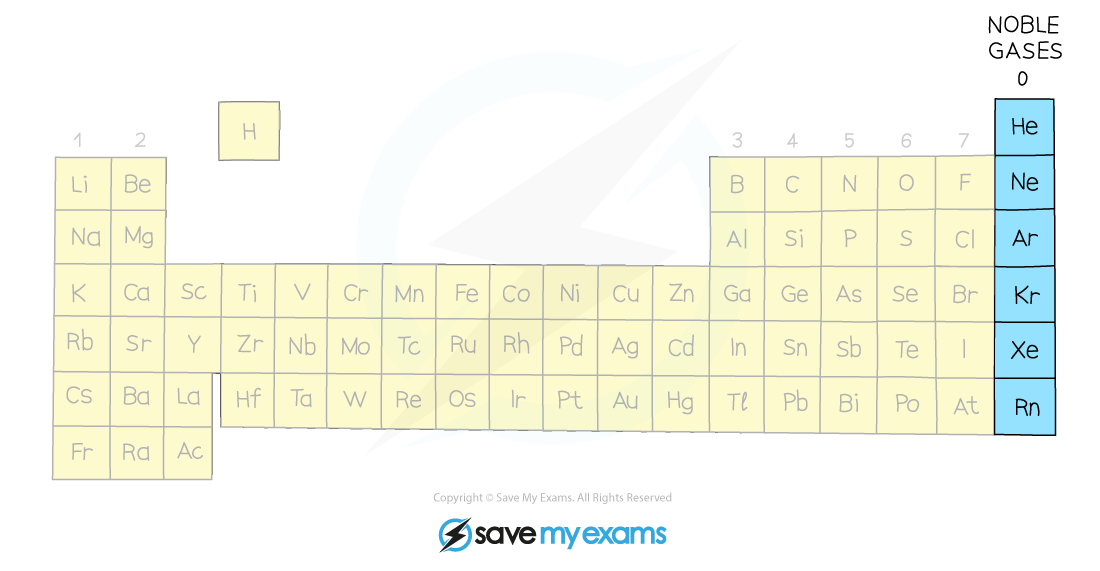
Noble gases are located in the last group on the right hand side of the Periodic Table
Exam Hint You do not need to know specific uses of noble gases but be aware that they are useful in many applications due to their inertness.
Was this revision note helpful?
Build on this topic