Ionic Bonds: Dot & Cross Diagrams (Edexcel IGCSE Chemistry)
Guided lessons are live for this note
Work through it step by step — key points, depth layers, a worked example and self-checks.
Spec point — draw dot-and-cross diagrams to show the formation of ionic compounds by electron transfer, limited to combinations of elements from Groups 1, 2, 3 and 5, 6, 7 only outer electrons need be shown
Dot and cross diagrams for ionic compounds
-
Ionic bonds can be represented diagrammatically using dot-and-cross diagrams
- The electrons from each atom should be represented by using solid dots and crosses
- If there are more than two atoms, then hollow circles or other symbols / colours may be used to make it clear
- The large square brackets should encompass each atom and the charge should be in superscript and on the right-hand side, outside the brackets
Sodium chloride dot and cross diagram
- Sodium is a Group 1 metal so will lose one outer electron to another atom to gain a full outer shell of electrons
- A positive sodium ion with the charge 1+ is formed
- Chlorine is a Group 7 non-metal so will need to gain an electron to have a full outer shell of electrons
- One electron will be transferred from the outer shell of the sodium atom to the outer shell of the chlorine atom
- A chlorine atom will gain an electron to form a negatively charged chloride ion with a charge of 1-
- The formula of sodium chloride is NaCl
Dot and cross diagram for sodium chloride
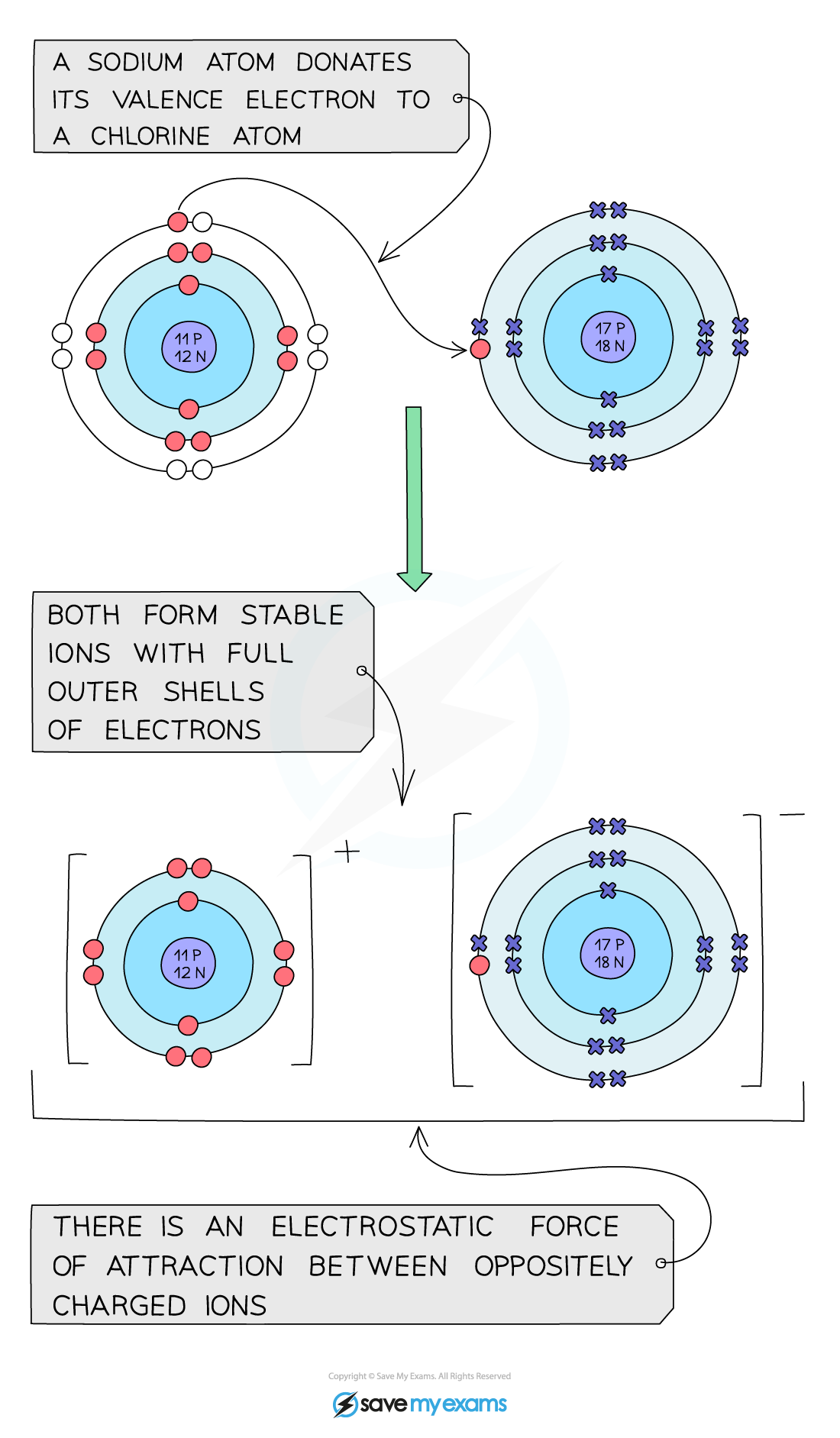
Sodium loses one electron, and chlorine gains one electron.
Magnesium oxide dot and cross diagram
- Magnesium is a group 2 metal so will lose two outer electrons to another atom to have a full outer shell of electrons
- A positive ion with the charge 2+ is formed
- Oxygen is a group 6 non-metal so will need to gain two electrons to have a full outer shell of electrons
- Two electrons will be transferred from the outer shell of the magnesium atom to the outer shell of the oxygen atom
- Oxygen atom will gain two electrons to form a negative ion with charge 2-
- The formula of magnesium oxide is MgO
Dot and cross diagram for magnesium oxide
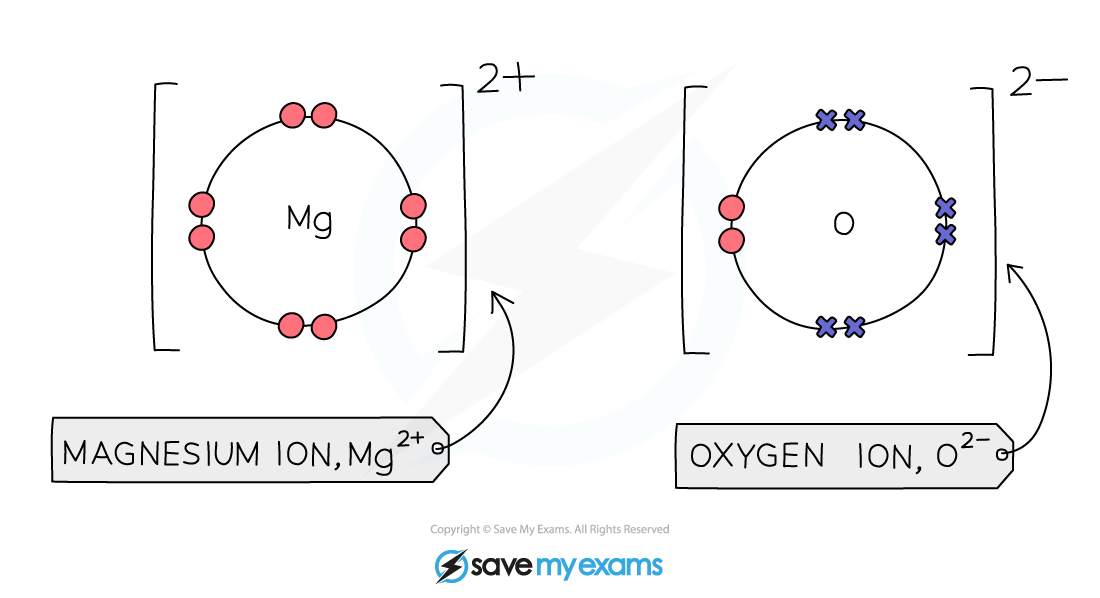
Magnesium loses two electrons and oxygen gains two electrons.
Exam Hint For exam purposes you need only show the outer electrons in dot & cross diagrams.
You should be able to draw dot & cross diagrams for combinations of ions from groups 1,2,3,5,6 and 7.
Was this revision note helpful?
Build on this topic