Practical: Determine the % of Oxygen in Air
2 guided lessons · 18 checks · 2. Inorganic Chemistry → Gases in the Atmosphere
Guided lessons for this note
Which concept don't you understand yet?
We'll explain it simply and check your understanding. Pick any lesson — any order works.
0 of 18 checks correct so far
Lesson 1 of 2
Aim and method
This practical determines how much of the air is oxygen, using the oxidation of iron as the measuring reaction. A piece of iron wool sits at the bottom of a burette filled with water, and the tube stands upside down in a trough, held upright by a clamp. Over several days the iron slowly uses up the oxygen inside, and the water level climbs to record exactly how much gas has gone.
What you know already
From Composition of Air you already know that oxygen makes up about one-fifth of dry air and that its share can be found by reacting a metal or non-metal with a sealed volume of air. This practical note walks the iron-wool burette experiment from aim to conclusion, including the working that turns water-level readings into the approximate percentage of oxygen.
Key points of understanding
- First the dead volume from the last graduation to the tap is measured by draining 50.0 mL of water.
- Iron filings or a piece of iron wool are placed in the bottom of the closed burette.
- The burette is inverted into a trough of water and clamped vertically.
- The starting water level is recorded, then read again after 3-4 days.
- A little water moistens the inside of the burette before the iron is added.
Choose a confidence level to continue.
Prefer to read it all at once? Show the full lesson as a page
1.Aim and method
This practical determines how much of the air is oxygen, using the oxidation of iron as the measuring reaction. A piece of iron wool sits at the bottom of a burette filled with water, and the tube stands upside down in a trough, held upright by a clamp. Over several days the iron slowly uses up the oxygen inside, and the water level climbs to record exactly how much gas has gone.
Key points
- First the dead volume from the last graduation to the tap is measured by draining 50.0 mL of water.
- Iron filings or a piece of iron wool are placed in the bottom of the closed burette.
- The burette is inverted into a trough of water and clamped vertically.
- The starting water level is recorded, then read again after 3-4 days.
- A little water moistens the inside of the burette before the iron is added.
First pass
You trap a measured column of air over water with iron wool inside, then wait days for the iron to rust. The rusting eats the oxygen, and the water rises to take its place, which you read off the scale.
Analogy — It is like watching a slow leak in a sealed tyre under water: bubbles of lost volume show up as water creeping up the gauge.
Exam pointer — Method questions want the sequence: measure the dead volume, add the iron, invert in water, record both water levels.
Going deeper
The apparatus fixes a known air volume at the start, and the iron oxidises inside it over several days, converting gaseous oxygen into solid rust. Because the product is solid, the gas volume falls by the oxygen share alone, and the rising water level records that fall against the fixed scale.
Analogy — Think of a guarantee: whatever gas disappears, water silently pays back the exact same volume, so the water scale becomes the oxygen counter.
Exam pointer — Explain why the burette is inverted in water: it seals the air sample and lets the water level double as the volume gauge.
Checks
0 of 9 attempted · 0 correct
2.Results, calculation and conclusion
The recorded readings are the 3.8 mL between the 50 mL mark and the tap, an initial water level of 2.6 mL and a final water level of 12.7 mL. From these, the starting air volume, the final air volume and the oxygen volume follow in turn. Dividing the oxygen volume by the starting air volume and scaling up gives the percentage of oxygen in the air.
Key points
- The initial volume of air is (50.0 + 3.8) - 2.6, which equals 51.2 mL.
- The final volume of air is 53.8 - 12.7, which equals 41.1 mL.
- The volume of oxygen used is 51.2 - 41.1, which equals 10.1 mL.
- The percentage of oxygen is 10.1 divided by 51.2, multiplied by 100.
- The result, 19.7 percent, agrees with oxygen making up approximately 20 percent of the air.
First pass
Work out the air volume at the start and at the end from the water readings, and the difference between them is the oxygen that the iron used. Turn that difference into a percentage of the starting air and you get about one-fifth.
Analogy — Like timing how much bathwater drained by reading the depth before and after: the difference tells the story in one subtraction.
Exam pointer — Show every line of the working and end with the percentage; the final mark is for the conclusion matching about 20 percent.
Going deeper
The initial air volume is the full column, 50.0 mL plus the 3.8 mL beyond the scale, less the 2.6 mL of water already inside, giving 51.2 mL. After oxidation the air column is 53.8 - 12.7 = 41.1 mL, so the oxygen used is 10.1 mL, and 10.1 / 51.2 x 100 = 19.7 percent, the approximate oxygen share of air.
Analogy — Treat the burette like a fuel gauge: you compare the tank before and after the journey, and the drop tells you exactly how much was burned.
Exam pointer — Quote the answer to a sensible precision and state the comparison with the expected one-fifth; that final comparison sentence is often a dedicated mark.
Checks
0 of 9 attempted · 0 correct
From the revision note
Diagrams on this note's page that are not tied to a specific lesson.
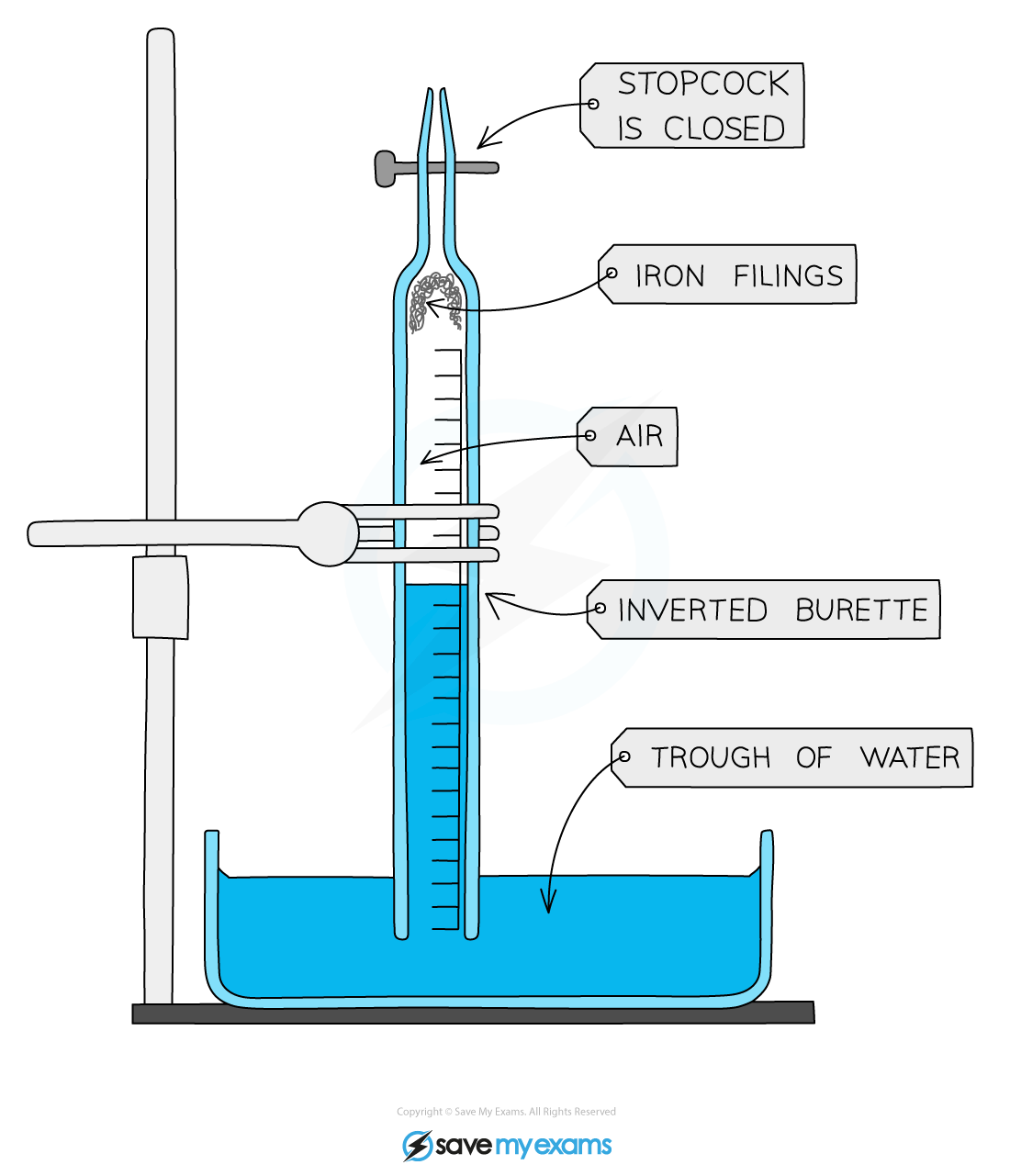
Apparatus to determine the percentage of oxygen in the air
Guided content from the SME authoring corpus — note rn_WJD4ZN4kQfzJNSPV, pinned at 6fb25fc02d1a · promoted SyllabAI/syllabai-resources e967e75f1339