If we increase x by a small amount, what happens to y?
Question
Given that y=4x3−7x2, find the value of dy/dx at the point (2,4).
Hence find the approximate increase in x which will cause y to increase from 4 to 4.05.
Suggestion
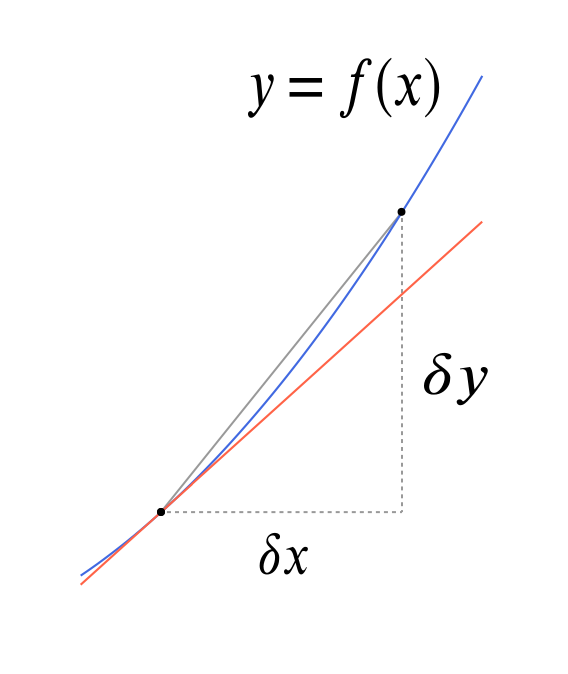
Suppose y=f(x), and that (x,y) is on this curve. We now increase x by a small amount δx, which increases y by a small amount δy (y could decrease, in which case δy would be negative).
Can you see why y′ evaluated at x is roughly δxδy? A diagram might help…
Solution
We know that the derivative of xn is nxn−1. Using this, we have that dxdy=y′=4×3x2−7×2x=12x2−14x. So we have that the value of dxdy at the point (2,4) is y′(2)=12×22−14×2=48−28=20.
Consider the following graph of a curve y=f(x).
The slope of the tangent is close to the slope of the chord; that is, to use the notation in the figure,
δxδy≈dxdywhen δx is small.
So if the
x
-coordinate of the leftmost point in this figure is denoted by
x0
, then
δxf(x0+δx)−f(x0)≈f′(x0)when δx is small.
In fact, the definition of f′(x0) is the value towards which δxf(x0+δx)−f(x0) tends as δx tends towards zero.
In our case:
-
f(x)=4x3−7x2,
-
x0=2,
-
f(x0)=4, and
-
f′(x0)=20.
If we choose δx so that f(x0+δx)=4.05, then, from (approximation−to−derivative), we would have δx4.05−4=δxf(x0+δx)−f(x0)≈f′(x0)=20, and so, by rearranging, δx≈204.05−4=201/20=4001=0.0025.
If we use our calculators, we find that f(2.0025)−f(2)=0.05010…, and so our approximation is a good one!