is a real number. Show that this curve touches the curve with equation
y=x3(∗∗)
at (2,8). Determine the coordinates of any other point of intersection of the two curves.
Sketch on the same axes the curves (1) and (2) when a=2.
Sketch on the same axes the curves (1) and (2) when a=1.
Sketch on the same axes the curves (1) and (2) when a=−2.
Interactive graph
A curve is given by the equation
y=ax3−6ax2+(12a+12)x−(8a+16),(∗)
where
a
is a real number. Show that this curve touches the curve with equation
y=x3(∗∗)
at (2,8).
You might like to use this applet to explore the behaviour of the curve (eqi:1) as a varies. The blue curve is y=x3(eqi:2).
You can also zoom in or out if that helps to see the behaviour of the curves.
[interactive embed (geogebra-iframe): //www.geogebratube.org/material/iframe/id/NCk55VUa/width/700/height/500/border/888888/rc/false/ai/false/sdz/true/smb/false/stb/false/stbh/false/ld/false/sri/true/asb/false/at/html5] — not part of the text import; see the source page.
Download GeoGebra file
As a varies, you might notice the following.
The curves always touch at (2,8) as the question suggests.
What happens to the red curve when a=0?
Are there any values of a for which the curves do not intersect again?
Solution
A curve is given by the equation
y=ax3−6ax2+(12a+12)x−(8a+16),(∗)
where
a
is a real number. Show that this curve touches the curve with equation
y=x3(∗∗)
at (2,8). Determine the coordinates of any other point of intersection of the two curves.
So the points of intersection have coordinates (2,8) and (a−12a+4,[a−12a+4]3).
The double root for x=2 means that we have a touching there; the two curves are tangent to each other at (2,8).
Alternatively…
To show that the curves (1repeat) and (2repeat)touch at (2,8), we need to show that both curves pass through (2,8) and that the gradients of the curves are equal at this point.
Now f(2)=8a−24a+2(12a+12)−(8a+16)=8 and g(2)=8, so both curves pass through the point (2,8).
Also f′(2)=12a−24a+(12a+12)=12 and g′(2)=12, so the curves have the same gradient at the point (2,8).
Therefore the curves (1repeat) and (2repeat) touch at (2,8).
Sketch on the same axes the curves (1repeat) and (2repeat) when a=2.
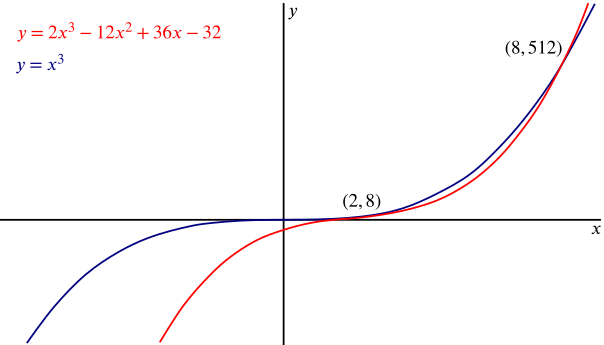
When a=2, (1repeat) becomes y=2x3−12x2+36x−32. From above, we have that the two graphs intersect at (8,512) and touch at (2,8).
Now differentiating gives
dxdy=6x2−24x+36,
so stationary points occur when
⟺⟺6x2−24x+36=0x2−4x+6=0(x−2)2=−2.
This equation has no real solutions, so there are no stationary points.
Further, we can see from this equation that y′>0 for all x, and so y is an increasing function.
Since y<0 when x=1 but y>0 when x=2, we know that it has a root (which must be the only root since y is increasing) somewhere between 1 and 2.
We also know that (1repeat) with a=2 intersects the y axis at (0,−32).
So when a=2, the graphs must have the following shape.
Sketch on the same axes the curves (1repeat) and (2repeat) when a=1.
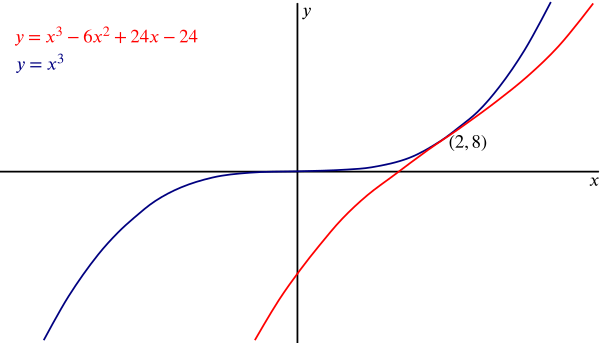
When a=1, (1repeat) becomes y=x3−6x2+24x−24. The two graphs touch at (2,8) but do not intersect elsewhere because a−12a+4 is undefined when a=1.
Differentiating gives
dxdy=3x2−12x+24,
so stationary points occur when
⟺⟺3x2−12x+24=0x2−4x+8=0(x−2)2=−4.
This equation has no real solutions, so there are no stationary points.
Again, this means that y′>0 for all x, and so y is an increasing function.
Since y<0 at x=1 but y>0 at x=2, we know that the graph of y crosses the x-axis somewhere between x=1 and x=2, which should help our sketch.
We also know that (1repeat) with a=1 intersects the y axis at (0,−24).
So when a=1, the graphs have the following shape.
Sketch on the same axes the curves (1repeat) and (2repeat) when a=−2.
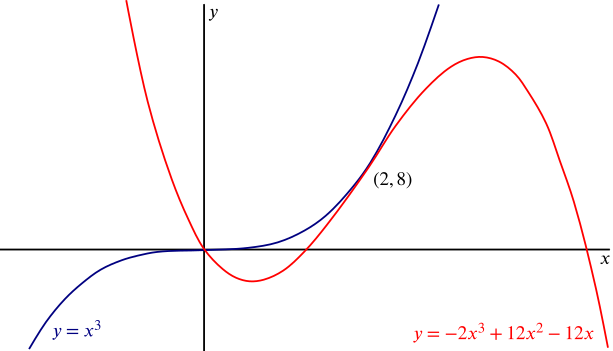
When a=−2, (1repeat) becomes y=−2x3+12x2−12x=−2x(x2−6x+6). We can find that y has roots at x=0,3±3, or approximately x=0,1.3,4.7.
The two graphs intersect at (0,0) and touch at (2,8).
Differentiating gives
dxdy=−6x2+24x−12,
so stationary points occur when
⟺⟺−6x2+24x−12=0x2−4x+2=0x=2±2.
So there are stationary points at x≈3.4 and x≈0.6.
So when a=−2, the graphs have the following shape.