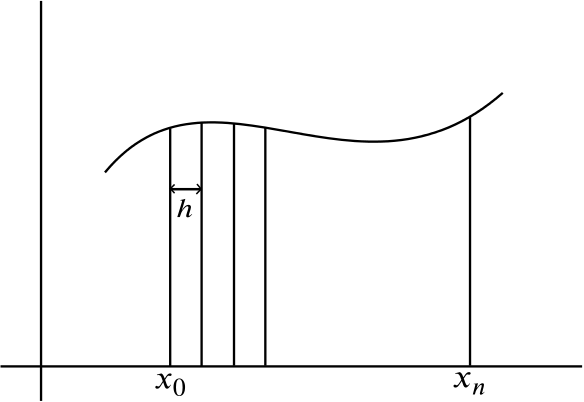
Can we use the trapezium rule to estimate this integral?
Question
When the trapezium rule is used to estimate the integral
∫012xdx
by dividing the interval 0≤x≤1 into N subintervals the answer achieved is
- 2N1(1+21/N+11),
- 2N1(1+21/N−12),
- N1(1−21/N−11),
- 2N1(21/N+15−1).
Suggestion
The notation ∫012xdx means the area between the curve y=2x and the x-axis, from x=0 to x=1.
Using the trapezium rule will give us a long sum that will have to be rewritten as a fraction. Can you think of another situation where we know how to rewrite a finite sum of numbers in fractional form?
Solution
When the trapezium rule is used to estimate the integral
∫012xdx
by dividing the interval 0≤x≤1 into N subintervals the answer achieved is
- 2N1(1+21/N+11),
- 2N1(1+21/N−12),
- N1(1−21/N−11),
- 2N1(21/N+15−1).
The trapezium rule says this:
The area under the curve f(x) between the points x0 and xn, with this interval divided into n smaller intervals of width h=n(xn−x0) is given by
∫x0xnf(x)dx≈21h[(y0+yn)+2(y1+y2+…b+yn−1)],
where yi=f(xi).
So dividing the interval 0≤x≤1 into N subintervals for our problem gives h=N1, and the trapezium rule gives
∫012xdx≈21N1[(20+21)+2(2N1+2N2+...+2NN−1)]
We have what looks like a series inside the brackets. Do we know any ways of simplifying series?
2N1+2N2+...+2NN−1
is a geometric series with a first term of 2N1, a common ratio of 2N1, and N−1 terms so we can write it as,
1−2N12N1(1−2NN−1)
using the formula for the sum of a geometric progression.
The whole expression can now be written as
2N1[3+2(1−2N12N1(1−2NN−1))].
There are many ways to rearrange this expression, but three answers have a 1 in them, so we can use that as a starting point.
2N1[3+2(1−2N12N1(1−2NN−1))]=2N1[1+2(1−2N11−2N1)+2(1−2N12N1(1−2NN−1))]=2N1[1+1−2NN−12(1−2N1)+2(2N1−2)]=2N1(1+2N1−12)
So the answer is (b).