Change one thing
Excerpt: Students are asked to think carefully about the different ways they can solve an arithmetic sequences question, and about what happens when they change one aspect of an arithmetic sequence.
Problem
Find the last term of the sequence that starts with , has a common difference of and has terms.
- In what ways can this problem be solved?
Change only one aspect of the sequence in order to make the last term .
-
What aspects can be changed?
-
What would they change to?
Solution
Let’s write the sequence numerically:
The first term is , and after that there will be other terms. is being added for each term, so over terms, will be added. Therefore the th term will be .
How does this example help us explain why the nth term of an arithmetic sequence is ? Why is it rather than ?
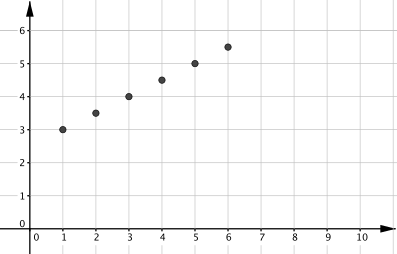
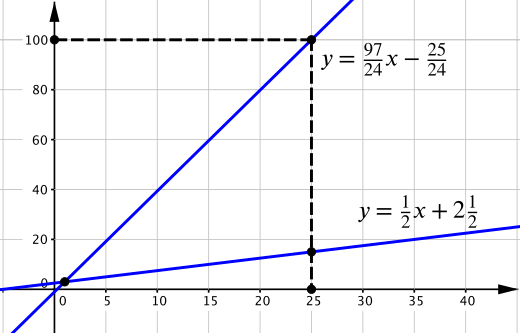
We could also plot the points of the sequence on a graph.
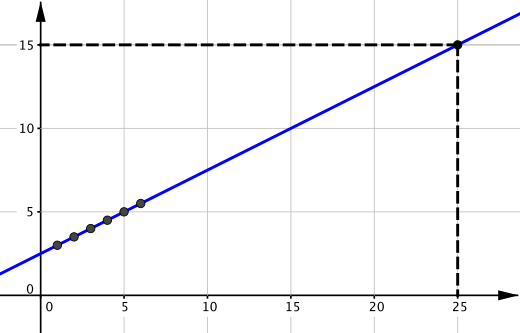
The sequence is a linear relationship, so we can draw a linear graph through the points with gradient of . The equation of the line is .
What is the value of ?
The equation of the line is
, and so the
th term will be,
How does thinking about the sequence graphically and the equation , link to , the formula for the nth term of an arithmetic sequence?
We are told about three aspects of the sequence: the first term, the number of terms, and the common difference.
The first term
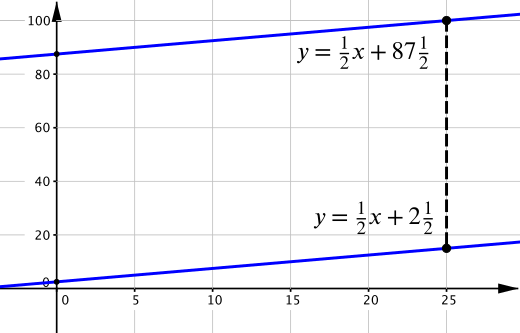
If we change the first term, then we still have a common difference of and terms, so difference between the first and last term will still be . Therefore, to make the last term the first term would be .
If we think about the old and new sequences as linear graphs then we have a translation of units in the direction.
The number of terms
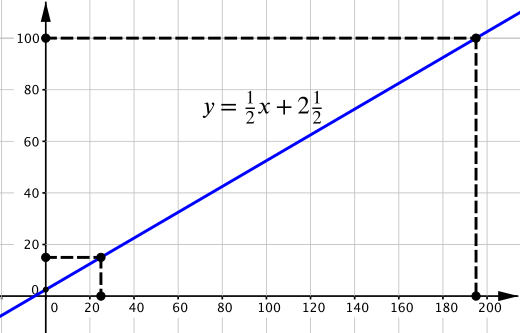
If we change the number of terms then we have the same intitial sequence, with a first term of and a common difference of . This means that we can look at the original graph of , and we want to know when . Solving for gives us , i.e. there would be terms in this sequence.
The common difference
If we change the common difference we want a sequence that starts at and gets to by the th term. This means we are adding on in 24 terms. Therefore the common difference will be . Graphically we have a line that still passes through the point , but also passes through giving the equation .
We might have tried to change the common difference in a different way. We could make it a common ratio, and change the sequence from arithmetic to geometric. Why can’t a geometric sequence with a first term of , and common ratio of ever have a nth term of ?
Is it possible to have other sequences that have a first term of , and a th term of ?