Prove that cos(A+B)=cosAcosB−sinAsinB, where the angles A, B and A+B are all acute.
By projecting the sides of an equilateral triangle onto a certain line, prove that cosθ+cos(θ+32π)+cos(θ+34π)=0 and find the value of the expression sinθ+sin(θ+32π)+sin(θ+34π).
Suggestion
There is a standard geometric proof of this formula using the unit circle. If you haven’t come across it before, you may like to have a look at the diagram hidden below.
A useful diagram
What lengths can you calculate, in terms of α and β?
Could we draw an equilateral triangle at an angle θ to the horizontal? What angles do we know? What horizontal lengths can we deduce?
To find the value of the sin sum, what vertical lengths can we deduce?
Solution
We’ll use α and β to represent the angles, and capital letters to represent points on the diagram. So we are trying to prove that
cos(α+β)=cosαcosβ−sinαsinβ.
The circle drawn has radius 1 (it’s a unit circle). From triangle OCD, we see that OD=cos(α+β).
From triangle OFC, we know CF=sinβ and OF=cosβ.
From triangle CFG, sinα=FCFG⟹FG=sinαsinβ.
From triangle OEF, cosα=OFOE⟹OE=cosαcosβ.
As FG is equal in length to DE, we have
OE=OD+DE=OD+FG.
Therefore cosαcosβ=cos(α+β)+sinαsinβ, so cos(α+β)=cosαcosβ−sinαsinβ, as required.
The restriction to acute angles is actually unnecessary - this works for all angles.
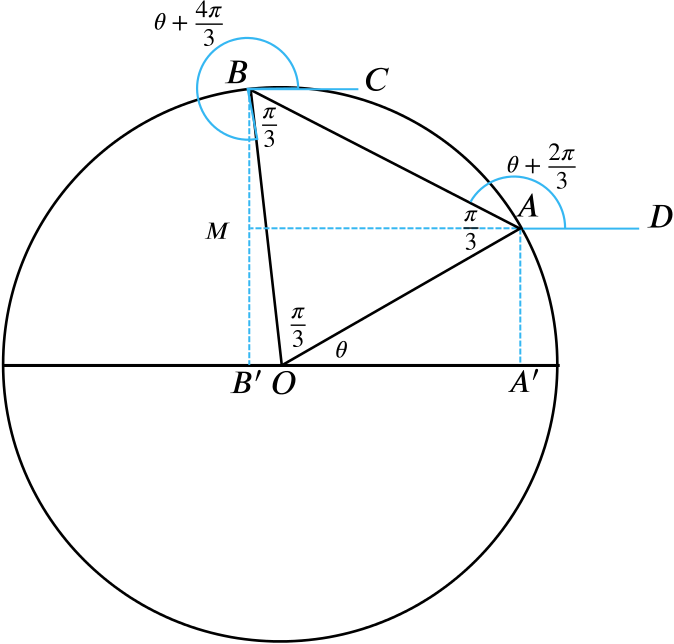
Let’s start by drawing an equilateral triangle inside a unit circle, at an angle θ to the horizontal.
We can quickly identify (using parallel lines and angles in triangles) that ∠BAD=θ+32πand∠CBO (reflex)=θ+34π.
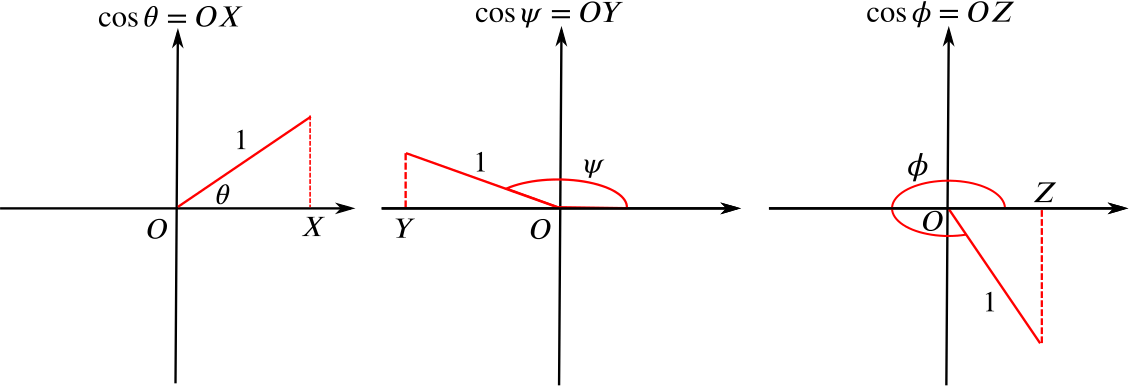
Thinking about the unit circle, we can see (by considering the diagrams below) that
If we take ψ=θ+32π, we see that
cos(θ+32π)=AM≡A′B′,
and taking ϕ=θ+34π, we have
cos(θ+34π)=B′O.
Therefore
cosθ+cos(θ+32π)+cos(θ+34π)=OA′+A′B′+B′O.
(i.e. we move from O to A′, return to B′ and then back to O).
Therefore the total displacement is zero, and so cosθ+cos(θ+32π)+cos(θ+34π)=0.
…and find the value of the expression sinθ+sin(θ+32π)+sin(θ+34π).
The sum for sin can similarly be found by projecting the sides of an equilateral triangle onto the y-axis.
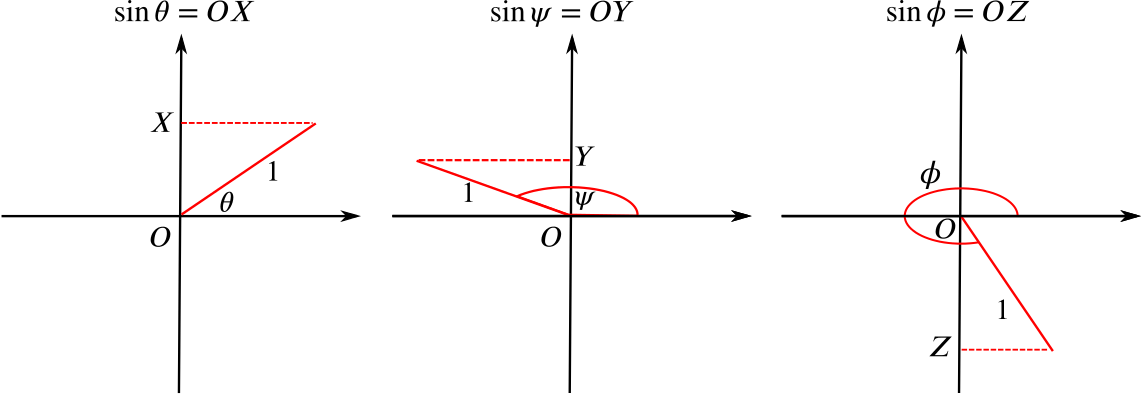
We can think again about the unit circle and how we find the sine of different angles:
Let ψ=θ+32π and ϕ=θ+34π. From our diagram above, we get
Suppose we are allowed to use any method for the last two parts. If we know about complex numbers, they can be tackled more quickly. Let w=cosθ+isinθ. Then if k=e2π/3, we have w+kw+k2w=cosθ+cos(θ+32π)+cos(θ+34π)+i(sinθ+sin(θ+32π)+sin(θ+34π)). But we know k3=1, so k3−1=(k−1)(k2+k+1)=0. Since k=1, we have k2+k+1=0, and so cosθ+cos(θ+32π)+cos(θ+34π)+i(sinθ+sin(θ+32π)+sin(θ+34π))=0, which gives us both our results.