When does this equation in x,y and θ represent a circle?
Question
[Choose the one correct answer and explain your reasoning.]
Given θ in the range 0≤θ<π, the equation x2+y2+4xcosθ+8ysinθ+10=0 represents a circle for
0<θ<3π;
4π<θ<43π;
0<θ<2π;
all values for θ.
Suggestion
What is the general form for the equation of a circle? Can we manipulate this equation into that form?
Solution
This applet shows the curve x2+y2+4xcosθ+8ysinθ+10=0. We can vary θ in the range 0≤θ<π.
What happens to the centre and radius of the circle?
[interactive embed (geogebra-iframe): //www.geogebratube.org/material/iframe/id/UQrH6fY9/width/500/height/450/border/888888/rc/false/ai/false/sdz/false/smb/false/stb/false/stbh/false/ld/false/sri/true/asb/false/at/html5] — not part of the text import; see the source page.
Download GeoGebra file
By completing the square we obtain (x+2cosθ)2−4cos2θ+(y+4sinθ)2−16sin2θ+10=0.
Then by rearranging we get (x+2cosθ)2+(y+4sinθ)2=4cos2θ+16sin2θ−10.
Since sin2θ+cos2θ=1, we see that the right-hand side becomes 4cos2θ+16sin2θ−10=12sin2θ−6.
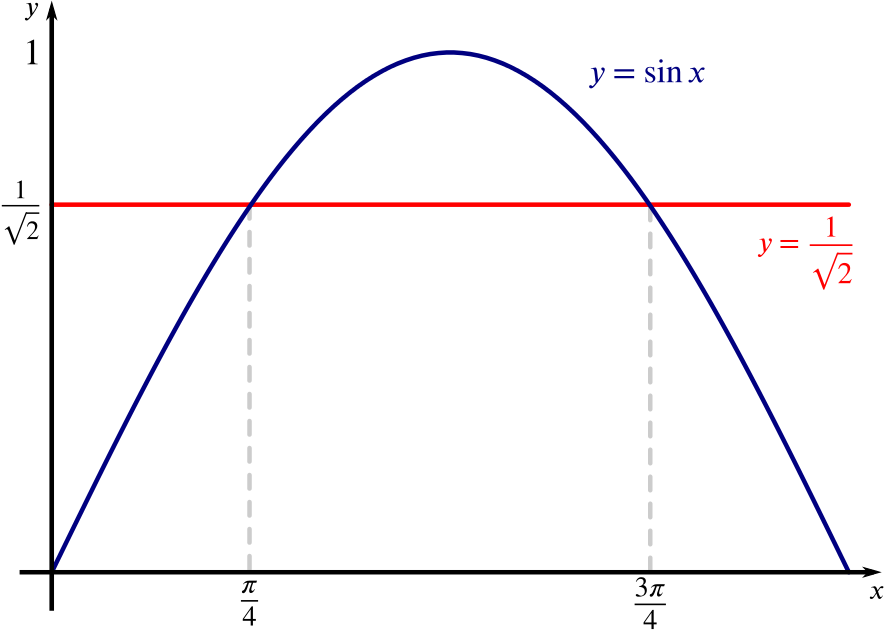
So the equation defines a circle of radius 12sin2θ−6, for sin2θ>21.
In the range 0≤θ<π, we have sinθ≥0 so we need sinθ>21.