As θ varies, what's the largest this ratio of areas can be?
Question
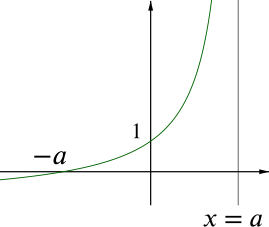
- Let a>0. Sketch the graph of y=a−xa+xfor−a<x<a.
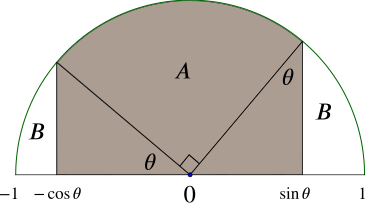
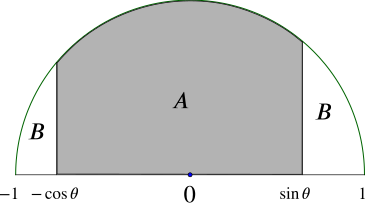
- Let 0<θ<2π. In the diagram below is the half-disc given by x2+y2≤1 and y≥0. The shaded region A consists of those points with −cosθ≤x≤sinθ. The region B is the remainder of the half-disc. Find the area of A.
- Assuming only that sin2θ+cos2θ=1, show that sinθcosθ≤21.
- What is the largest area of Barea of A can be, as θ varies?
Suggestion
Are there any noticeable features of this function over this interval?
Can we divide the area A into regions where we can easily calculate the areas?
Would it help to consider (sinθ−cosθ)2?
How does our work for (i) help us here?
Solution
Now y=a−xa+x=a−x2a−(a−x)=a−x2a−1, so as x increases from −a towards a,y increases from 0 towards ∞. Also (0,1) is on the curve.
If we use calculus, dxdy=(a−x)22a>0, and so this function is always increasing (with a discontinuity at x=a).
We can see from the diagram that A consists of a quarter of the circle with two additional congruent triangles.
Thus the area A=4π+2[21sinθcosθ]=4π+sinθcosθ.
We know that 0≤(sinθ−cosθ)2=sin2θ+cos2θ−2sinθcosθ.
Thus 2sinθcosθ≤sin2θ+cos2θ=1⟹sinθcosθ≤21.
We know area of Barea of A=2π−(4π+sinθcosθ)4π+sinθcosθ=4π−sinθcosθ4π+sinθcosθ.
Now from part (i), we know that 4π−sinθcosθ4π+sinθcosθ increases as sinθcosθ increases.
But the maximum value sinθcosθ can take is 21, and so the maximum value of 4π−sinθcosθ4π+sinθcosθ is 4π−214π+21=π−2π+2.