Can we find the height of a tower using its reflection?
Question
A tower stands on a river bank. From a point on the other bank directly opposite, and at height h above the water level, the angle of elevation of the top of the tower is α and the angle of depression of the reflection of the top in the water is β. [It is to be assumed that the water is smooth, so that the reflection of any object in the water will appear to be as far below the surface as the tower is above it.] Prove that the height of the top of the tower above the water is hsin(α+β)cosec(β−α), and the width of the river is 2hcosαcosβcosec(β−α).
Find these two distances (to the nearest foot) when h=15ft., α=24∘, and β=31∘.
Suggestion
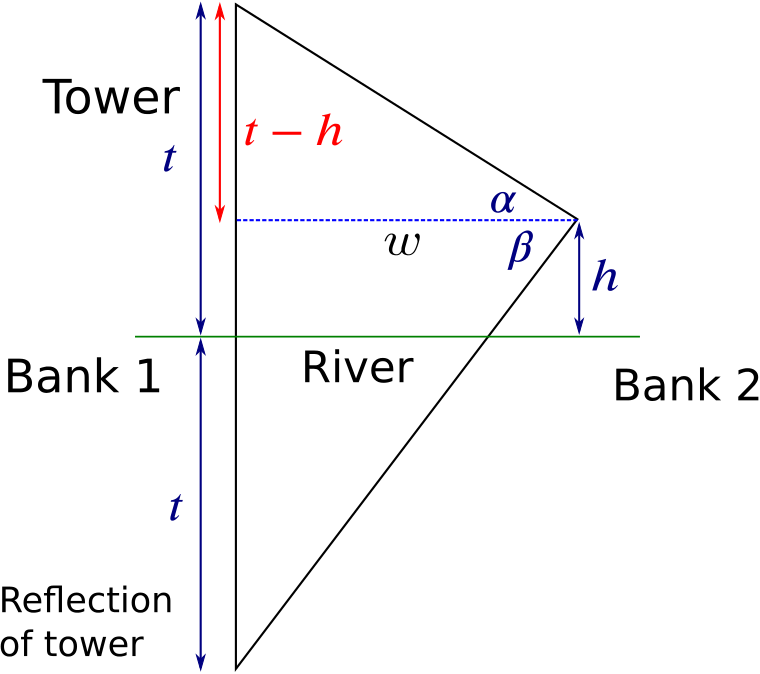
Could we draw a helpful diagram including the reflection of the tower?
Let’s call the height of the tower t, and the width of the river w.
Are there any right-angled triangles that could aid us?
The question says that sin(α+β) and cosec(β−α) are in the solution – do we know another way of writing these?
Solution
A tower stands on a river bank. From a point on the other bank directly opposite, and at height h above the water level, the angle of elevation of the top of the tower is α and the angle of depression of the reflection of the top in the water is β. [It is to be assumed that the water is smooth, so that the reflection of any object in the water will appear to be as far below the surface as the tower is above it.] Prove that the height of the top of the tower above the water is hsin(α+β)cosec(β−α), and that the width of the river is 2hcosαcosβcosec(β−α).
The question wants us to find the height of the tower, t, and the width of the river, w. It’s as if someone of height h is measuring α and β using a theodolite, and is then using these three values to calculate t and w. Notice how we deal with the reflection of the tower in our diagram.
We have two right-angled triangles we can work with from the picture. We have
tanα=wt−h,
from the top triangle, and
tanβ=wt+h,
from the bottom triangle.
We will first find the height of the tower, t. Rearranging (2) we find that w=tanβt+h.
Substituting this value of
w
into equation
(1)
yields
tanα⟹(t+h)tanα⟹(t+h)sinαcosβ⟹t⟹t=t+h(t−h)tanβ=(t−h)tanβ=(t−h)sinβcosα=sinαcosβ−sinβcosα−h(sinαcosβ+sinβcosα),=sin(β−α)hsin(α+β)=hsin(α+β)cosec(β−α).
We have used here that
tanθsin(θ±ϕ)cosecθ=cosθsinθ,=sinθcosϕ±cosθsinϕ, and=sinθ1.
Now we wish to find the width of the river, w. We now know what t is, so we have, using our expression for w above, w=tanβt+h=tanβhsin(α+β)cosec(β−α)+h.
So we must now rearrange this to check that this agrees with the answer in the question. We have
w=h(sinβsin(β−α)sin(α+β)cosβ+sinβcosβ),=hcosβ(sinβsin(β−α)sin(α+β)+sin(β−α)),=hcosβ(sinβsin(β−α)2sinβcosα),=2hcosαcosβcosec(β−α),
as required.
Alternatively we can use the identity sinθ+sinϕ=2sin(2θ+ϕ)cos(2θ−ϕ).
We have
tw=15sin(31−24)sin(24+31)=15sin7sin55=101ft.,=30sin7cos24cos31=193ft.,
to the nearest foot (using a calculator).
We need to make sure our calculator is in the correct mode (degrees or radians) before making the computation.