Current (Cambridge International IGCSE Physics)
Spec point —
4.2.5· - Know that electric current is related to the flow of charge
Current
- Electric current is defined as:
The rate of flow of electric charge
-
Current flows:
- when a circuit is formed e.g. when a wire connects the two oppositely charged terminals of a cell
- from the positive terminal to the negative terminal of a cell
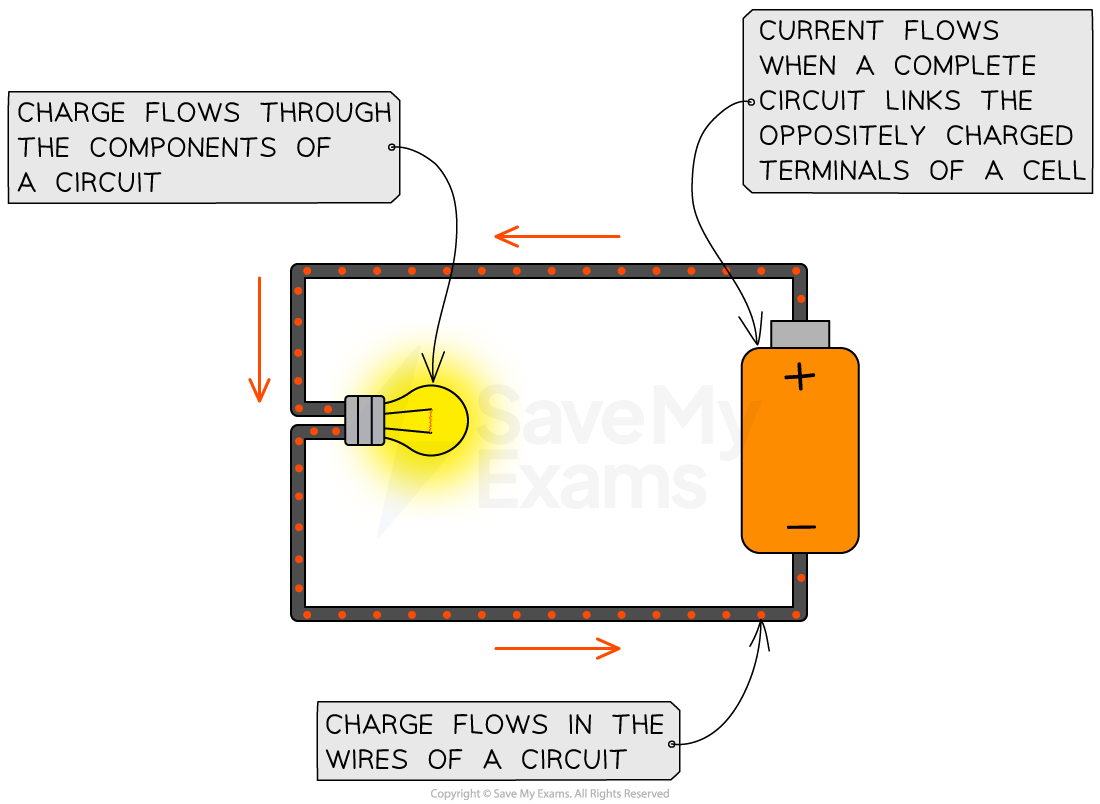
Charge flows from the positive terminal to the negative terminal
Measuring current
Spec point —
4.2.5· Describe the use of ammeters (analogue and digital) with different ranges
- Current can be measured using an ammeter
- Ammeters must be connected in series with the component being measured
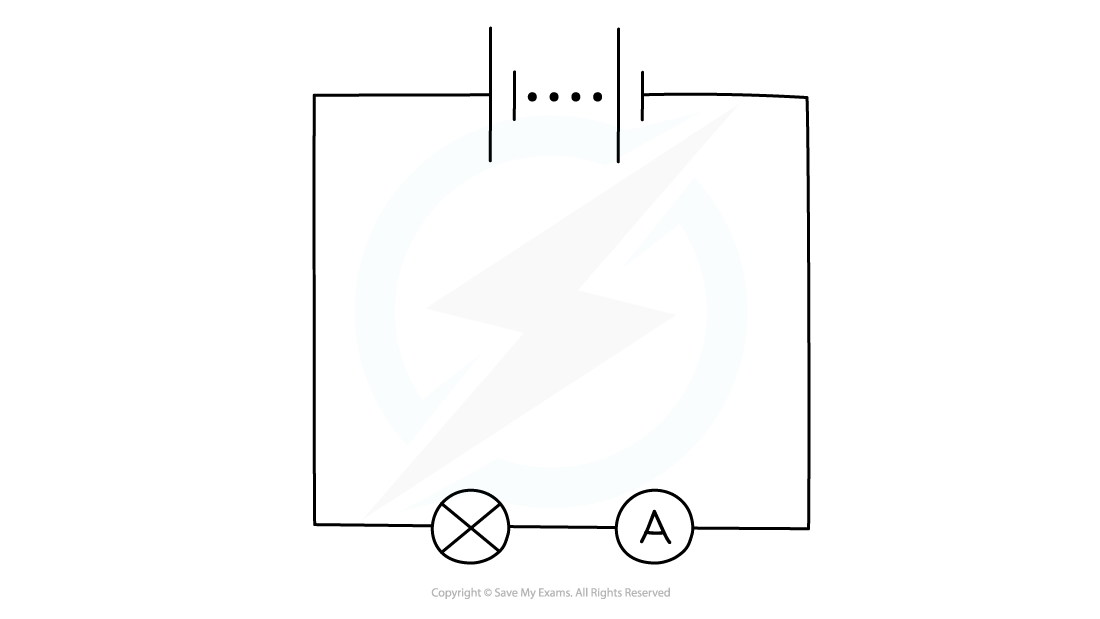
An ammeter can be used to measure the current around a circuit
-
Ammeters can be:
- digital (with an electronic read out)
- analogue (with a needle and scale)
Analogue ammeters
-
Typical ranges are 0.1-1.0 A and 1.0-5.0 A for analogue ammeters
- Always double-check exactly where the marker is before an experiment
- If it is not at zero, this value will need to subtracted from all measurements
- They should be checked for zero errors before using
-
They are also subject to parallax error
- Always read the meter from a position directly perpendicular to the scale
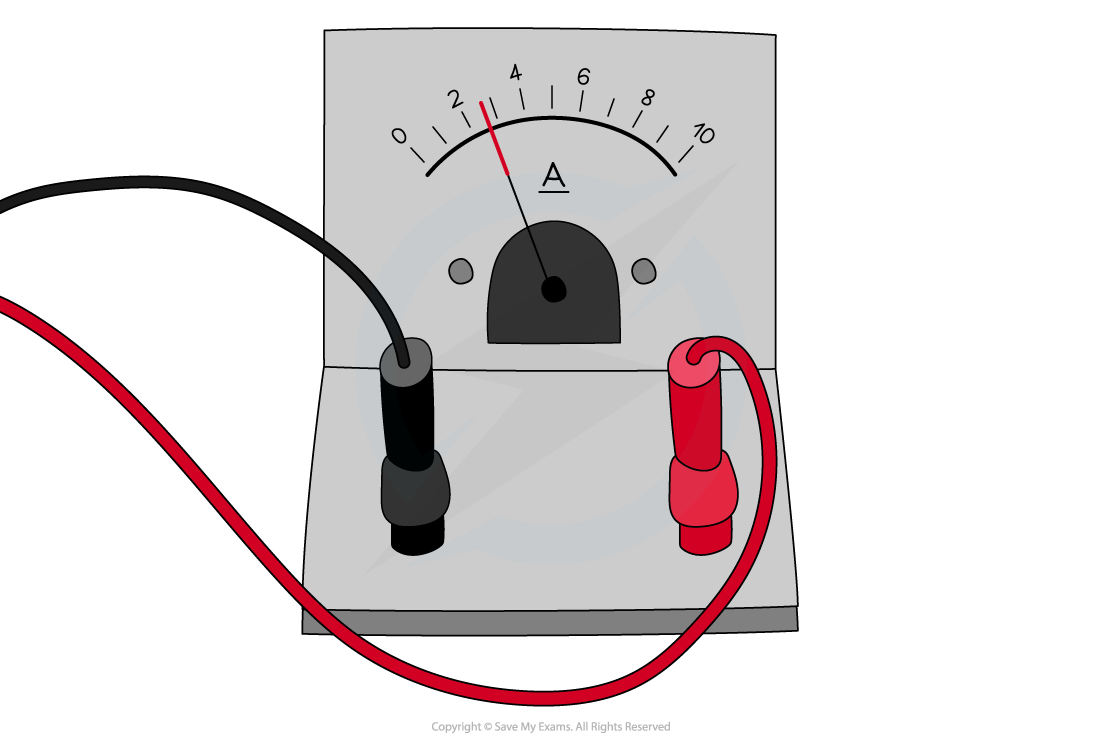
An analogue ammeter scale
Digital ammeters
-
Digital ammeters can measure very small currents, in mA or µA
-
Digital displays show the measured values as digits and are more accurate than analogue displays
-
They’re easy to use because they give a specific value and are capable of displaying more precise values
- However digital displays may 'flicker' back and forth between values and a judgement must be made as to which to write down
-
Digital ammeters should be checked for zero error
- Make sure the reading is zero before starting an experiment, or subtract the “zero” value from the end results
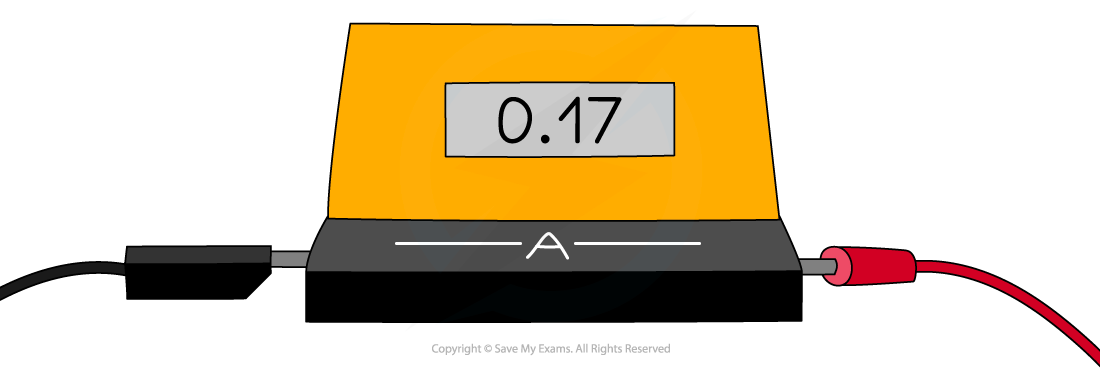
A digital ammeter display
Electrical conduction in metals
Spec point —
4.2.5· Describe electrical conduction in metals in terms of the movement of free electrons
- The wires in an electric circuit are made of metal because it is a good conductor of electric current
- In the wires, the current is a flow of negatively charged electrons
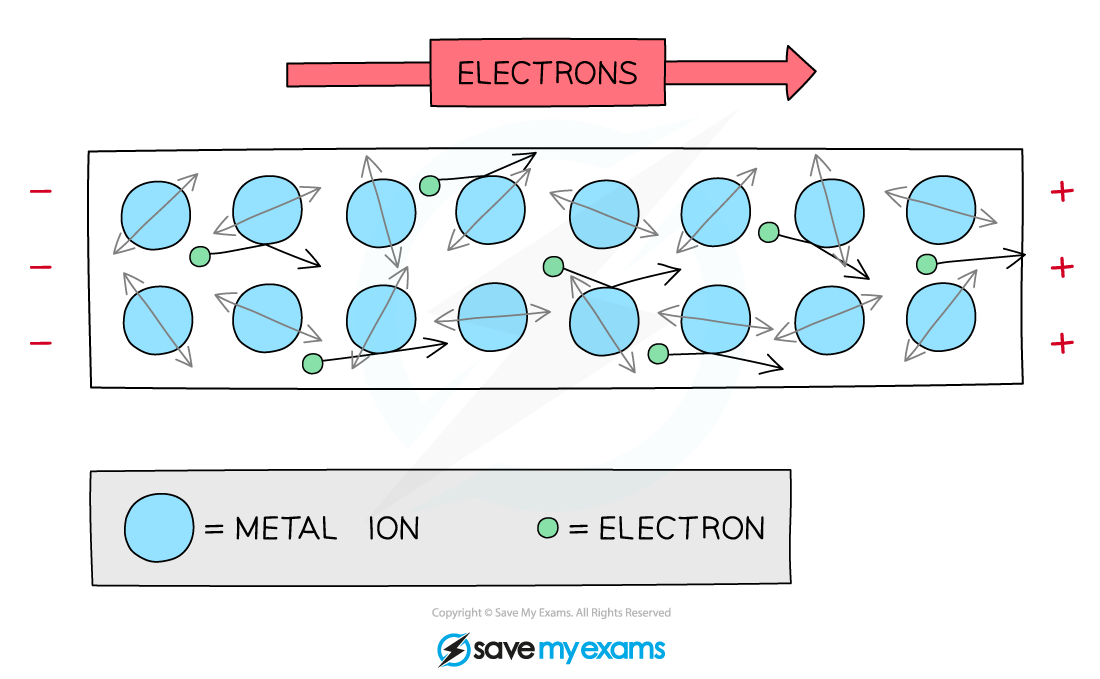
In metal wires, the current is a flow of negatively charged electrons. When a potential difference is applied, electrons flow through the lattice of metal ions
Calculating current
Spec point —
4.2.5· - Define electric current as the charge passing a point per unit time; recall and use the equation I = Q/t (E)
Extended Tier Only
- Electric current can be defined more precisely as:
The charge passing a point in a circuit per unit time
-
Current is measured in units of amperes or amps (A)
- 1 amp is equivalent to a charge of 1 coulomb flowing in 1 second, or 1 A = 1 C/s
-
This means the size of an electric current is the amount of charge passing through a component each second
-
Current, charge and time are related by the equation:
-
Where:
- = current, measured in amps (A)
- = charge, measured in coulombs (C)
- = time, measured in seconds (s)
Worked Example When will 8 A of current pass through an electrical circuit?
A. When 8 J of energy is used by 1 C of charge
B. When a charge of 4 C passes in 0.5 s
C. When a charge of 8 C passes in 0.1 s
D. When a charge of 1 C passes in 8 s
[1]
Answer:
- The equation relating current, charge and time is:
- Rearrange to make current I the subject of the equation:
- Consider option B, where Q = 4 C and t = 0.5 s:
- Therefore, the correct answer is B [1 mark]
A is incorrect as this is the definition of a voltage of 8 V between two points and does not describe current
C is incorrect as
D is incorrect as
Exam Hint Electric currents in everyday circuits tend to be quite small, so it's common for examiners to throw in a unit prefix like 'm' next to quantities of current, e.g. 10 mA (10 milliamperes). Make sure you can convert these into standard units, e.g. .
Conventional current
Spec point —
4.2.5· State that conventional current is from positive to negative and that the flow of free electrons is from negative to positive
Extended Tier Only
-
Current is the flow of positive charge i.e. from the positive terminal to the negative terminal of a cell
- This is known as conventional current
-
This is in the opposite direction to electron flow
- Electrons are negatively charged, so they flow from the negative terminal to the positive terminal of a cell
Conventional current and electron flow
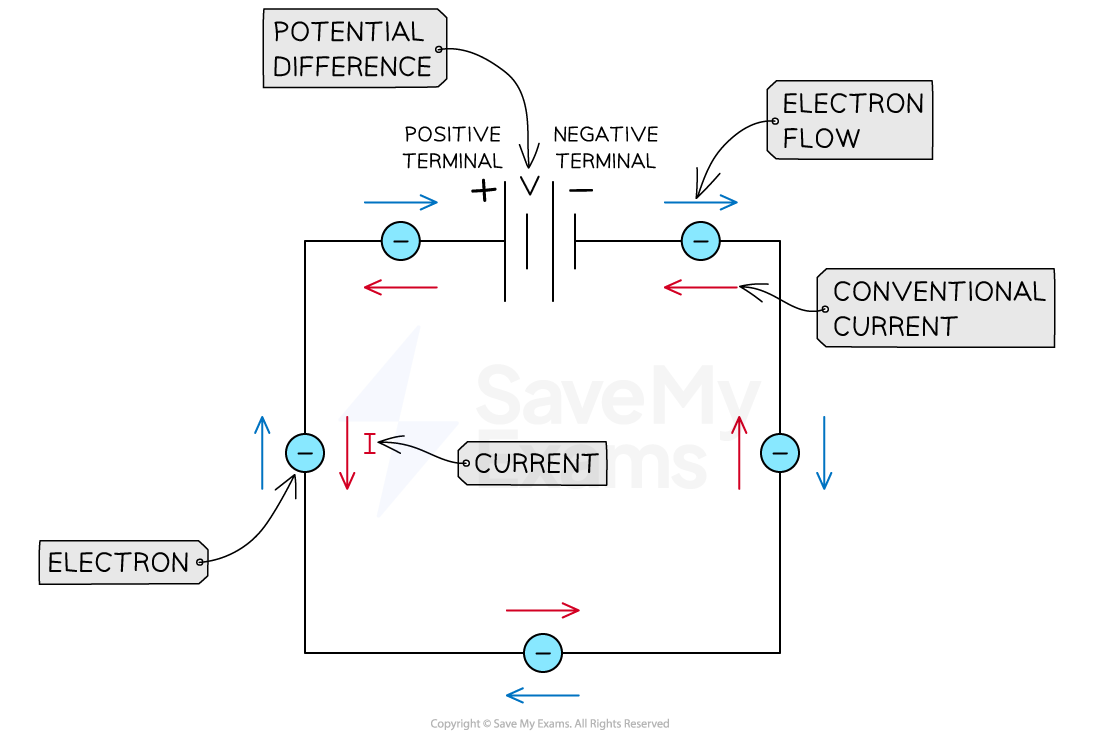
By definition, conventional current always goes from positive to negative. This is in the opposite direction to the flow of electrons
Was this revision note helpful?
Build on this topic