Direct & Alternating Current (Cambridge International IGCSE Physics)
Spec point —
4.2.6· Know the difference between direct current (d.c.) and alternating current (a.c.)
Direct & alternating current
-
There are two types of current:
- direct current (d.c.)
- alternating current (a.c.)
Direct current
- A direct current (d.c.) is defined as:
A steady current, constantly flowing in the same direction in a circuit, from positive to negative
-
The potential difference across a cell in a d.c. circuit travels in one direction only
- The current travels from the positive terminal to the negative terminal
-
A d.c. power supply has a fixed positive terminal and a fixed negative terminal
-
Electric cells, or batteries, produce direct current (d.c.)
Alternating current
- An alternating current (a.c.) is defined as:
A current that continuously changes its direction, going back and forth around a circuit
-
An alternating current power supply has two identical terminals that change from positive to negative and back again
- The alternating current always travels from the positive terminal to the negative terminal
- Therefore, the current changes direction as the polarity of the terminals changes
-
The frequency of an alternating current is the number of times the current changes direction back and forth each second
- In the UK, mains electricity is an alternating current with a frequency of 50 Hz and a potential difference of around 230 V
Graphs of direct current and alternating current
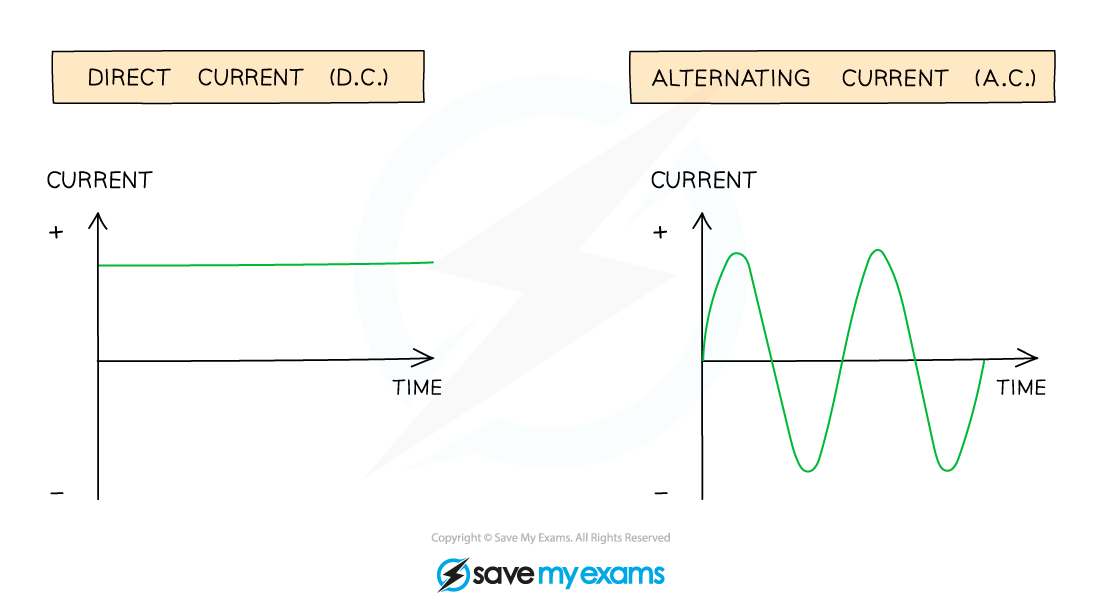
Two graphs showing the variation of current with time for alternating current and direct current
Comparing direct and alternating current
- The following table summarises the differences between d.c. and a.c.
| Direct current (d.c.) | Alternating current (a.c.) |
|---|---|
| Continuous and in one direction | Constantly changing direction |
| Produced by cells and batteries | Produced by electrical generators (mains electricity) |
| Involves a positive and negative terminal | Involves two identical terminals |
Exam Hint If asked to explain the difference between alternating and direct current, sketch the graphs shown above: a well-sketched (and labelled) graph can earn you full marks.
AC & DC current video
Spec point —
4.2.6· nan
Was this revision note helpful?
Build on this topic