Efficiency (Cambridge International IGCSE Physics)
Efficiency of energy transfer
Spec point —
1.7.7· Understand, qualitatively, the concept of efficiency of energy transfer
- The efficiency of a system is a measure of the amount of useful and wasted energy in an energy transfer
- Efficiency is defined as:
The ratio of the useful power or energy output from a system to its total power or energy input
-
If a system has high efficiency, this means most of the energy transferred is useful
-
If a system has low efficiency, this means most of the energy transferred is wasted
- If a lamp is 25% efficient, this means that 25% of the energy supplied to it is transferred usefully as light, and the other 75% is wasted.
-
No system reaches 100% efficiency
- Energy is always wasted into other non-useful forms, such as sound and thermal energy which is lost to the surroundings (often due to friction)
Calculating efficiency
Spec point —
1.7.7· Define efficiency as: (a) (%) efficiency = (useful energy output)/(total energy input) (× 100%) (b) (%) efficiency = (useful power output)/(total power input) (× 100%) recall and use these equations
Calculating efficiency
Extended Tier Only
-
Efficiency can be calculated using two equations
-
Efficiency in terms of energy:
- Efficiency in terms of power:
-
Efficiency can be given as a decimal between 0 and 1, or as a percentage between 0 and 100%.
-
In the production of electricity:
-
Energy is used to heat water to produce steam
-
The steam turns a turbine
-
The turbine turns a generator
-
The generator produces electricity
- At each stage of this process, energy is dissipated to the surroundings
-
-
The overall efficiency of a typical thermal power station is approximately 30%
- This means that about 70% of the energy from the fuel is wasted inside the power station, mostly as thermal energy transferred to the surroundings, and only about 30% is transferred usefully as electrical energy
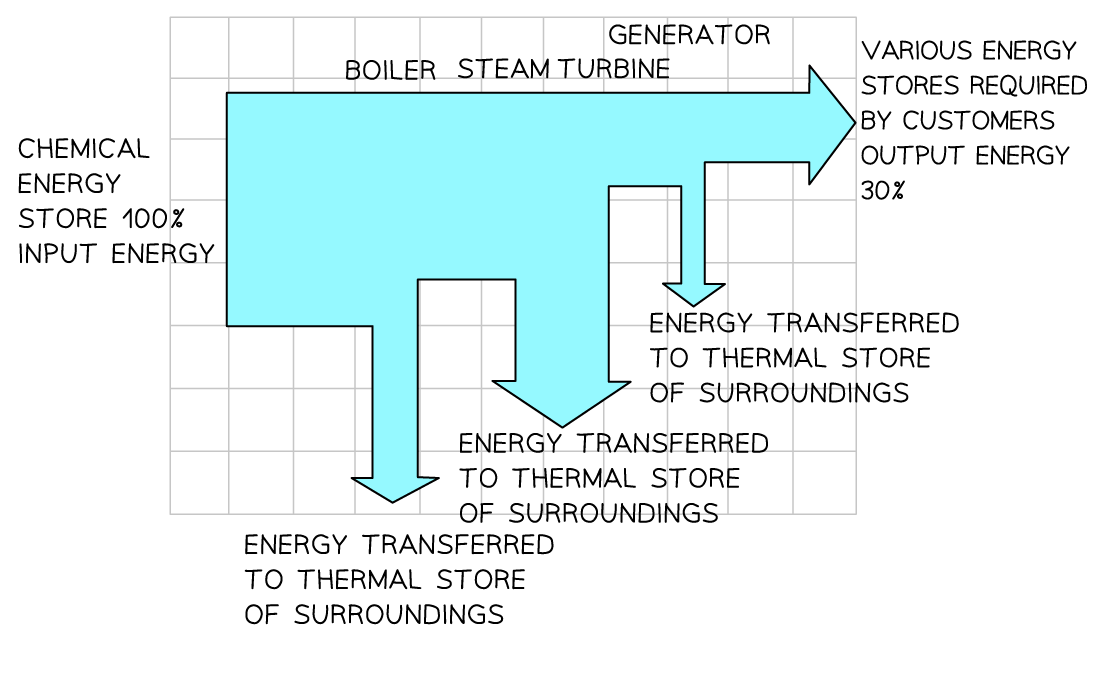
Sankey diagram showing the energy transfers involved in generating electricity in a gas-fired power station
Worked Example An electric motor lifts a 7.2 kg load through a height of 5.0 m in 3 seconds. The efficiency of the motor is 35%.
Calculate the power supplied to the motor.
[4]
Answer:
Step 1: List the known quantities
- Mass of load, = 7.2 kg
- Change in height, = 5.0 m
- Gravitational field strength, = 9.8 N/kg
- Time, = 3 s
- Efficiency = 35% or 0.35
Step 2: Calculate the power output of the motor
- The useful energy output is the work done in lifting the load
- The useful power output is that energy divided by the time taken
- is equal to the change in gravitational potential energy as the load is lifted
[1 mark]
- Therefore:
[1 mark]
Step 3: Write down the efficiency equation in terms of power
Step 4: Rearrange to make power input the subject
Step 5: Substitute the values into the power input equation
[1 mark]
[1 mark]
Exam Hint Efficiency can be given in a decimal (between 0 and 1) or percentage format (between 0 and 100%)
If the answer is required as a percentage, remember to multiply the ratio by 100 to convert it:
- if the decimal = 0.25, percentage = 0.25 × 100 = 25%
Remember that efficiency is calculated using the useful energy or power output. Efficiency has no units, and can never exceed 100%.
Efficiency video
Spec point —
1.7.7· nan
Was this revision note helpful?
Build on this topic