Investigating Centre of Gravity (Cambridge International IGCSE Physics)
Investigating the centre of gravity
Spec point —
1.5.4· nan
Investigating centre of gravity
Aim of the experiment
-
This experiment aims to determine the position of the centre of gravity of an irregularly shaped plane lamina
-
Independent variable = shape of plane lamina
-
Dependent variable = position of centre of gravity
-
Control variables:
- Punching the holes in the plane lamina before determining the line of action of the weight force
Equipment
Equipment list
| Equipment | Purpose |
|---|---|
| Irregularly shaped plane lamina | The object whose centre of gravity is being determined |
| Hole punch | To make the holes from which the lamina is suspended |
| Pin (or nail) | To hang the plane lamina from the cork |
| Thread with a small mass or sticky tack attached | To form the plumb line, which hangs vertically and shows the line of action of the weight |
| Pencil and ruler | To draw the line of action of the weight force |
| Cork | To be held horizontally in the clamp |
| Clamp stand, boss & clamp | To hang the cork from |
Method
Determining the centre of gravity of an irregularly shaped plane lamina
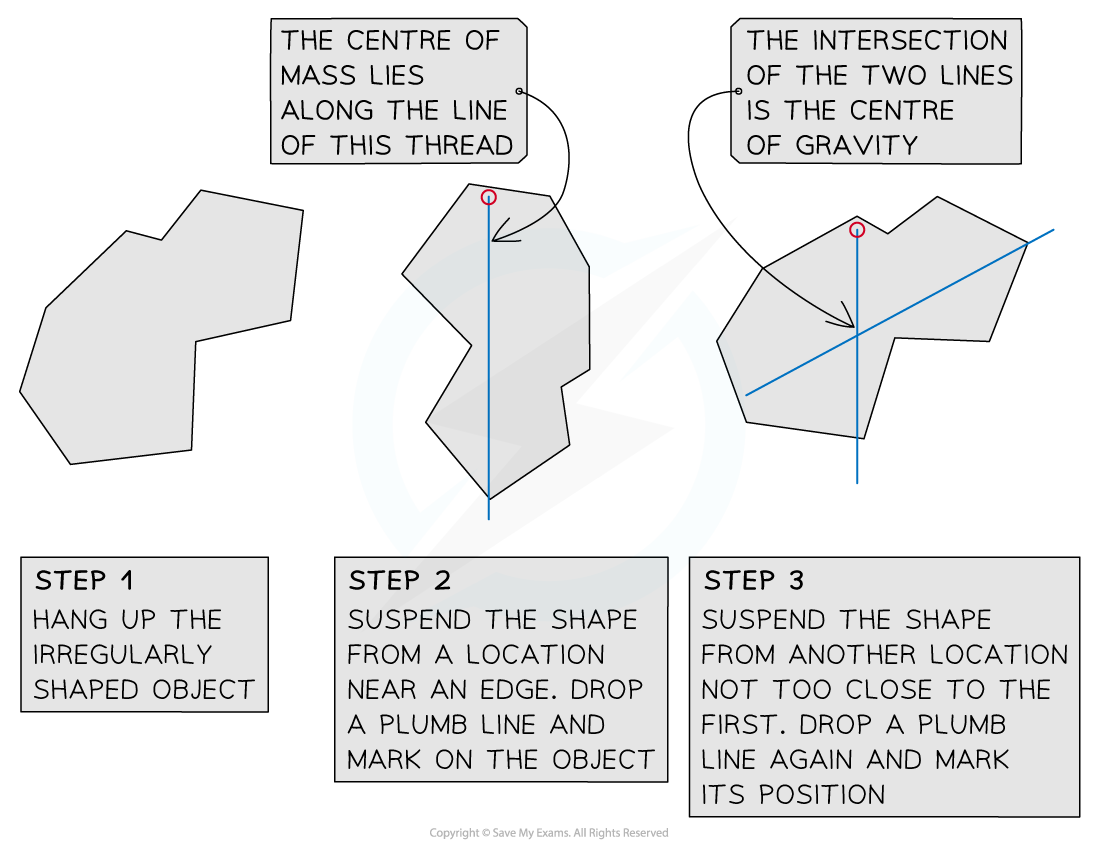
For irregularly shaped objects, the centre of gravity can be found using the suspension method
- Punch three holes near the outer edges of the plane lamina in different locations
- Hang the cork horizontally in the clamp
- Hang the plane lamina on the pin through one of the holes, and check that it can swing freely before it settles
- Use a plumb line (a weighted thread) aligned with the hanging thread to show the line of action of the weight force
- Use a ruler and pencil to mark the line of action of the weight force onto the plane lamina
- Repeat steps 2 to 4, hanging the lamina from a different hole each time, until three lines have been drawn
- The point at which the lines cross is the position of the centre of gravity
- Balance the lamina on the tip of a pin or a sharp pencil at the marked point — if it balances horizontally without tilting, the centre of gravity has been correctly located
Exam Hint Note that two lines are enough to locate the centre of gravity, and the role of the third line is to confirm the first two — if it passes through the same point, the position is right.
Past papers prior to 2023 refer to this as centre of mass rather than centre of gravity, but from 2023 onwards the specification changed to use centre of gravity.
Analysis of results
- When an object is suspended from a point, it will always settle with its centre of gravity directly below the point of suspension
- Because the lamina settles with its centre of gravity directly below the point of suspension, the line drawn along the plumb line must pass through the centre of gravity — which is why two such lines are enough to find it.
Evaluating the experiment
-
Systematic errors
- The plumb line should be viewed straight on to avoid a parallax error
- Check that the lamina swings freely on the pin before taking each reading, as friction at the pin will stop it settling in its true position.
- Dots should be made on the plane lamina whilst in position and then a ruled line should be made after the lamina has been removed from the clamp
- Use a sharp pencil to draw the thin lines as thicker, poorly drawn lines would produce a less accurate result
-
Random errors
- The plane lamina should be allowed to settle before determining the line of action of the weight force
- The holes should be punched in the plane lamina before determining the line of action of the weight force, because punching the holes after can affect the position of the centre of gravity
Safety considerations
- Secure the clamp stand so it cannot topple
- Take care with the sharp pin and push it into a cork when not in use
Was this revision note helpful?
Build on this topic