Centre of Gravity (Cambridge International IGCSE Physics)
Spec point —
1.5.3· State what is meant by centre of gravity
Centre of gravity
- The centre of gravity of an object is defined as:
The point through which the weight of an object acts
-
For a symmetrical object of uniform density, the centre of gravity is located at the point of symmetry
- For example, the centre of gravity of a sphere is at the centre
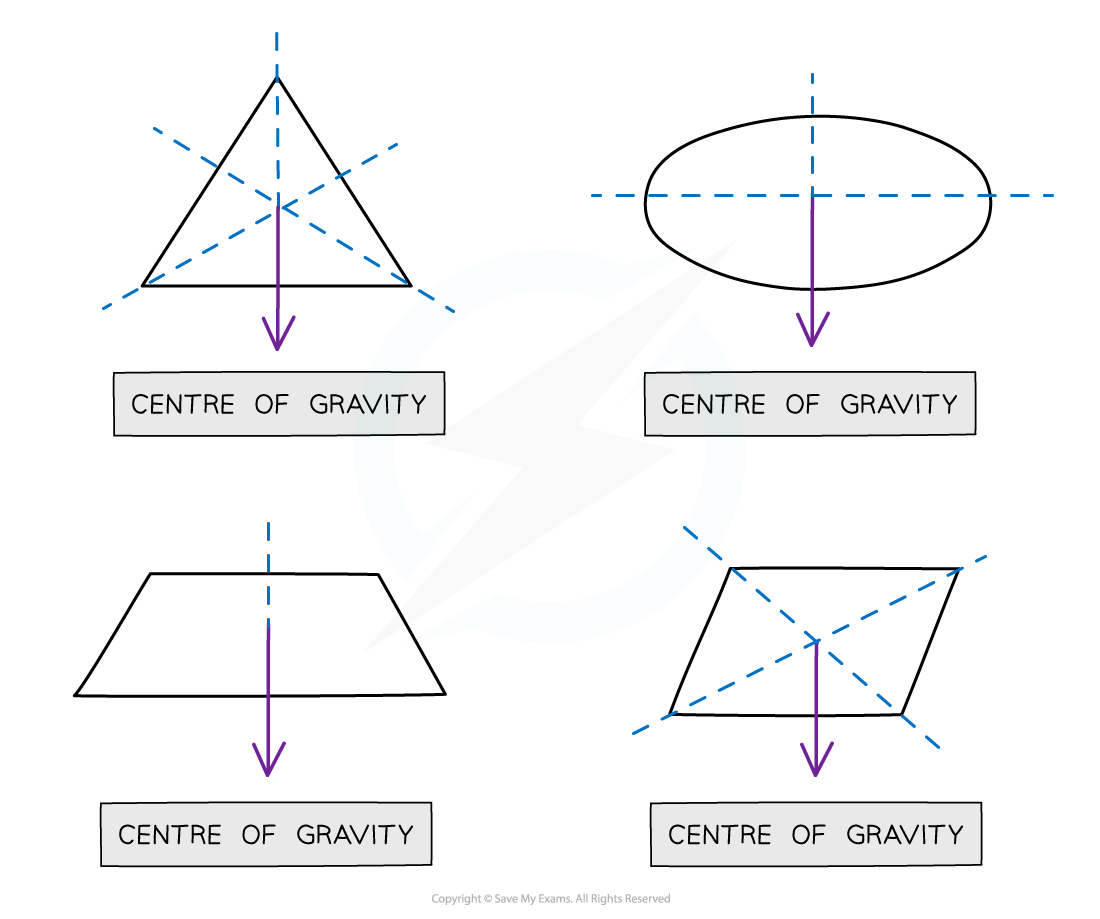
The centre of gravity of a regularly shaped object can be found using symmetry
Exam Hint Since the centre of gravity is a hypothetical point, it can lie inside or outside a body. The centre of gravity will constantly shift depending on the shape of a body. For example, a human body’s centre of gravity is lower when leaning forward than when standing upright
However, when you are drawing force diagrams, always draw the weight force as if it were acting from the centre of gravity of the object.
Stability
Spec point —
1.5.3· Describe, qualitatively, the effect of the position of the centre of gravity on the stability of simple objects
- The position of the centre of gravity affects the stability of an object
- An object is stable when its centre of gravity lies above its base
- If the centre of gravity does not lie above its base, it produces a moment that causes the object to topple over
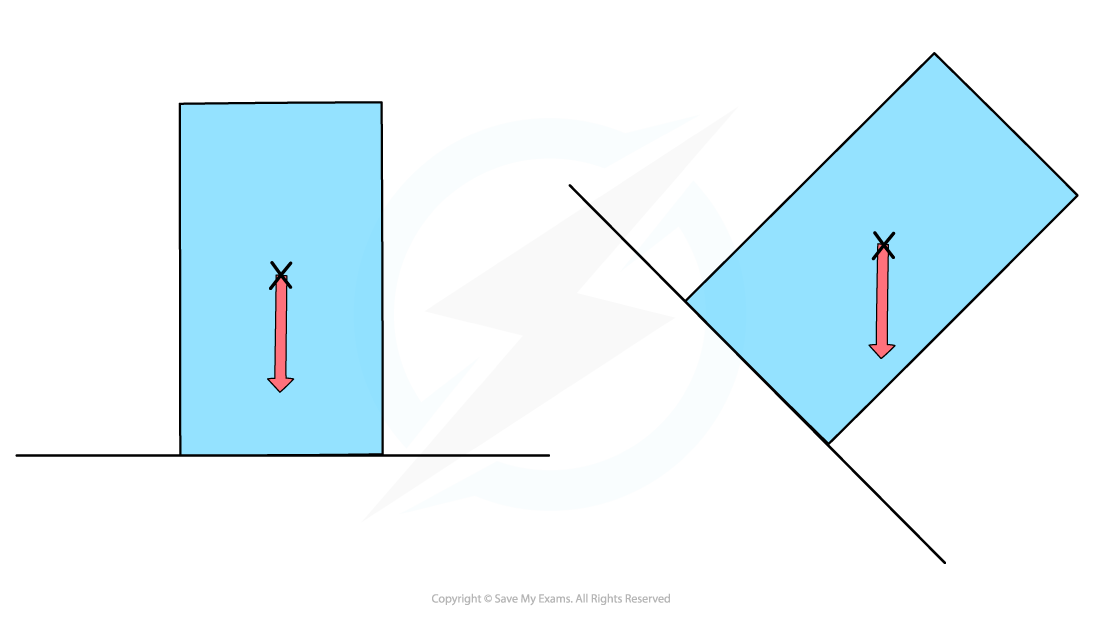
The object will topple when its centre of gravity is no longer over its base
-
The most stable objects have a low centre of gravity and a wide base
- Cars are stable because they have a low centre of gravity and a wide base
-
Taller objects with a narrow base have a higher centre of gravity and are less stable
- This is why high-sided vehicles such as lorries are sometimes advised to avoid exposed bridges on very windy days
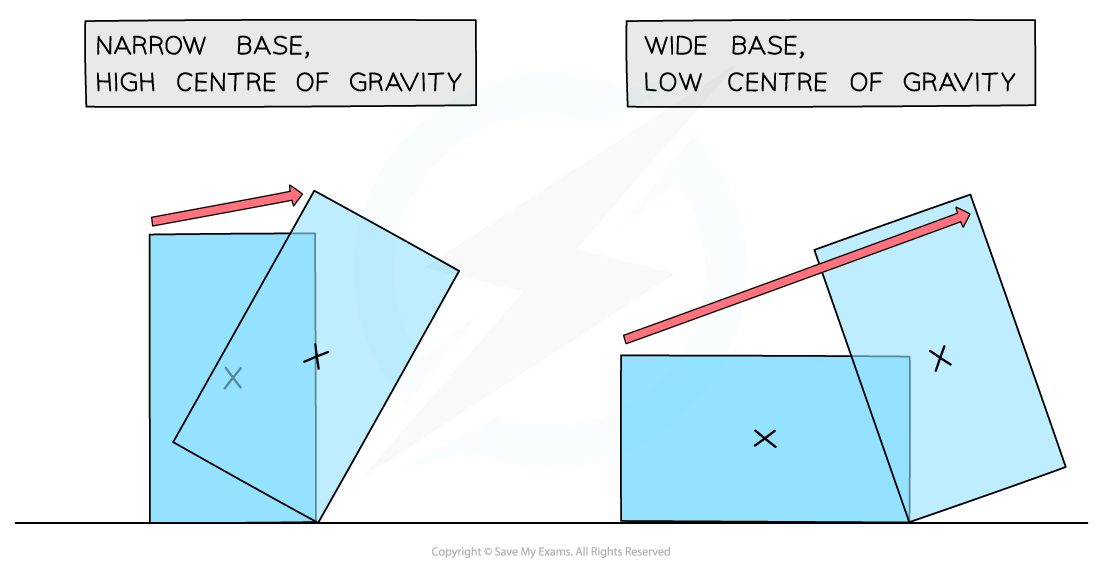
When the object is positioned on its narrow base, it is less stable because its centre of gravity is higher
Moments and stability
- If the line of action of the weight force lies outside the base of the object, there will be a resultant moment, and the body will topple
Car and bus on varying inclines
The car can be tilted to 60° without toppling, but the bus will topple at 45°
-
Tall objects with a narrow base will topple easily
- Ten-pin bowling pins are designed specifically to topple easily
-
The stability of objects can be increased by widening the base
- High chairs are designed with a wide base so that they do not topple
- Bunsen burners have a wide base to ensure they do not topple
Exam Hint You must explicitly link the design choices of objects to the physics principles involved when explaining the stability of objects. For example, increasing the base area will lower the centre of gravity or increase the tipping angle required to knock the object over.
Was this revision note helpful?
Build on this topic