The Life Cycle of Larger Stars (Edexcel IGCSE Physics)
Spec point —
8.10· describe the evolution of stars with a mass larger than the Sun
The life cycle of larger stars
- After the main sequence, a high-mass star finishes its life cycle in the following evolutionary stages:
Red supergiant → supernova → neutron star or black hole
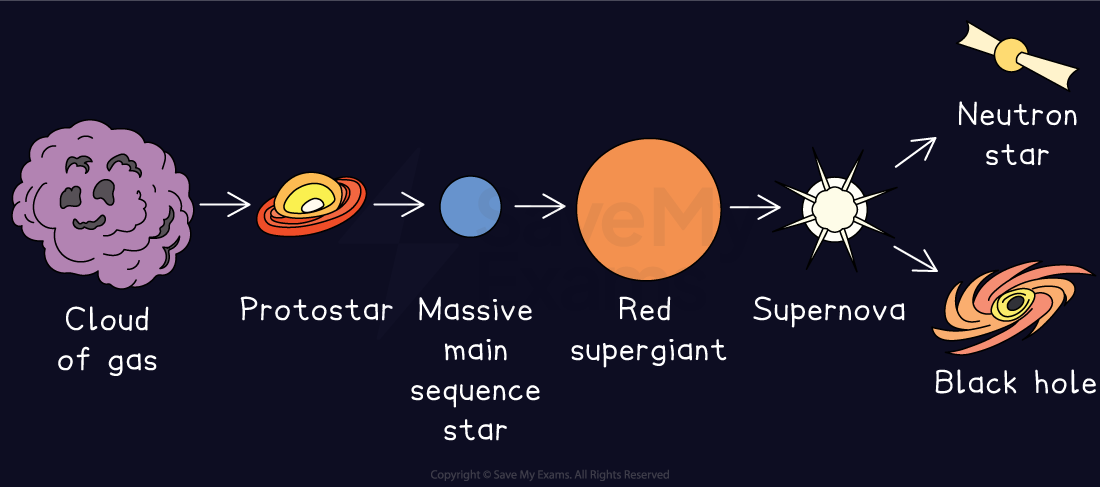
The life cycle of a star much larger than the Sun
-
The key differences between a lower mass and a higher mass star at this stage are:
- A higher mass star will stay on the main sequence for a shorter time before it becomes a red supergiant
- A lower mass star fuses helium into heavy elements, such as carbon, whereas a higher mass star fuses helium into even heavier elements, such as iron
Red supergiant
- After several million years, the hydrogen causing the fusion reactions in the star will begin to run out
- Once this happens, the fusion reactions in the core will start to die down
- The star will begin to fuse helium which causes the outer part of the star to expand
- As the star expands, its surface cools and it becomes a red supergiant
Supernova
-
Once the fusion reactions inside the red supergiant cannot continue, the core of the star will collapse suddenly and cause a gigantic explosion called a supernova
-
At the centre of this explosion, a dense body called a neutron star will form
-
The outer remnants of the star are ejected into space forming new clouds of dust and gas (nebula)
- The heaviest elements are formed during a supernova, and these are ejected into space
- These nebulae may form new planetary systems
Neutron star (or black hole)
-
In the case of the most massive stars, the neutron star that forms at the centre will continue to collapse under the force of gravity until it forms a black hole
- A black hole is an extremely dense object which has a gravitational pull so strong that not even light can escape from it
Exam Hint Make sure you remember the life cycle for a high-mass star and that you can describe the sequence logically in case a 6-marker comes up in the exam!
Ensure you can clearly remember the end stages for a high-mass star (red supergiant, supernova, neutron star/black hole), as this is different from a star that is a similar size to the Sun!
Was this revision note helpful?
Build on this topic