The Life Cycle of Solar Mass Stars (Edexcel IGCSE Physics)
Spec point —
8.9· describe the evolution of stars of similar mass to the Sun through the following stages: • nebula • star (main sequence) • red giant • white dwarf.
The life cycle of solar mass stars
- All stars, including the Sun, began as a cloud of dust and gas
- Once a star has formed, it will spend its life going through a sequence of evolutionary stages, known as the life cycle of a star
Summary of the life cycles of stars
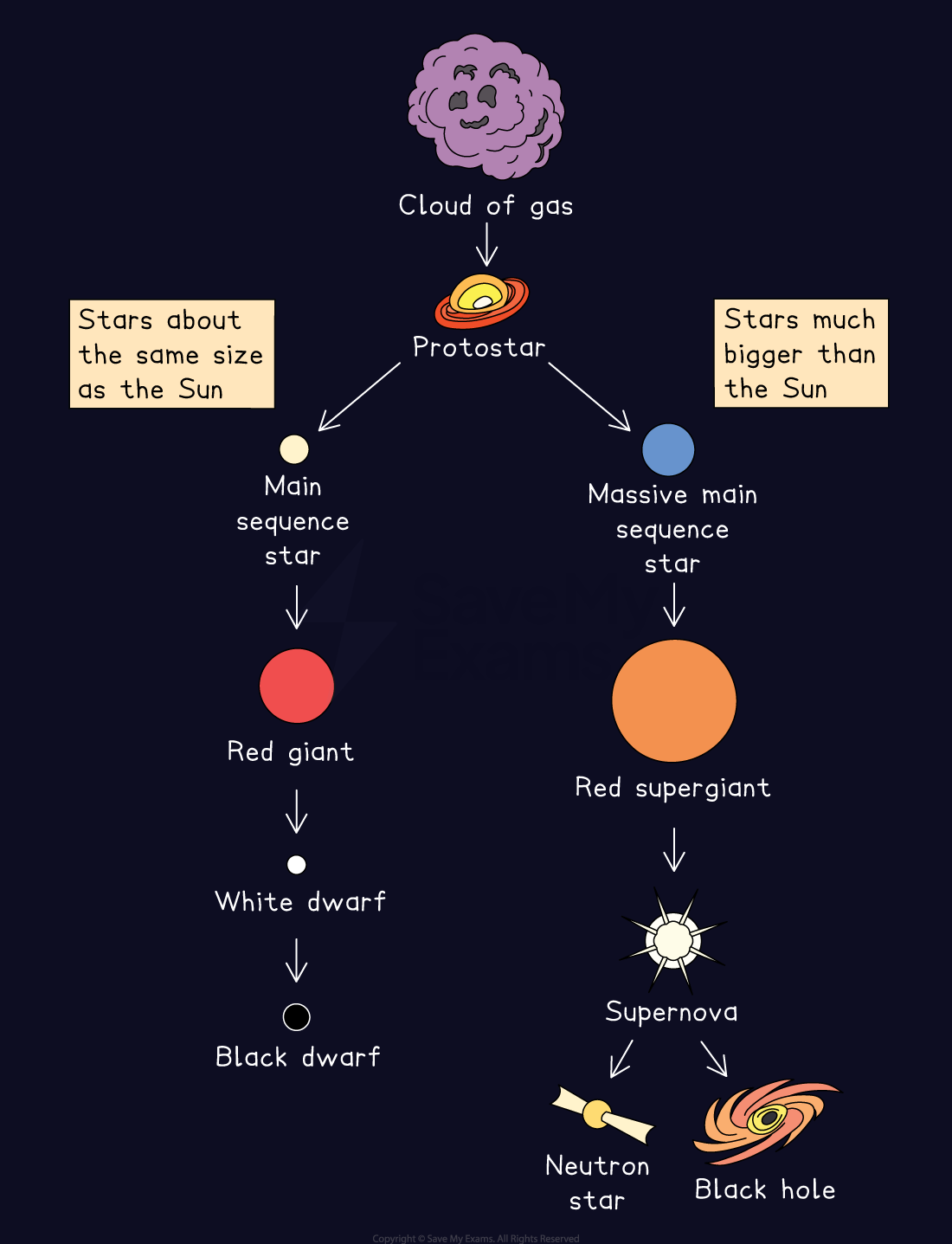
The life cycle of a star depends on whether it is similar in size to the Sun or much larger
Star formation
- All stars follow the same initial stages:
nebula → protostar → main sequence star
Nebula
- Stars form from a giant interstellar cloud of gas and dust called a nebula
Protostar
- The force of gravity within a nebula pulls the particles closer together until a hot ball of gas forms, known as a protostar
- As the particles are pulled closer together the density of the protostar will increase
- This results in more frequent collisions between the particles which causes the temperature to increase
Main sequence star
- Once the protostar becomes hot enough, nuclear fusion reactions occur within its core
- Once a star initiates fusion, it is known as a main sequence star
- During the main sequence, the star is in equilibrium and said to be stable
Evolution of a solar mass star
- After the main sequence, stars which are similar in size to the Sun go through the following evolutionary stages:
main sequence → red giant → white dwarf
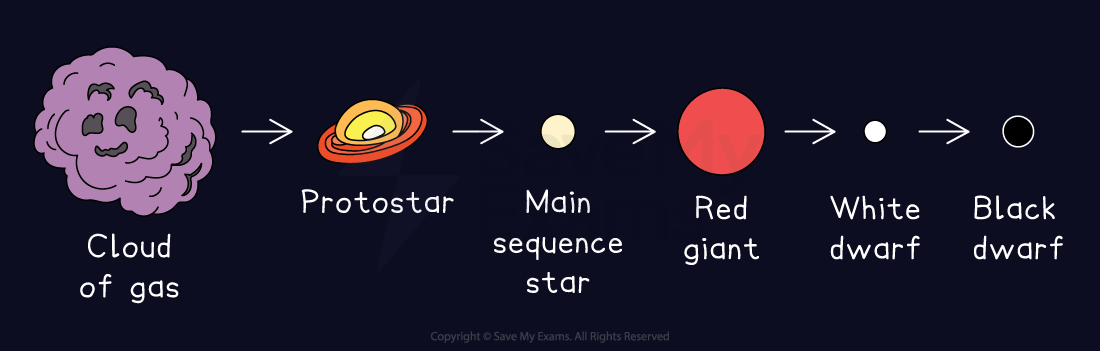
The life cycle of a star that is similar to our Sun
Red giant
- After several billion years, the hydrogen causing the fusion reactions in the star will begin to run out
- Once this happens, the fusion reactions in the core will start to die down
- The star will begin to fuse helium which causes the outer part of the star to expand
- As the star expands, its surface cools and it becomes a red giant
White dwarf
-
Once the helium fusion reactions have finished, the star collapses and becomes a white dwarf
-
The white dwarf cools down over time and as a result, the amount of energy it emits decreases
- Once the star has lost a significant amount of energy and no longer emits light, it becomes a black dwarf
Exam Hint Make sure you remember the life cycle for a solar mass star and ensure you can describe the sequence in a logically structured manner in case a 6 marker comes up in the exam!
Ensure you can remember the end stages for a solar mass star clearly (red giant, then white dwarf), as this is different for a star that is much larger than our Sun!
Video of the Life Cycle of Low-Mass Stars
Spec point — nan
Was this revision note helpful?
Build on this topic