Identifying Devices (Edexcel IGCSE Ict)
Exam board Pearson Edexcel · IGCSEUpdated 2024-06-05
IP Addresses
Spec point —
2.3.1
What is an IP address?
- An IP (Internet Protocol) address is a unique identifier given to devices which communicate over the Internet (WAN)
- IP addresses can be allocated by a network administrator or assigned dynamically by a Dynamic Host Configuration Protocol server (DHCP)
- IP addresses make it possible to deliver data to the right device
- A device connecting to a network will be given an IP address, if it moves to a different network then the IP address will change
IPv4
- Internet Protocol version 4 is represented as 4 blocks of denary numbers between 0 and 255, separated by full stops
- Each block is one byte (8 bits), each address is 4 bytes (32 bits)
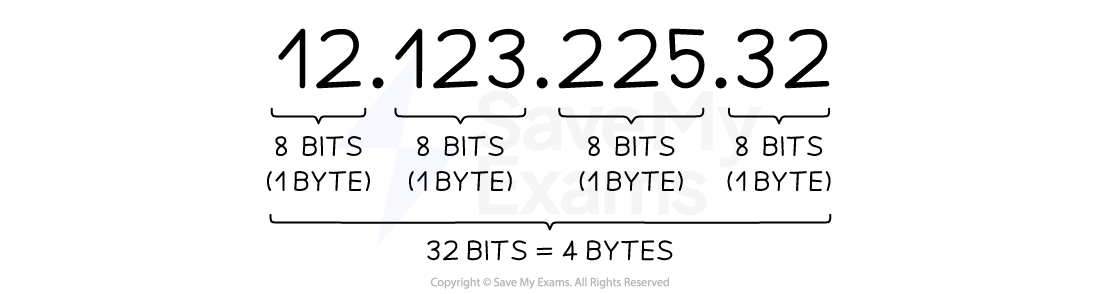
- IPv4 provides over 4 billion unique addresses(232), however, with over 7 billion people and countless devices per person, a solution was needed
IPv6
- Internet Protocol version 6 is represented as 8 blocks of 4 hexadecimal digits, separated by colons
- Each block is 2 bytes (16 bits), each address is 16 bytes (128 bits)
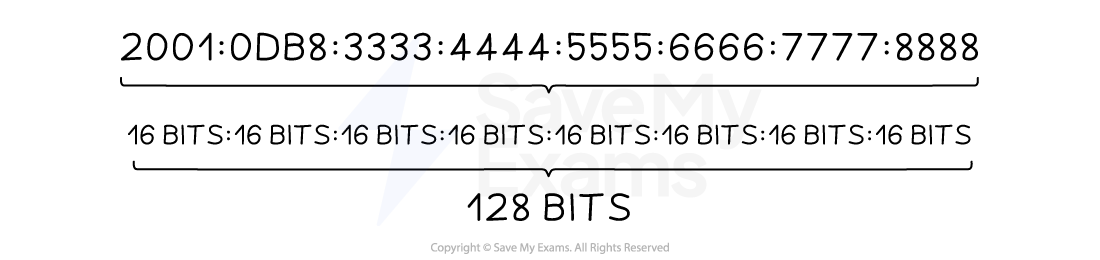
- IPv6 could provide over one billion unique addresses for every person on the planet (2128)
MAC Addresses
Spec point —
2.3.1
What is a MAC address?
- A MAC (Media Access Control) address is a universally unique identifier given to devices which communicate over a local area network (LAN)
- MAC addresses are static, they can never change
- MAC addresses make it possible for switches to efficiently forward data to the intended recipient
- Any device that contains a Network Interface Card (NIC) has a MAC address assigned during manufacturing
- A device connecting to a local network already has a MAC address, if it moves to a different network then the MAC address will stay the same
-
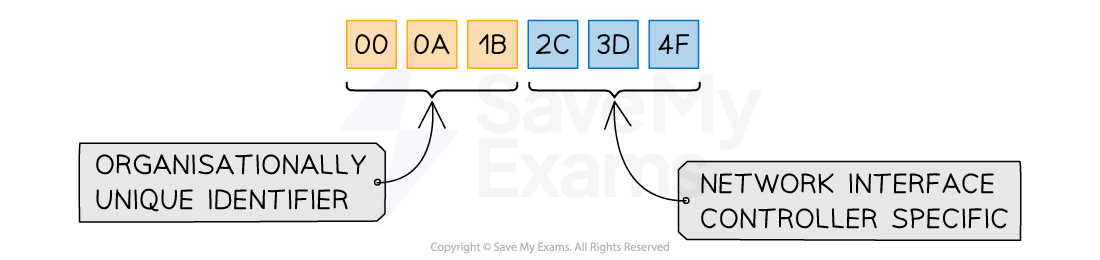
A MAC address is represented as 12 hexadecimal digits (48 bits), usually grouped in pairs
-
The first three pairs are the manufacturer ID number (OUI) and the last three pairs are the serial number of the network interface card (NIC)
-
There are enough unique MAC addresses for roughly 281 trillion devices
-
MAC addresses can be used to:
- Restrict or allow access to a network
- Identify a device on a network
- Track a device
- Assign 'static' or 'fixed' IP addresses
Device name
Spec point —
2.3.1
What is a device name?
- A device name is a way for users to describe/name a device so that it is easier to identify on a network
- Device names are not used by devices to communicate as they are not always unique
- Device names are set by users in the devices operating system or from a router
Worked Example Computers in a network can be identified using both IP addresses and MAC addresses.
Describe two differences between IP addresses and MAC addresses
[2]
Answer
- IP address is dynamic/can change // MAC address is static/cannot change [1]
- IP address is used to communicate on a WAN/Internet // MAC address is used to communicate on a LAN [1]
Was this revision note helpful?
Build on this topic