Methods of Securing a Network (Edexcel IGCSE Ict)
Usernames & Passwords
Spec point —
2.5.1
How does a password help?
- Passwords are a digital lock to prevent unauthorised access to an account
- Passwords are used to authenticate **a user to the network
- They are often stored as an encrypted/ciphered text entry in a database, ensuring that even with unauthorised access to a database, a hacker would not be able to gain access to the individual passwords of users -** Strong passwords and regular password changes are important to maintain security

Firewalls
Spec point —
2.5.1
What is a firewall?
-
A firewall is a barrier between a network and the internet
-
A firewall prevents unwanted traffic from entering a network by filtering requests to ensure they are legitimate
-
It can be both hardware and software and they are often used together to provide stronger security to a network
- Hardware firewalls will protect the whole network and prevent unauthorised traffic
- Software firewalls will protect the individual devices on the network, monitoring the data going to and from each computer
Encryption
Spec point —
2.5.1
What is encryption?
-
Encryption is a method of scrambling data so that unauthorised users cannot understand it
-
Encryption methods use 'keys', which are specialised programs designed to scramble or unscramble data
-
Encryption uses complex mathematical algorithms to scramble the data
-
There are two common methods of encryption:
- Symmetric
- Public key
Symmetric encryption
- The sender uses a key to encrypt the data before transmission
- The receiver uses the same key to decrypt the data
- It's usually faster, making it ideal for encrypting large amounts of data
- The significant downside is the challenge of securely sharing this key between the sender and receiver
- If an unauthorised user captures the key, they can decrypt all messages intercepted in transmission
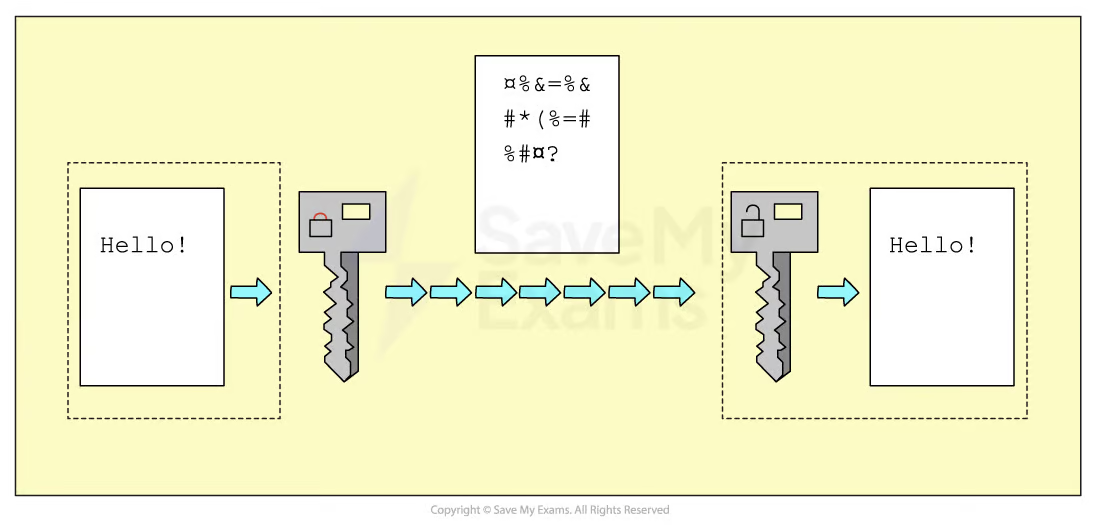
Structure of Symmetric Encryption
Public key encryption
-
Public key encryption uses two keys:
- a public key for encryption
- and a private key for decryption
-
Receivers openly share their public key
-
Senders use this public key to encrypt the data
-
The receiver's private key is the only key that can decrypt the data and is kept locally on their side
-
The public and private keys are created at the same time and are designed to work together in this way
-
It is typically slower than symmetric encryption
-
It is generally used for more secure and smaller data transactions, e.g. passwords, bank details
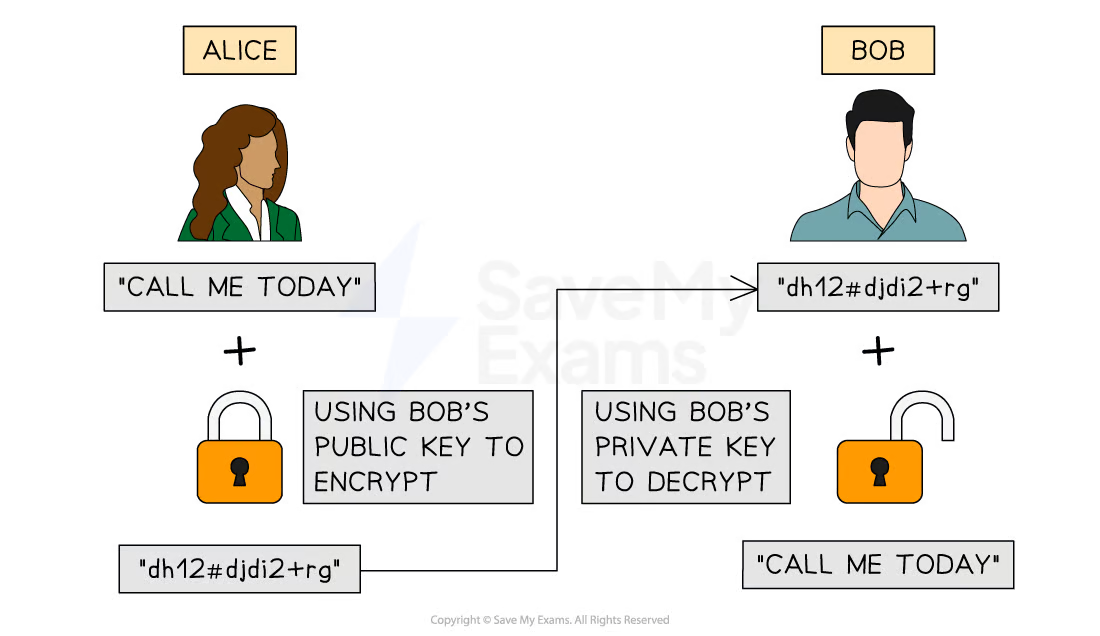
Structure of Public Key Encryption
WEP/WPA
Spec point —
2.5.1
What is WEP?
- Wireless Encryption Protocol (WEP) is a method of encrypting data being transmitted on a wireless network
- Each device on the network uses the same key to encrypt and decrypt data
- It is a less secure encryption method due to all devices on the network sharing the same key
- Eavesdropping software (packet sniffers) can be used to intercept data packets and identify the key
What is WPA?
- Wi-fi Protected Access (WPA) is a more secure method of encrypting data being transmitted on a **wireless **network
- Each device connected to the network receives a different key
- New keys are used for** every packet** transmitted on the network
Virtual private networks (VPN)
Spec point —
2.5.1
What is a VPN?
-
A VPN allows users to remotely connect to private local area networks (LANs)
-
All data sent and received using a VPN is encrypted
-
Common uses of a VPN include:
- Remotely accessing a companies network (working from home)
- Making secure payments
- Hiding web activities
- Bypassing geolocation rights management or online censorship
File access rights
Spec point —
2.5.1
What are file access rights?
-
File access rights can be set to determine different levels of access to specific files/folders
-
Examples of file permissions include:
- Read- can read the contents of a file only
- Write- can make changes to file contents and/or create new files
- Delete- can delete files
- Execute- can run applications/launch software
Transaction logs & backups
Spec point —
2.5.1
What is a transaction log?
-
A transaction log is a secure file on a network that keeps a record of every action performed by devices on a network
-
Transactions logs include:
- Device & data access
- Timestamps
- User IDs
- Successful/failed login attempts
-
Transaction logs don't directly protect a network, they help administrators monitor any identify any unusual activity
-
Backups are another indirect method of protecting a network
-
Keeping copies of data in a secure place on the network in the event of a data breach/loss
Worked Example Describe one method that could be used to secure payment data transferred between a server and other computers
[3]
Answer
A description to include three linked points:
- Encryption [1] encodes/scrambles data / makes data unreadable [1] using a key [1]
Was this revision note helpful?
Build on this topic