Electronic Configurations (Edexcel IGCSE Chemistry)
Guided lessons are live for this note
Work through it step by step — key points, depth layers, a worked example and self-checks.
Deducing Electronic Configurations
Spec point — understand how to deduce the electronic configurations of the first 20 elements from their positions in the Periodic Table
Electronic configuration of the first 20 elements
-
We can represent the structure of the atom in two ways: using diagrams called electron shell diagrams or by writing out a special notation called the electronic configuration(or electronic structure or electron distribution)
-
Electrons orbit the nucleus in shells (or energy levels) and each shell has a different amount of energy associated with it
-
The further away from the nucleus, the more energy a shell has
-
Electrons fill the shell closest to the nucleus
-
When a shell becomes full of electrons, additional electrons have to be added to the next shell
- The first shell can hold 2 electrons
- The second shell can hold 8 electrons
- For this course, a simplified model is used that suggests that the third shell can hold 8 electrons
- For the first 20 elements, once the third shell has 8 electrons, the fourth shell begins to fill
Electron shell diagram
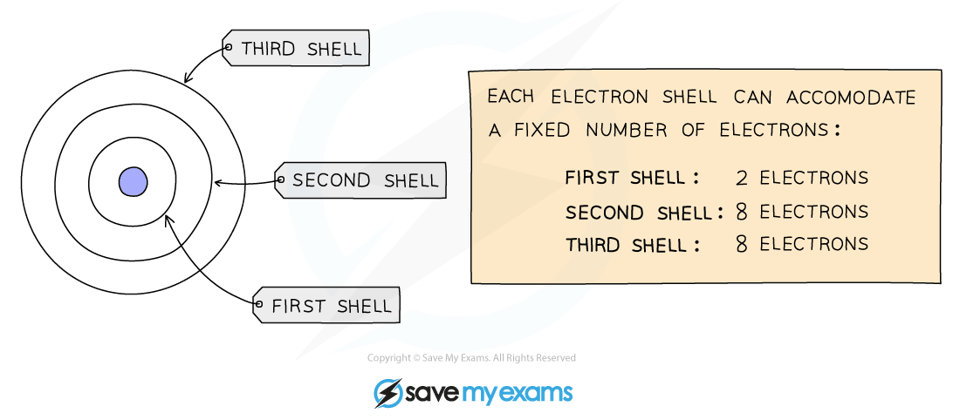
A simplified model showing the electron shells
-
The arrangement of electrons in shells can also be explained using numbers
-
Instead of drawing electron shell diagrams, the number of electrons in each electron shell can be written down, separated by commas
-
This notation is called the electronic configuration (or electronic structure)
-
The electronic structure of carbon is 6 electrons, 2 in the 1st shell and 4 in the 2nd shell
- So its electronic configuration is 2,4
-
-
Electronic configurations can also be written for ions
-
E.g. A sodium atom has 11 electrons, a sodium ion has lost one electron, therefore has 10 electrons; 2 in the first shell and 8 in the 2nd shell
- Its electronic configuration is 2,8
-
-
You should be able to write the electron configuration for the first twenty elements
Electronic configurations of the first 20 elements
| Element | Atomic Number | Electronic Configuration |
|---|---|---|
| hydrogen | 1 | 1 |
| helium | 2 | 2 |
| lithium | 3 | 2,1 |
| beryllium | 4 | 2,2 |
| boron | 5 | 2,3 |
| carbon | 6 | 2,4 |
| nitrogen | 7 | 2,5 |
| oxygen | 8 | 2,6 |
| fluorine | 9 | 2,7 |
| neon | 10 | 2,8 |
| sodium | 11 | 2,8,1 |
| magnesium | 12 | 2,8,2 |
| aluminium | 13 | 2,8,3 |
| silicon | 14 | 2,8,4 |
| phosphorus | 15 | 2,8,5 |
| sulfur | 16 | 2,8,6 |
| chlorine | 17 | 2,8,7 |
| argon | 18 | 2,8,8 |
| potassium | 19 | 2,8,8,1 |
| calcium | 20 | 2,8,8,2 |
Note: Although the third shell can hold up to 18 electrons, the filling of the shells follows a more complicated pattern after potassium and calcium. For these two elements, the third shell holds 8 and the remaining electrons (for reasons of stability) occupy the fourth shell first before filling the third shell
Exam Hint You should be able to represent the first 20 elements using either electron shell diagrams or written electronic configuration.
Electronic Configurations & the Periodic Table
Spec point — understand how the electronic configuration of a main group element is related to its position in the Periodic Table
Electronic configurations and the periodic table
-
There is a clear relationship between the electronic configuration and how the Periodic Table is designed
-
The number of notations in the electronic configuration tells us the number of occupied shells
- This tells us what period an element is in
-
The last notation shows the number of outer electrons the atom has
- This tells us the group an element is in
-
Elements in the same group have the same number of outer shell electrons
The relationship between the electronic configurations and periodic table
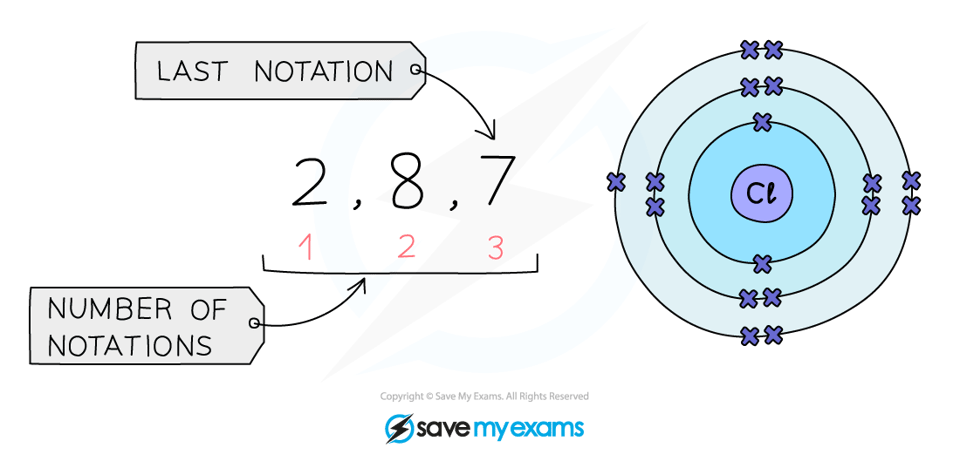
The electronic configuration for chlorine
-
Period: The red numbers at the bottom show the number of notations
- The number of notations is 3
- Therefore chlorine has 3 occupied shells
-
Group: The last notation, in this case 7
- This means that chlorine has 7 electrons in its outer shell
- Chlorine is therefore in Group 7
The position of chlorine on the periodic table
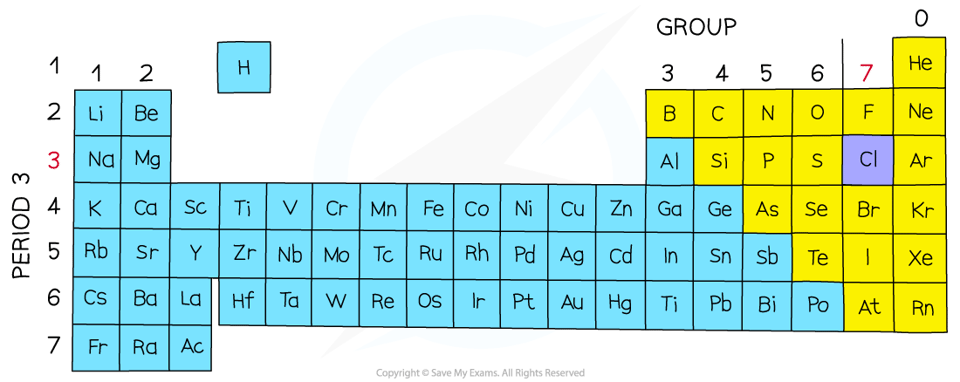
Chlorine is in Group 7, Period 3
Exam Hint The group number will be labelled on the Periodic Table you are given in your exam, but the period number isn't so it is a good idea to write this on yourself at the beginning.
Was this revision note helpful?
Build on this topic