Naming Organic Compounds (Edexcel IGCSE Chemistry)
Guided lessons are live for this note
Work through it step by step — key points, depth layers, a worked example and self-checks.
Spec point — understand how to name compounds relevant to this specification using the rules of International Union of Pure and Applied Chemistry (IUPAC) nomenclature students will be expected to name compounds containing up to six carbon atoms
Naming organic compounds
Names of compounds
- The names of organic compounds have two parts: the prefix or stem and the end part (or suffix)
- The prefix tells you how many carbon atoms are present in the longest continuous chain in the compound
- The suffix tells you what functional group is on the compound
Examples of naming organic molecules
| First part of name | Second part of name | |||
|---|---|---|---|---|
| Name | Number of carbon atoms | Name | Functional group | Family |
| Meth... | 1 | ...ane | None | Alkane |
| Eth... | 2 | ...ene | C=C bond | Alkene |
| Prop... | 3 | ...anol | R-OH | Alcohol |
| But... | 4 | ...anoic acid | R-C=O-OH | Carboxylic acid |
| Pent... | 5 | ....amine | R-NH2 | Amine |
| Hex... | 6 | ...yl ...anoate | R-C=O-O-R | Ester |
Further rules for naming compounds
- When there is more than one carbon atom where a functional group can be located it is important to distinguish exactly which carbon the functional group is on
- Each carbon is numbered and these numbers are used to describe where the functional group is
- When 2 functional groups are present di- is used as a prefix to the second part of the name
Naming isomers
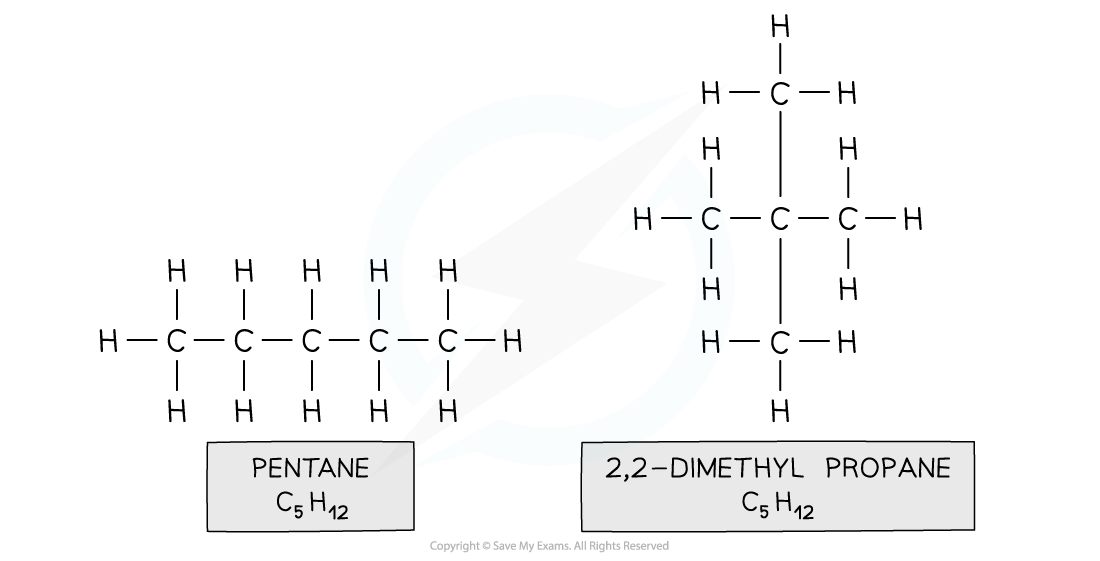
Isomers can be distinguished by following the naming rules
Exam Hint For Double Award, you’re mainly expected to name simple (straight-chain) compounds and unbranched isomers.
You might still see branched names in questions, so make sure you understand that the numbers show the positions of side chains, but you usually won’t need to generate branched names from scratch
Was this revision note helpful?
Build on this topic