Calorimetry
2 guided lessons · 18 checks · 3. Physical Chemistry → Energetics
Guided lessons for this note
Which concept don't you understand yet?
We'll explain it simply and check your understanding. Pick any lesson — any order works.
0 of 18 checks correct so far
Lesson 1 of 2
Calorimetry for reactions in solution
Mixing two solutions and watching the thermometer is the simplest energy measurement in chemistry. This lesson shows the insulated set-up that keeps the heat in and the working assumptions that let the numbers be trusted.
What you know already
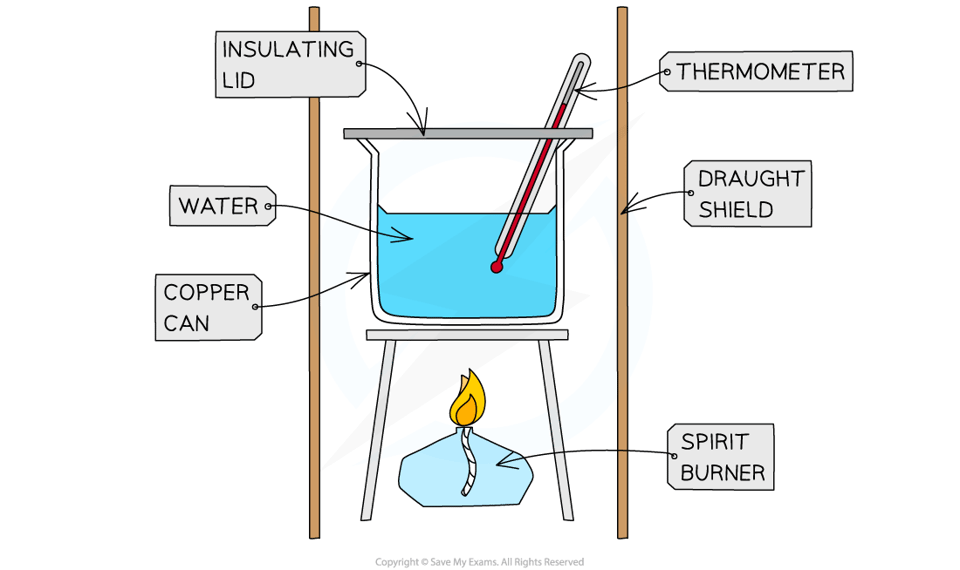
From Exothermic & Endothermic you already know that reactions hand heat to their surroundings or take it from them. This note shows how simple calorimetry turns that heat into numbers you can compare, first for reactions mixed in solution and then for burning fuels. It ends with the errors that spoil the measurement and how to shut them down.
Key points of understanding
- The energy produced by a reaction in solution is found by measuring the temperature change when the solutions are mixed.
- The solutions are mixed in an insulated container to prevent heat loss to the surroundings.
- Solution calorimetry suits neutralisation reactions, dissolving solids in water and displacement reactions.
- A simple calorimeter can be a polystyrene cup, a vacuum flask or a metal can.
- Assumptions include a specific heat capacity of 4.18 J/g/°C, a density of 1 g/cm3 and negligible heat losses.
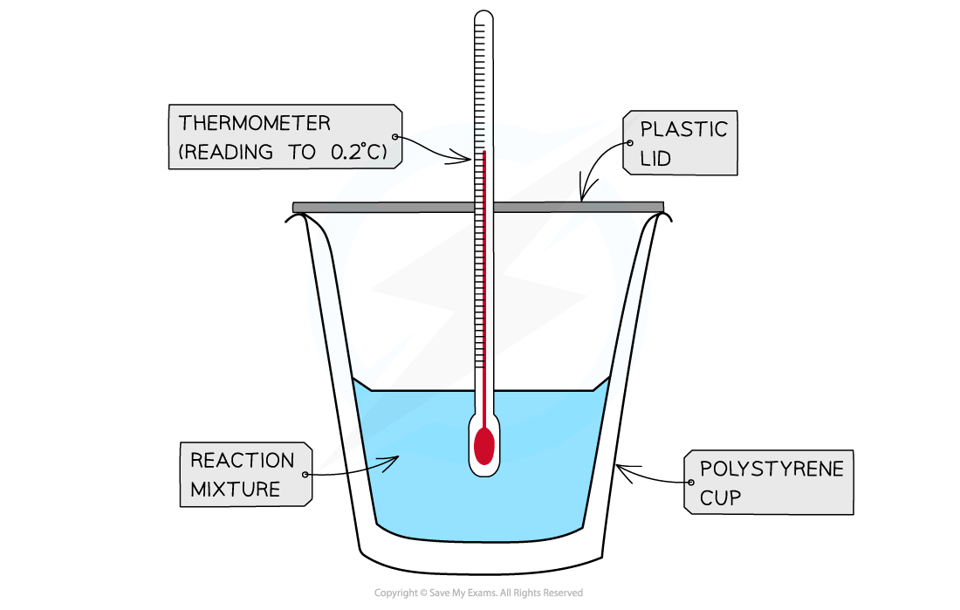
A polystyrene cup can act as a calorimeter to find enthalpy changes in a chemical reaction
Choose a confidence level to continue.
Prefer to read it all at once? Show the full lesson as a page
1.Calorimetry for reactions in solution
Mixing two solutions and watching the thermometer is the simplest energy measurement in chemistry. This lesson shows the insulated set-up that keeps the heat in and the working assumptions that let the numbers be trusted.
A polystyrene cup can act as a calorimeter to find enthalpy changes in a chemical reaction
Key points
- The energy produced by a reaction in solution is found by measuring the temperature change when the solutions are mixed.
- The solutions are mixed in an insulated container to prevent heat loss to the surroundings.
- Solution calorimetry suits neutralisation reactions, dissolving solids in water and displacement reactions.
Guided content from the SME authoring corpus — note rn_w25KHshCMNQWwftj, pinned at 51a6ed34e715 · promoted SyllabAI/syllabai-resources e967e75f1339