Manufacture of Ethanol
2 guided lessons · 18 checks · 4. Organic Chemistry → Alcohols
Guided lessons for this note
Which concept don't you understand yet?
We'll explain it simply and check your understanding. Pick any lesson — any order works.
0 of 18 checks correct so far
Lesson 1 of 2
Hydration of ethene
Industry builds ethanol from ethene, the short alkene that cracking hands over in bulk. This lesson states the three conditions that switch the reaction on and follows the exit mixture through the condenser, where everything is sorted by boiling point.
What you know already
From the previous note you already know the two-carbon alcohol and its eagerness to meet oxygen. This note steps back to ask where industrial ethanol comes from: an oil-derived alkene joined with steam in one route, and living yeast digesting sugar in the other.
Key points of understanding
- The ethene feedstock comes from the cracking of hydrocarbons.
- Steam adds across the ethene double bond using a concentrated phosphoric acid catalyst.
- The conditions are a temperature of about 300 degrees Celsius and a pressure of 60 to 70 atmospheres.
- Unreacted ethene leaves first because it boils at minus 103 degrees, far below the liquids.
- The ethanol and water are then separated by fractional distillation.
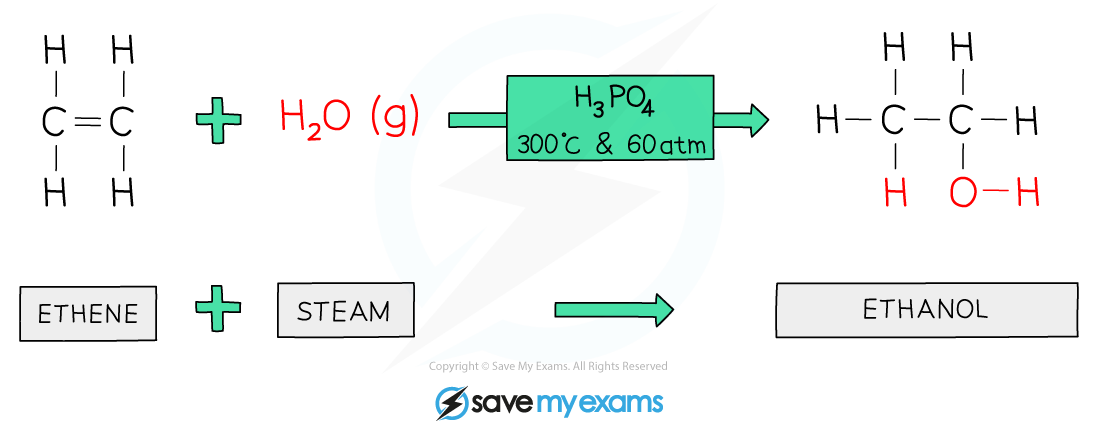
A water molecule adds across the C=C in the hydration of ethene to produce ethanol
Choose a confidence level to continue.
Prefer to read it all at once? Show the full lesson as a page
1.Hydration of ethene
Industry builds ethanol from ethene, the short alkene that cracking hands over in bulk. This lesson states the three conditions that switch the reaction on and follows the exit mixture through the condenser, where everything is sorted by boiling point.
A water molecule adds across the C=C in the hydration of ethene to produce ethanol
Key points
- The ethene feedstock comes from the cracking of hydrocarbons.
- Steam adds across the ethene double bond using a concentrated phosphoric acid catalyst.
- The conditions are a temperature of about 300 degrees Celsius and a pressure of 60 to 70 atmospheres.
Guided content from the SME authoring corpus — note rn_ncFJkGhXFsKrkNkH, pinned at 45d591243cae · promoted SyllabAI/syllabai-resources e967e75f1339