Practical: Investigate the Electrolysis of Aqueous Solutions
2 guided lessons · 18 checks · 1. Principles of Chemistry → Electrolysis
Guided lessons for this note
Which concept don't you understand yet?
We'll explain it simply and check your understanding. Pick any lesson — any order works.
0 of 18 checks correct so far
Lesson 1 of 2
Method & testing the products
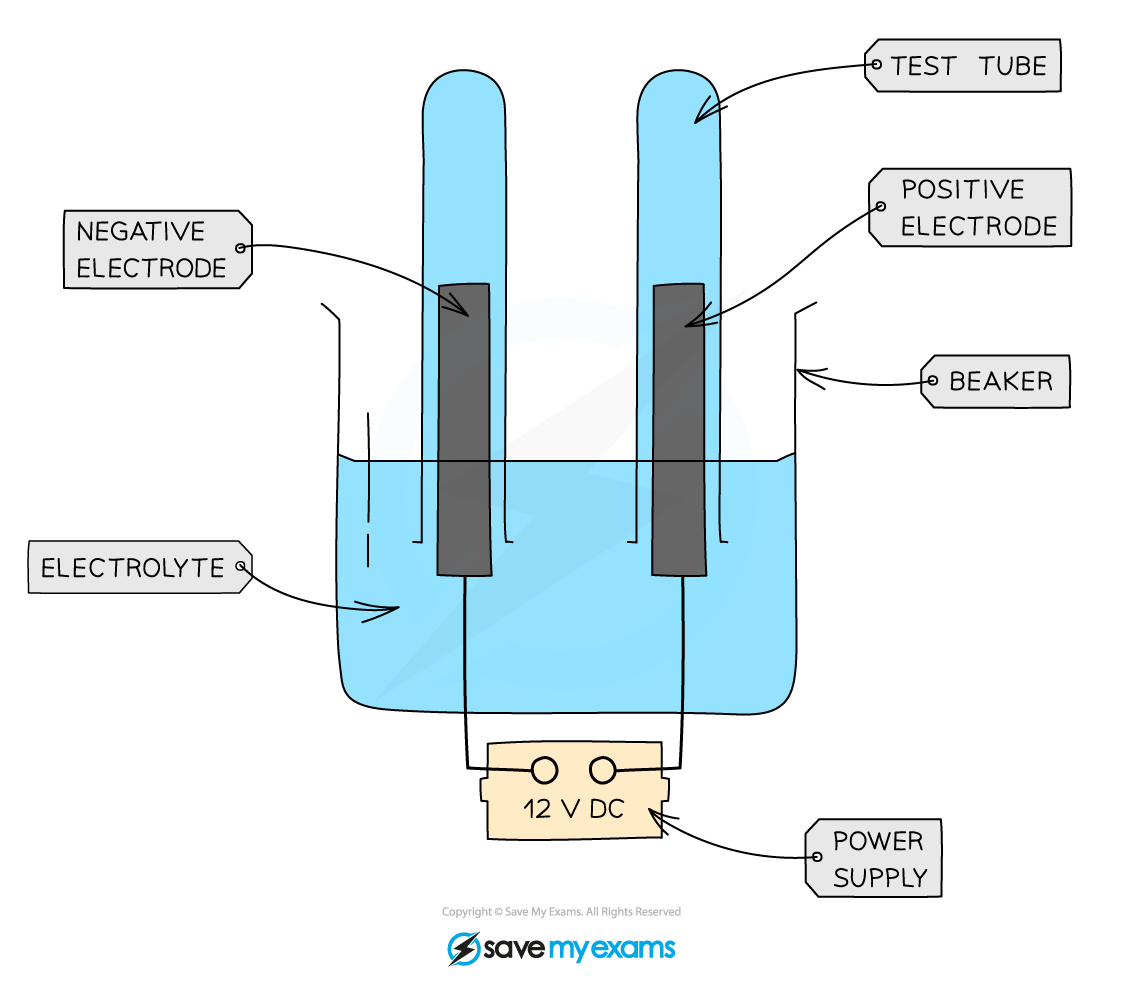
The experiment electrolyses three solutions, sodium chloride, dilute sulfuric acid and copper(II) sulfate, in a beaker whose electrodes are covered by the liquid. Two inverted test tubes sit over the electrodes to catch any gas, a power pack drives the current, and each collected sample is then tested: a lighted splint for hydrogen, a glowing splint for oxygen, and litmus paper for chlorine.
What you know already
From Electrolysis Experiments you know the apparatus and the prediction rules for aqueous electrolysis. This note is the practical itself: electrolyse three named solutions in the lab, collect the gases in inverted test tubes, run the identity tests, and read the products straight off what appears at each electrode.
Key points of understanding
- The aim is to electrolyse sodium chloride, dilute sulfuric acid and copper(II) sulfate solutions, collecting and identifying the products.
- The electrodes are covered with the solution, and two inverted test tubes sit over them to collect gases.
- The electrodes connect to a power pack or battery, which is switched on to let electrolysis take place.
- A gas that burns with a pop from a lighted splint is hydrogen, collected at the cathode.
- A gas that relights a glowing splint is oxygen, and a gas that bleaches litmus is chlorine.
Choose a confidence level to continue.
Prefer to read it all at once? Show the full lesson as a page
1.Method & testing the products
The experiment electrolyses three solutions, sodium chloride, dilute sulfuric acid and copper(II) sulfate, in a beaker whose electrodes are covered by the liquid. Two inverted test tubes sit over the electrodes to catch any gas, a power pack drives the current, and each collected sample is then tested: a lighted splint for hydrogen, a glowing splint for oxygen, and litmus paper for chlorine.
Key points
- The aim is to electrolyse sodium chloride, dilute sulfuric acid and copper(II) sulfate solutions, collecting and identifying the products.
- The electrodes are covered with the solution, and two inverted test tubes sit over them to collect gases.
- The electrodes connect to a power pack or battery, which is switched on to let electrolysis take place.
- A gas that burns with a pop from a lighted splint is hydrogen, collected at the cathode.
- A gas that relights a glowing splint is oxygen, and a gas that bleaches litmus is chlorine.
Guided content from the SME authoring corpus — note rn_kdRjZHjHcpVZsD3h, pinned at fa1f302050ba · promoted SyllabAI/syllabai-resources e967e75f1339