Tests for Anions
3 guided lessons · 27 checks · 2. Inorganic Chemistry → Chemical Tests
Guided lessons for this note
Which concept don't you understand yet?
We'll explain it simply and check your understanding. Pick any lesson — any order works.
0 of 27 checks correct so far
Lesson 1 of 3
Test for carbonate ions
Three quick tests between them identify every anion this note covers, and this lesson takes the first: the carbonate ion. A carbonate is a compound carrying CO3 2–, and acid plus limewater exposes it in seconds. The star of the test is carbon dioxide, the gas that turns limewater cloudy.
What you know already
You already know from Ionic Bonding how atoms gain or lose electrons to form ions, and that negative ions are called anions. That vocabulary is exactly what this note needs, because every test here is designed to detect one specific anion in solution. You will meet three short, parallel procedures: one for carbonate ions, one for halide ions, and one for sulfate ions, each ending in a visible positive result.
Key points of understanding
- A carbonate compound fizzes with dilute acid because carbon dioxide gas is produced.
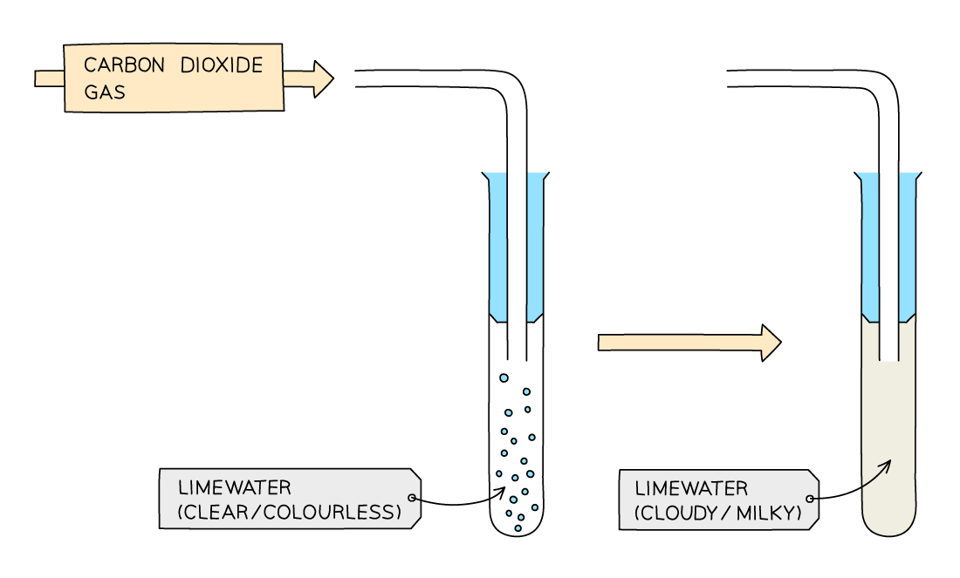
- The test adds dilute acid, then bubbles the gas released through limewater.
- Limewater turning cloudy is the positive result for the carbonate ion.
- The cloudiness is a white precipitate of calcium carbonate forming in the limewater.
- Ionic form: CO3 2– (aq) + 2H+ (aq) → CO2 (g) + H2O (l).
Choose a confidence level to continue.
Prefer to read it all at once? Show the full lesson as a page
1.Test for carbonate ions
Three quick tests between them identify every anion this note covers, and this lesson takes the first: the carbonate ion. A carbonate is a compound carrying CO3 2–, and acid plus limewater exposes it in seconds. The star of the test is carbon dioxide, the gas that turns limewater cloudy.
Key points
- A carbonate compound fizzes with dilute acid because carbon dioxide gas is produced.
- The test adds dilute acid, then bubbles the gas released through limewater.
- Limewater turning cloudy is the positive result for the carbonate ion.
- The cloudiness is a white precipitate of calcium carbonate forming in the limewater.
- Ionic form: CO3 2– (aq) + 2H+ (aq) → CO2 (g) + H2O (l).
Guided content from the SME authoring corpus — note rn_kJg2gwF77vdFZZ2H, pinned at 78ad6a2073c6 · promoted SyllabAI/syllabai-resources e967e75f1339