Group 7: Reactivity & Electronic Configurations
2 guided lessons · 18 checks · 2. Inorganic Chemistry → Group 7 (Halogens)
Guided lessons for this note
Which concept don't you understand yet?
We'll explain it simply and check your understanding. Pick any lesson — any order works.
0 of 18 checks correct so far
Lesson 1 of 2
Group 7: Reactivity & Electronic Configurations
When halogen atoms react they gain one electron to complete their outer shell, forming negative ions called halide ions. This gain is what makes them reactive, and how easily it happens decides the reactivity order. Down the group the growing number of shells pushes the outer shell further from the nucleus, so the reactivity of the halogens decreases.
What you know already
From Group 7 (Halogens) you already know that each halogen carries seven electrons in its outer shell and commonly forms a 1- ion. This note explains why reactivity falls down the group: gaining that extra electron becomes harder the further the outer shell sits from the nucleus, which is the exact opposite of the Group 1 pattern.
Key points of understanding
- Halogen atoms gain one electron during reactions to form -1 ions called halide ions.
- Reactivity of the Group 7 non-metals decreases as you go down the group.
- The number of electron shells increases by one with each element down the group.
- The growing distance from the outer shell to the nucleus makes the halogens less reactive.
- Fluorine, with the smallest atom, is the most reactive halogen in the group.
Choose a confidence level to continue.
Prefer to read it all at once? Show the full lesson as a page
1.Group 7: Reactivity & Electronic Configurations
When halogen atoms react they gain one electron to complete their outer shell, forming negative ions called halide ions. This gain is what makes them reactive, and how easily it happens decides the reactivity order. Down the group the growing number of shells pushes the outer shell further from the nucleus, so the reactivity of the halogens decreases.
Key points
- Halogen atoms gain one electron during reactions to form -1 ions called halide ions.
- Reactivity of the Group 7 non-metals decreases as you go down the group.
- The number of electron shells increases by one with each element down the group.
- The growing distance from the outer shell to the nucleus makes the halogens less reactive.
- Fluorine, with the smallest atom, is the most reactive halogen in the group.
First pass
Halogens react by gaining one electron into their outer shell, and the ease of that gain falls down the group. More shells mean the incoming electron is further from the nucleus and less strongly pulled in.
Analogy — Like trying to signal a friend across a growing crowd: the further they stand back, the weaker the pull of your wave.
Exam pointer — State the trend, then give the electron-gain reason; examiners award the mark for the configuration-based explanation.
Going deeper
Each halogen needs exactly one electron to complete its outer shell, so reactivity measures how strongly the atom attracts that electron. Added shells down the group increase the distance between nucleus and outer shell, weakening the attraction and lowering the reactivity from fluorine to iodine.
Analogy — Picture a magnet drawing in a stray pin: slide extra sheets of paper between them and the pin settles onto the table more and more easily unclaimed.
Exam pointer — Answers earn full credit by linking distance, attraction and ease of electron gain in one chain, not by quoting the trend alone.
Checks
0 of 9 attempted · 0 correct
2.Electronic configuration of Group 7 elements
The atoms of every Group 7 element show seven electrons in their outer shell, one short of a complete set. As you descend the group, one extra filled shell is added at each element, so the outer shell sits progressively further from the nucleus. The forces of attraction for the incoming electron therefore weaken, making each halogen below the last less able to gain its electron and so less reactive.
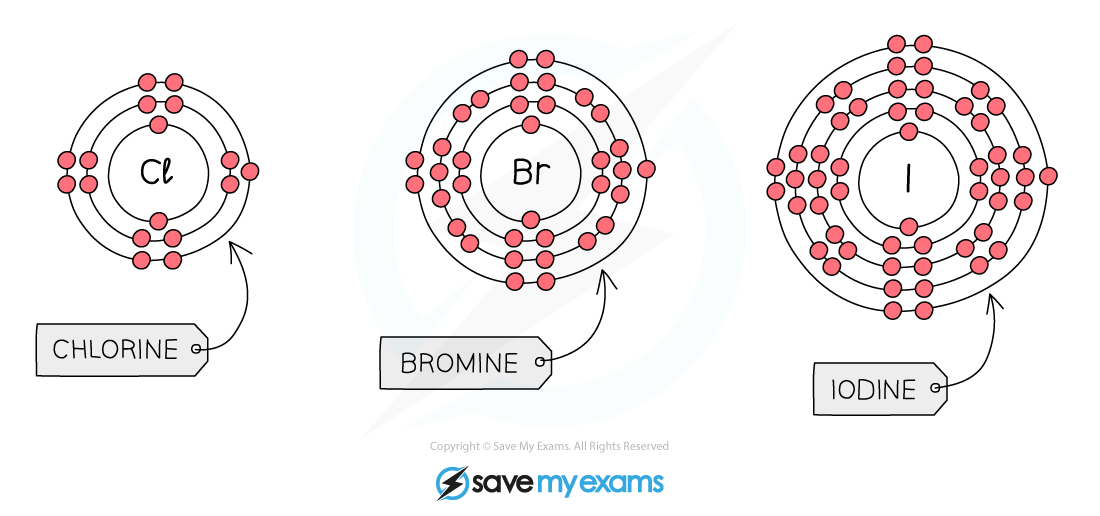
The atoms of the elements of Group 7 all have 7 electrons in their outer shell
Key points
- All Group 7 atoms have seven electrons in their outermost shell.
- Descending the group adds one filled shell at each element.
- The added shells carry the outermost shell further from the nucleus.
- The attraction between the nucleus and the incoming electron grows weaker with distance.
- Gaining the electron becomes harder down the group, so reactivity falls.
First pass
Every halogen is one electron short of a full outer shell. Down the group the extra shells push that shell outward, the nucleus holds the incoming electron less tightly, and reactivity drops.
Analogy — Catching a ball thrown from further and further away gets harder each time; the electron faces the same fading reach.
Exam pointer — Shell diagrams of the halogens often appear in questions; use them to read off the seven outer electrons and the growing distance.
Going deeper
The fixed seven-outer-electron pattern means the trend comes entirely from distance: each element down the group adds a complete inner shell, increasing the radius of the outermost shell. Electrostatic attraction for the electron to be gained weakens with that distance, so fluorine reacts fiercely and iodine sluggishly.
Analogy — Think of gravity weakening with orbital distance: a far satellite drifts free with the slightest tug, just as a distant outer shell barely pulls the electron in.
Exam pointer — Compare with Group 1 in your answer when asked: one group loses electrons, the other gains them, and their trends run in opposite directions.
Checks
0 of 9 attempted · 0 correct
Guided content from the SME authoring corpus — note rn_jXXsc4wt2344BjxX, pinned at 6fb25fc02d1a · promoted SyllabAI/syllabai-resources e967e75f1339