Group 1 (Alkali Metals)
3 guided lessons · 27 checks · 2. Inorganic Chemistry → Group 1 (Alkali Metals)
Guided lessons for this note
Which concept don't you understand yet?
We'll explain it simply and check your understanding. Pick any lesson — any order works.
0 of 27 checks correct so far
Lesson 1 of 3
Group 1 elements
The first column of the periodic table holds a family so consistent in its behaviour that it carries its own name: the alkali metals. Drop any of them into water and you get the same story, an alkaline solution plus bubbles of hydrogen. That shared pattern of reactions is the evidence chemists use to recognise them as one family.
What you know already
You already know from Atomic Structure that electrons sit in shells around the nucleus, and that an atom's chemistry depends heavily on its outermost shell. That single idea carries this whole note: the alkali metals each hold one outer electron, and everything from their softness to their ferocious water reactions flows from it.
Key points of understanding
- The alkali metals are lithium, sodium, potassium, rubidium, caesium and francium, found in the first column.
- They share characteristic chemical behaviour because each carries a single electron in its outermost shell.
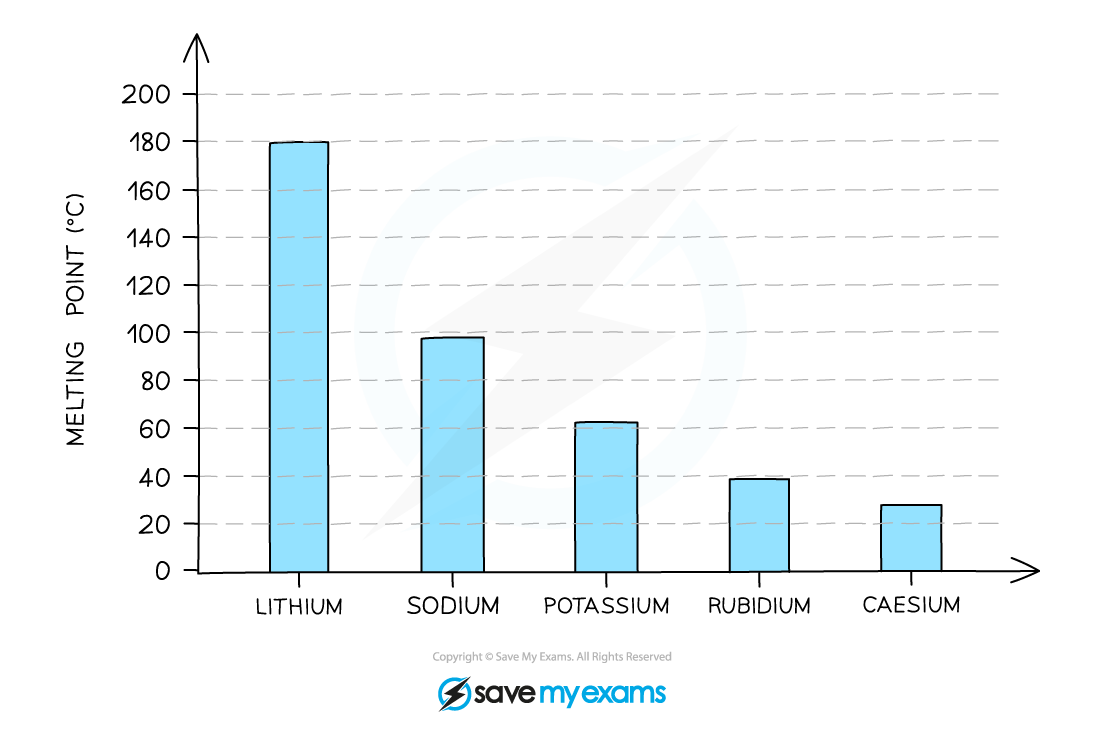
- They are soft, easily cut with a knife, with low densities and low melting points.
- All react with water to give an alkaline solution, which is how the family earned its name.
- The family equation: a Group 1 metal plus water yields a metal hydroxide and hydrogen gas.
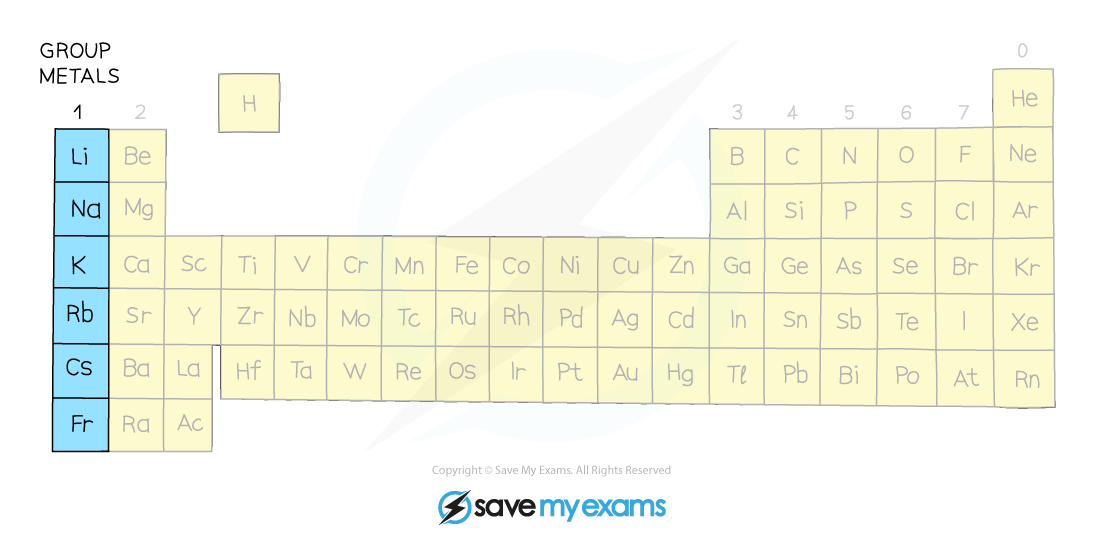
The alkali metals lie on the far left of the periodic table, in the very first group
Choose a confidence level to continue.
Prefer to read it all at once? Show the full lesson as a page
1.Group 1 elements
The first column of the periodic table holds a family so consistent in its behaviour that it carries its own name: the alkali metals. Drop any of them into water and you get the same story, an alkaline solution plus bubbles of hydrogen. That shared pattern of reactions is the evidence chemists use to recognise them as one family.
The alkali metals lie on the far left of the periodic table, in the very first group
Key points
- The alkali metals are lithium, sodium, potassium, rubidium, caesium and francium, found in the first column.
- They share characteristic chemical behaviour because each carries a single electron in its outermost shell.
- They are soft, easily cut with a knife, with low densities and low melting points.
Guided content from the SME authoring corpus — note rn_jNJ4gTmcHqdFqsNh, pinned at 78ad6a2073c6 · promoted SyllabAI/syllabai-resources e967e75f1339